Cash Converters Brand Guidelines
A 1984 Perth second-hand store and a franchise map.
Aa
Two constants: an ink blue and ticket yellow palette and a condensed sans register. Abstract homage — not a Cash Converters product or mark; no logo, sign or shopfront is reproduced.
Victoria Park
One Perth store and a formula to copy.
Cash Converters began in Perth, Western Australia, in 1984. The Western Australian business title Business News says its founder, Brian Cumins, began operating his first retail outlet in the city that year, and that over the next four years the merchandising formula and trading style behind the group were developed and tested. The company places that first store in the Perth suburb of Victoria Park, and says the idea began when Cumins saw an opportunity to take pawnbroking into mainstream retail. English Wikipedia describes the founders as Cumins and a group of partners.
The early growth stayed close to home. The company says the operating model was refined in the first Perth store and that a further seven stores followed across Western Australia. It dates its first two franchised stores to 1988, both in Western Australia, and says that by 1990 the group had spread to other Australian states.
The stores buy goods from the public and sell them on second-hand, across categories that the company’s Australian website lists as jewellery, phones, cameras and computers, gaming, musical instruments, televisions and hi-fi, tools and outdoor gear. In Australia the chain is widely called “Cashies”, English Wikipedia says, and the company now uses that nickname for some of its own services. Alongside second-hand retail, Cash Converters offers pawnbroking and personal loans.
Colour
From Essex and France to fifteen countries.
The name travelled early. The company says its first international store opened in Essex, in the United Kingdom, in 1991, and that in December 1994 it entered its first non-English-speaking market, France. Inside Retail reported in October 2022 that Cash Converters had begun operating in New Zealand in 1993. Other markets followed through master franchise agreements, under which a local company holds the rights for a country, and the company’s international page today lists sites as far apart as Belgium, Spain, Portugal, Switzerland, South Africa, Namibia, Nigeria, Malaysia, Singapore, the United Arab Emirates and the French overseas islands of Réunion and Martinique.
The listings tracked that spread. English Wikipedia says the group listed on the London Stock Exchange in 1995, gained a dual listing on the Australian Securities Exchange in February 1997, moved its primary listing to Australia in 2001 and left the London market on 19 February 2013, citing the make-up of its share register and low trading in the UK. The company today is Cash Converters International Limited, headquartered in Perth.
The size of the network has moved up and down. The company says it reached 450 stores worldwide in 2005 and marked its 30th birthday in 2014 with 768 stores in 21 countries. Its investor website gives 659 stores across 15 countries as at 30 June 2025, and its Australian website says more than 150 of them are in Australia.
Part of that change has come from buying back its own franchise networks. In October 2022 Inside Retail reported that Cash Converters had agreed to acquire the remaining 75 per cent of its New Zealand master franchisor, having taken a quarter of it in 2014; the New Zealand business then ran 22 stores, 11 franchised and 11 owned by the master franchisor. The company’s own timeline lists that purchase as completed in 2022, and lists the purchase of Capital Cash, a franchise group in the United Kingdom, in 2023.
Typography
Design and documentation.
Second-hand and resale chains present themselves in two broad ways. Some, such as Savers and its Value Village banner in North America, run large thrift stores stocked with donated goods that the company buys from charity partners; in Australia, Savers signs its larger shops as “thrift superstores” and has added a smaller inner-city “thrift boutique.” Others run buy-and-sell counters, where shoppers bring in their own clothes, games or equipment and are paid on the spot, as Plato’s Closet describes its stores.
Ownership shapes how these names look. Franchise systems such as Winmark’s resale brands, among them Plato’s Closet and Once Upon A Child, keep one name, one buying routine and one website across hundreds of shops that are each independently owned, as Plato’s Closet’s own pages state. Company-run chains can instead carry several regional names under one owner: Savers trades as Savers, Value Village, Village des Valeurs and Unique in different markets.
The companies in this group, in North America, the United Kingdom, Australia and Japan, range from family-founded businesses to franchisors and listed groups with private-equity owners. Their corporate pages usually tell a founding story, name the current owner and explain how the buy or donation counter works; logos, shop signs and colour schemes are shown as the companies publish them on their own sites and storefronts.
These guides set out what can be checked about each chain — who founded it, who owns it now, how its stores and counters are described, and which of those descriptions rest only on the company’s own word — and suggest an unofficial palette and a stand-in typeface for designers studying the category.
Aa
A condensed sans for price tickets and window signs. (Specimen set in Barlow Condensed, a sans STAND-IN; NOT the Cash Converters logo.)
Cash Converters
A rebrand, a shareholder and the regulator.
The current look dates from the middle of the 2000s. The company says that in 2006 it carried out a complete re-brand, covering its logo, its store design and its advertising, and that in 2007 it launched an online platform for second-hand goods. In 2009, it says, EZCORP became a strategic shareholder; English Wikipedia says EZCORP bought a 30 per cent stake that November and held 36 per cent by June 2021. Sam Budiselik was appointed chief executive and managing director in 2020, the company says.
The lending side has drawn regulatory and legal attention, recorded here as dated outcomes. In November 2016 the Australian Securities and Investments Commission said it had accepted an enforceable undertaking from Cash Converters after concerns that, for small loans made through its website, the company had not made reasonable inquiries into customers’ income and expenses; under the undertaking it agreed to refund customers on about 118,000 small loan contracts, and it paid penalties after 30 infringement notices. Business News reported the outcome the same month. In October 2019 ABC News reported that Cash Converters had agreed to settle a Queensland class action over fees on personal loans made between 2009 and 2013, without admitting liability and subject to approval by the Federal Court.
Today the group describes itself as a business earning from franchising, store operations and personal finance, controlled from its Perth head office. Its shops still follow the pattern set in the 1980s: walk-in counters where goods are bought and sold, with the same name repeated from Western Australia to Europe and Africa.
For a design guide, Cash Converters shows how one store format and a plain, descriptive name can be licensed across many countries while staying recognisable. Compare CeX, the London exchange chain that also grew through franchising, and Hard Off, a Japanese reuse chain that began as an audio shop. For this guide we use an ink blue, a ticket yellow and a cream with a condensed sans, an unofficial interpretation; no product or logo is reproduced.
Explore & save
Keep Cash Converters’s identity on hand — save it to a board in the Made Good inspiration library.
Cash Converters identity set
Pin the Cash Converters ink blue and ticket yellow palette and the condensed sans register to your own board.
Source & notes
Frequently Asked Questions
What font can I use to match the Cash Converters look?
This guide describes Cash Converters’ type as “A condensed sans for price tickets and window signs”. Its type specimen is set in Barlow Condensed from Google Fonts as a stand-in; Barlow Condensed is not Cash Converters’ own lettering.
What colours are in the Cash Converters palette?
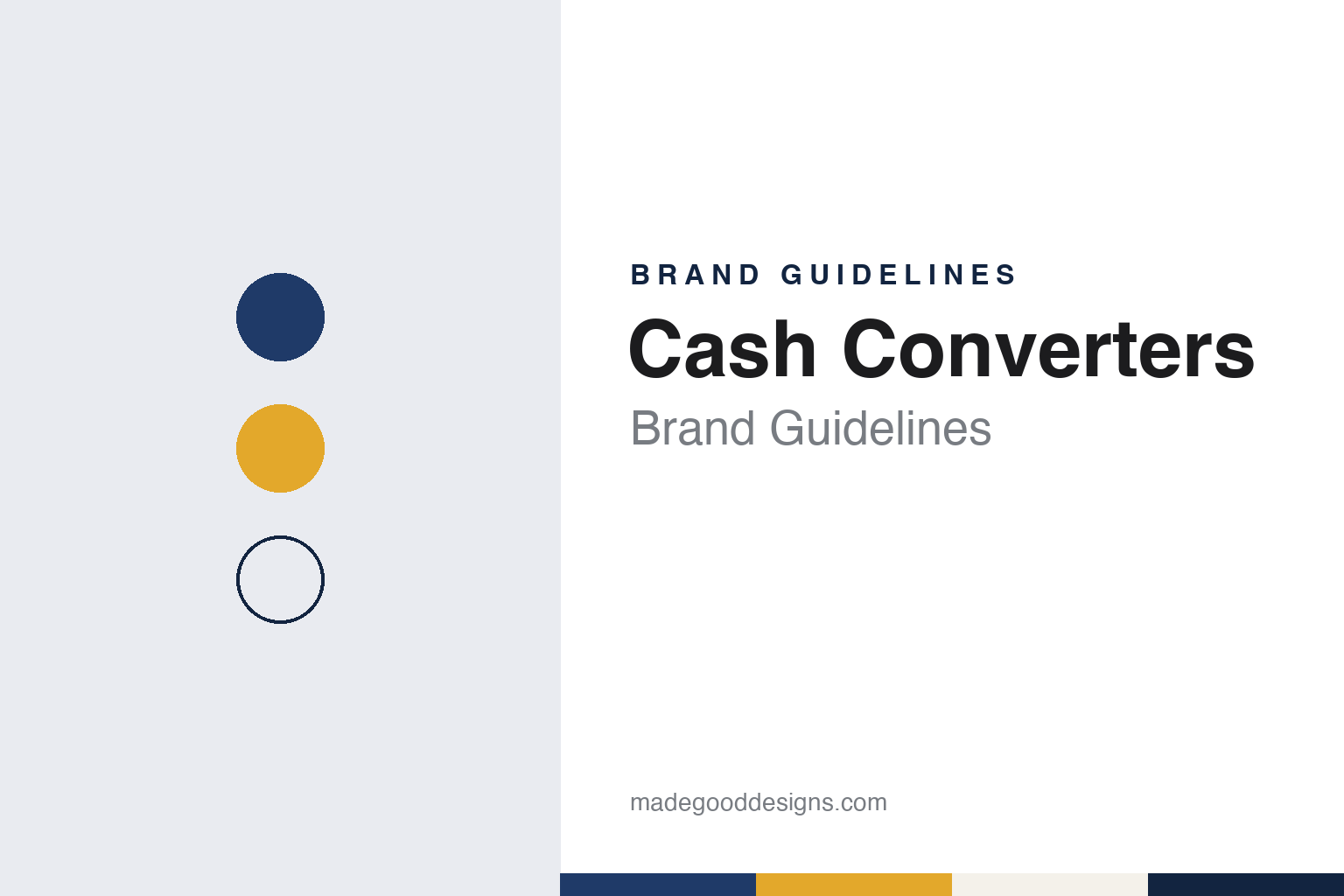
This guide’s Cash Converters palette is Ink blue #1F3A68, Deep ink #122440, Ticket yellow #E3A82B, Shop-floor cream #F4F1EA and Paper #FBF9F4. The tones are the guide’s own unofficial interpretation, not official Cash Converters hex codes.
When was Cash Converters founded?
Cash Converters was founded in 1984, in Perth, Western Australia.
Who founded Cash Converters?
Cash Converters was founded by Brian Cumins (with partners) in 1984.