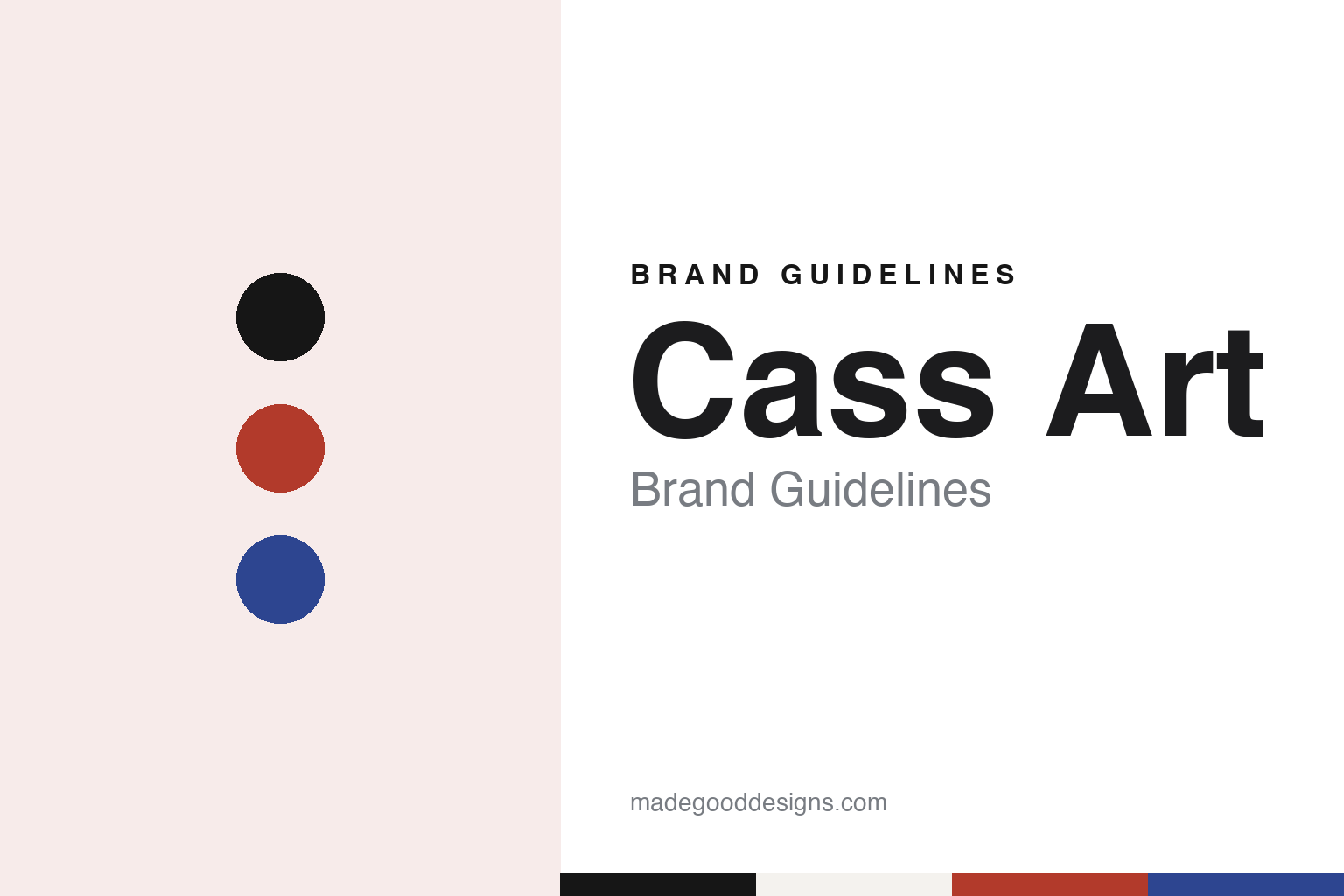
Cass Art Brand Guidelines
The London art shop behind “Let’s fill this town with artists.”
Aa
Two constants: a black, red and deep blue palette and a bold manifesto sans register. Abstract homage — not a Cass Art product or mark; no shop sign, bag or logo is reproduced.
Charing Cross Road
An old art shop, taken over in 1984.
Cass Art traces its start to 1984, when Mark Cass took over an art-supplies shop on Charing Cross Road in London. The company says the site had already been an art shop for more than a century by then. The business behind the name is Art-Line Limited, which the UK’s Companies House register lists as incorporated in March 1984 and still active; Cass Art’s own website names Cass Art as Art-Line’s trading name.
In an interview published by the company for its 30th anniversary, Mark Cass says retail ran in the family: from 1979 his family ran Craftsmith, the craft business of the WHSmith group, whose shops sold yarns and hobby kits but had no art department. The Charing Cross shop traded for years under names such as Cass Arts & Crafts and Cass Arts.
The change came in 2001. Mark Cass says he was then working for Getty Images in New York, and that on his way home he visited art shops around the world and found that few had become modern retailers. Back in London, he says, he took the idea of a new kind of art-materials shop to the design firm Pentagram: light, studio-like rooms, staff with real art knowledge, and lower prices on good materials.
The company’s own timeline gives the order of what followed. The first shop under the Cass Art name opened on High Street Kensington in 2001; a Soho shop on Berwick Street followed in 2003; Charing Cross Road was rebranded in 2004; the Islington flagship opened in 2006, filling three floors with about 10,000 lines of art materials; Hampstead followed in 2010 and Kingston in 2012. In 2013 the company launched its online shop.
Colour
A manifesto, a tote bag and a doodle book.
Cass Art’s look comes from a long partnership with Angus Hyland of Pentagram. Pentagram says the work began in 2001, when Hyland was commissioned to design a new visual identity built around a manifesto and the line “Let’s Fill This Town With Artists.” Speaking to Eye magazine in November 2011, Hyland described the identity as “deliberately constructivist” in design and polemic in tone; Pentagram says the bold, typographic identity runs across shop signage, graphics, the website and Cass Art’s own-brand products. In that 2011 piece, Eye called Cass Art London’s largest art-materials chain.
The same Eye article gives the thinking behind the shops. Mark Cass’s idea, Hyland said, was to take the old-fashioned, widely stocked art shop and give the floor to about a third of the products, buying them in bulk. Because the leading product brands were craft-based, the team added promotional pieces carrying the Cass identity, including bags based on particular paint colours; Mark Cass reckoned about 200,000 had been given out by then. Hyland said Cass Art persuaded Daler-Rowney first to let it repackage one of its smaller products and then to let it re-badge the firm’s products, with packaging designed by the illustrator Marion Deuchars.
Deuchars told Eye that a children’s department was opened in part of the Islington basement, and that a promotional doodle and activity book she made for it, about 10,000 copies, led to her book Let’s Make Some Great Art for Laurence King Publishing.
Pentagram says the Cass Art Collection of own-brand materials launched in 2013 with a series of art pads whose covers show the medium each pad is meant for, the first set illustrated by Deuchars. The range has since grown to pastels, brushes, portfolios and pencils, and each year brings a new typographic tote bag named after a different artists’ paint colour. In 2023 a set of tote bags made with Pentagram and Bags of Ethics was launched at the London Design Festival.
Typography
How art-supply chains present themselves.
Art-supply retail chains sell materials made by other companies, so much of their identity lives in the shop itself: the sign over the door, the name on the carrier bag, the catalogue cover and the colours of a website. The chains in this guide come from Germany, the United Kingdom, France, the United States, Canada and Singapore, and each presents that identity in its own way, often in a name its founders or owners chose decades ago.
Store formats vary widely. Some chains run large stores on the edge of town; German Wikipedia gives the average sales area of a Boesner branch as about 3,000 square metres. Others keep compact shops in city centres or near art schools, and several run both, alongside web shops that now carry most of their range.
Print still matters in this trade. Gerstaecker, which began in Eitorf in 1953, built its business on a mail-order catalogue that the company says took its present form in 1982, and Boesner publishes its own catalogue and customer magazines. Chains also name their own-label ranges and services, such as framing workshops, and many describe courses, demonstrations and workshops held in their stores; where this guide repeats such descriptions, they are given as the companies’ own words.
Corporate pages tell the rest of the story: who founded each chain, who owns it now and how it grew, through new stores, sister chains abroad or changes of owner. This guide sets out what can be checked about each company, separates documented facts from what the company says about itself, and states plainly where a chain has changed hands or closed.
Aa
A bold manifesto sans, in the spirit of a typographic identity. (Specimen set in Archivo Black, a sans STAND-IN; NOT the Cass Art logo.)
Cass Art
From one shop to a small group.
Cass Art has since moved beyond London. The company says it is now the UK’s leading art-supplies retailer, with 14 stores across the UK and an online shop of more than 20,000 products; Pentagram gives the same count of 14 shops. Pentagram also says that in 2021 Hyland’s first exhibition of paintings opened at Cass Art’s Glasgow Art Space, one of the shops outside the capital.
The company has also grown by buying other businesses. Cass Art says that in July 2022 it bought the SAA, a membership service for amateur and professional artists, and Artcoe, a trade manufacturer, distributor and wholesaler whose own brand is Frisk. It says Hyland then designed new Cass Group branding as a home for the three companies, while each continues to trade under its own identity day to day.
Staff are part of the pitch. In its anniversary interview, the company said more than 100 of its staff were artists, and Mark Cass described the refit of the Charing Cross Road shop as a turning point, saying the number of people coming through the door tripled after it reopened. Companies House lists Art-Line Limited, the company behind the shops, as active, with accounts filed up to June 2025.
For a design guide, Cass Art shows how a shop can carry its identity through a manifesto, a typeface-led sign and its own bags and pads rather than through a pictorial mark. Compare Daler-Rowney, the maker whose products Cass Art re-badged, and Hobbycraft, another UK creative-materials chain. For this guide we use black, a signal red and a deep blue with a sans, an unofficial interpretation; no product or logo is reproduced.
Explore & save
Keep Cass Art’s identity on hand — save it to a board in the Made Good inspiration library.
Cass Art identity set
Pin the Cass Art black, red and deep blue palette and the manifesto sans register to your own board.
Source & notes
Frequently Asked Questions
What font can I use to match the Cass Art look?
This guide describes Cass Art’s type as “A bold manifesto sans, in the spirit of a typographic identity”. Its type specimen is set in Archivo Black from Google Fonts as a stand-in; Archivo Black is not Cass Art’s own lettering.
What colours are in the Cass Art palette?
This guide’s Cass Art palette is Studio black #161616, Signal red #B23A2B, Deep blue #2D4590, Canvas #E7DFD1 and Gallery white #F4F2EE. The tones are the guide’s own unofficial interpretation, not official Cass Art hex codes.
When was Cass Art founded?
Cass Art was founded in 1984, in London, United Kingdom.
Who founded Cass Art?
Cass Art was founded by Mark Cass in 1984. Cass Art is known for London art shops, Cass Art Collection.