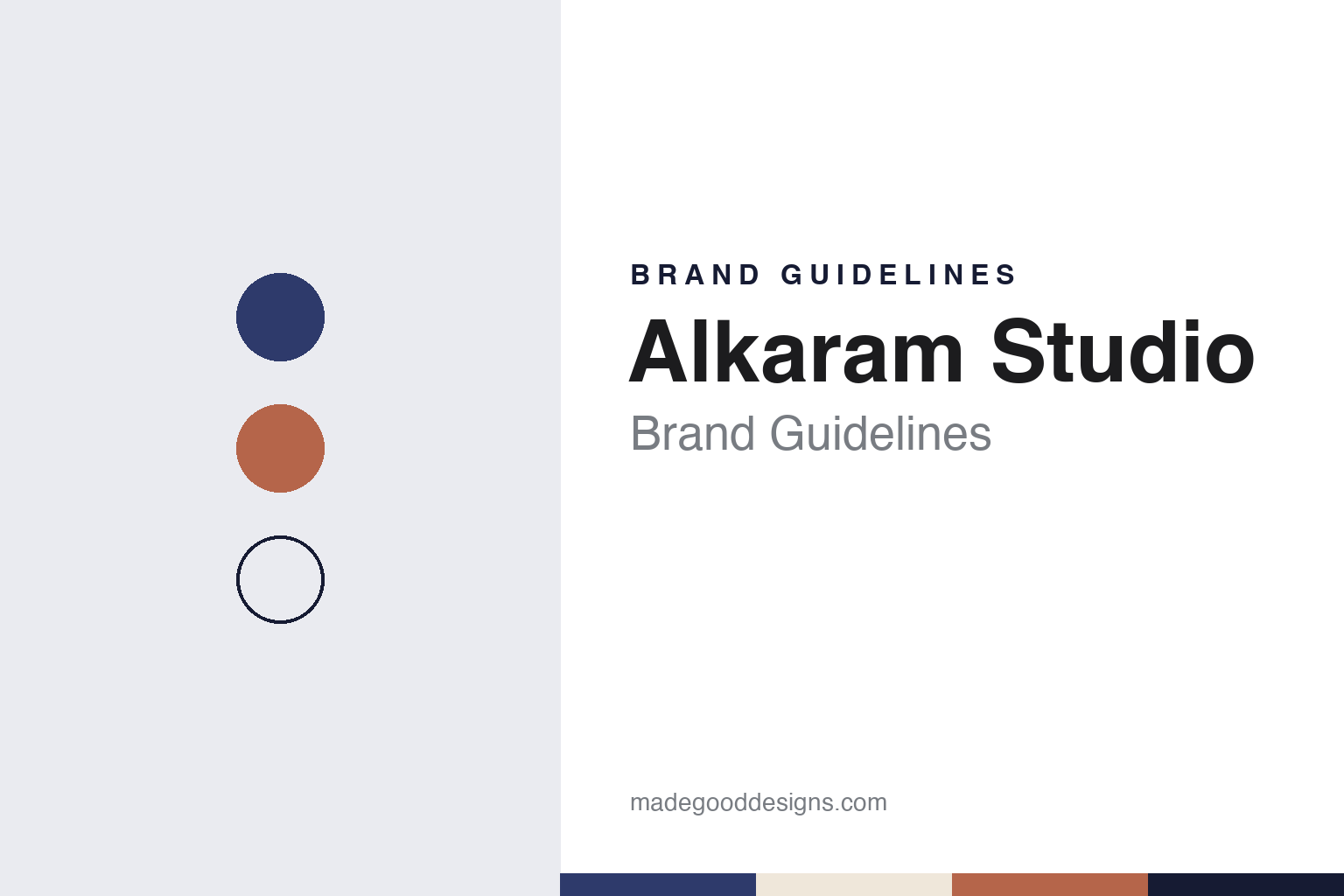
Alkaram Studio Brand Guidelines
A textile mill’s retail arm, from unstitched lawn to prêt.
Aa
Two constants: an indigo, cotton and terracotta palette and a geometric sans register. Abstract homage — not an Alkaram product or mark; no garment, print or logo is reproduced.
A mill opens a shop
From export fabric to a high-street name.
Alkaram Studio is the retail side of Alkaram Textile Mills, a Pakistani textile maker and exporter. The company says the mill began in 1986 and that Alkaram Studio was launched in 2010 to sell to shoppers at home in Pakistan, describing it as a “fabric-first fashion house.” Aurora, the Dawn group’s marketing magazine, called Alkaram Studio “the retail arm of Alkaram Textiles” in October 2019.
The mill came first. In a May 2017 interview with Aurora, Sumrin Ali, a Parsons School of Design graduate who worked on Al-Karam’s product development, said the company had built its name abroad by making cotton bed linen and fabric to customers’ designs, which were recreated and shipped. She said it showed its own work at three trade fairs a year, two in New York and one in Germany, and began to supply design ideas of its own to international fashion brands. Until shortly before that interview, she said, the export and domestic businesses had run as separate units; once they were brought under one umbrella she moved into product development for the home market.
The brand’s spelling has varied. The 2017 interview uses Al-Karam, the mill and shop names are written Alkaram, and trade-fair listings use Al Karam. This guide uses Alkaram Studio, the shop name of 2010 to 2024, and Alkaram for the name used since.
Colour
Unstitched first, then prêt.
Alkaram Studio grew up selling unstitched fabric: printed lawn and other cloth sold as matching suit lengths for the buyer to have tailored. Sumrin Ali told Aurora in 2017 that Al-Karam had long been associated with traditional three-piece shalwar kameez suits and a more mature customer, and that the women’s range made up most of its domestic sales. To reach younger buyers the company hired recent graduates from textile and design schools and asked them to write a new design approach; prints, the tone of the advertising and the look of the stores all changed. Ali recalled that on her own first visit an Al-Karam shop felt like a large department store rather than a boutique, with a masculine feel for what had always been a women’s clothing brand, so the stores were reworked in ambience, layout and decor. The actor Mahira Khan became the face of a campaign that, Ali said, used flowing ball gowns made from lawn to show off the cloth.
The push into ready-to-wear continued. In February 2023 Mehvish Waliany, then chief operating officer of Alkaram Studio, told Aurora that the company had refashioned its prêt line, Calico, around clean, minimal silhouettes, and added Calico Express, a lower-priced mix of solids and prints. She said unstitched fabric remained the core of the business while the company built prêt for customers in their twenties and thirties.
The store count is given only in dated snapshots. Aurora, citing its own September–October 2015 cover story, put Alkaram Studio at 22 stores in 12 cities. Its October 2019 survey of Pakistani fashion retail listed the company among brands that had added accessories, home textiles and shoes, and quoted the company’s marketing head on its part in a fashion show that year. In the same survey Khurram Koraishy, then the brand’s senior general manager for marketing, said Alkaram Studio reached shoppers on tighter budgets through regular sales, especially in stores in areas such as Korangi in Karachi. The company’s website now says it has more than 60 stores in 30 cities.
Typography
Design and documentation.
Pakistani and Bangladeshi fashion and retail brands present themselves through a few recurring touchpoints: the shop sign over a mall unit, the logo on a carrier bag, the seasonal look-book and the corporate page that names a founder or a parent company. Some marks point back to craft — Khaadi, for example, says the hands in its logo symbolise its heritage in handloom craft — while others set a short name in plain capitals, as Sapphire does.
The formats vary widely. Some of the brands in this group began as a single shop and grew into mall flagships at home and abroad; others are the retail arms of textile mills, and can draw on a parent’s own spinning, weaving and printing before cloth reaches a store, as Sapphire describes. Alongside them sit supermarket chains, craft-led lifestyle stores and online marketplaces, each with its own way of showing a name on a shopfront, a shelf or a screen.
Collections are named in the companies’ own terms. Lawn, prêt and unstitched fabric appear again and again in their catalogues, and the balance between them has shifted: Profit by Pakistan Today reported in 2017, from Pakistan Bureau of Statistics data, that ready-made clothes took 13 percent of household clothing spending in 2002 and 33 percent in 2016, while unstitched cloth and accessories fell from more than 68 percent to 50 percent.
Ownership is set out plainly in each guide: family-owned, founder-owned, mill-owned or group-owned, with dates where a dated source gives them. Each guide separates what independent press and official filings record from what the company says about itself, and the palettes and type pairings shown are an unofficial interpretation rather than a reproduction of any brand’s colours or marks.
Aa
A clean geometric sans, in the spirit of the brand’s modern shop lettering. (Specimen set in Jost, a sans STAND-IN; NOT the Alkaram logo.)
Alkaram
A shorter name after 2024.
In April 2024 the brand posted on Instagram that it was “closing the door on an era” as Alkaram Studio, followed by a post about “new beginnings,” the newspaper Daily Pakistan reported on 16 April 2024, describing the business as having run for 14 years. The shops and website kept trading: what followed was a rebrand under the single name Alkaram. In June 2024 Urooj Ahmed, who had joined as head of marketing the year before, told the ProPakistani lifestyle site Lens that the brand had been losing ground with shoppers under forty and that the change was “a total business transformation,” covering design and supply chain as well as marketing. She said the work began with research carried out with the agency Oula and led to “a fresher and more modern look.”
Ahmed described the practical changes: monthly capsule collections, the same design offered in several styles so it could be dressed up or down, a refreshed in-store experience and an updated online shop. For unstitched cloth, which she said most of the market still preferred, the company added inlays suggesting two ways to stitch the same fabric.
The current website sorts its women’s clothing into tiers named Basics, Essentials, Signature and Luxe, alongside Capsule, Fusion and Modest edits, with seasonal drops such as Summer Lawn and Winter collections, menswear, kids, home textiles, footwear and fragrance. It calls the brand one that blends “heritage with modern living,” and says the collections cover women, men, children and the home.
For a design guide, Alkaram Studio shows how a mill-owned label can move from selling cloth by the suit length to running a full fashion and home brand, and then shorten its own name as part of a push for younger shoppers. Compare Gul Ahmed, a Karachi mill with its own shops, and Nishat Linen, the retail arm of the Nishat Group. For this guide we use a deep indigo, unbleached cotton and a terracotta with a geometric sans, an unofficial interpretation; no product or logo is reproduced.
Explore & save
Keep Alkaram Studio’s identity on hand — save it to a board in the Made Good inspiration library.
Alkaram Studio identity set
Pin the Alkaram Studio indigo, cotton and terracotta palette and the geometric sans register to your own board.
Source & notes
Frequently Asked Questions
What font can I use to match the Alkaram Studio look?
This guide describes Alkaram Studio’s type as “A clean geometric sans, in the spirit of the brand’s modern shop lettering”. Its type specimen is set in Jost from Google Fonts as a stand-in; Jost is not Alkaram Studio’s own lettering.
What colours are in the Alkaram Studio palette?
This guide’s Alkaram Studio palette is Mill indigo #2E3A6B, Night thread #161B33, Unbleached cotton #EFE7DA, Kiln terracotta #B5654A and Paper #F8F6F2. The tones are the guide’s own unofficial interpretation, not official Alkaram Studio hex codes.
When was Alkaram Studio founded?
Alkaram Studio was founded in 2010 (company says), in Pakistan.
Who owns Alkaram Studio?
Alkaram Studio is owned by Alkaram Textile Mills (since 1986).