Naivas Brand Guidelines
From a Rongai shop in 1990 to a Kenyan supermarket chain.
Aa
Two constants: an orange and green palette and a rounded geometric sans register. Abstract homage — not a Naivas sign, bag or mark; no logo is reproduced.
Gitwe General Stores
A shop in Rongai, a family and three names.
Naivas began in 1990 in Rongai, a small town in Kenya’s Nakuru County. English Wikipedia gives its registration date as 24 July 1990. The company’s own history says that Jorum Kamau, the founder of the Tuskys chain, left one of his business premises in Rongai to his nephews David Kimani and Simon Mukuha, who named it Gitwe General Stores, and that their father, Peter Mukuha, joined them. English Wikipedia names Peter Mukuha Kago as the founder whose family holds the shares, so both accounts point to the same family business.
The name changed several times. The company says the shop became Rongai Self Service Stores in 1993, when it opened a second store at Elburgon, about ten kilometres north of Rongai, and another sibling, Linet Wairimu Mukuha, joined. In 1998 it moved into the town of Naivasha, closed the original Rongai shop, and a fourth sibling, Grace Wambui Mukuha, joined the business. The company’s timeline says its first Nairobi outlet opened on Ronald Ngala Street in the city centre in 2001, and that the Elburgon store was shut to pay for the move.
The trading name then became Naivasha Self Service Stores, named after the lakeside town that had become its base, and finally Naivas. The company dates that change to 2006; English Wikipedia, citing the company’s history page and a 2019 Daily Nation profile, gives 2007. Naivas is a shortened form of that earlier Naivasha name.
Colour
Orange and green, and new store formats.
Naivas documents one clear change to its own look. Its corporate timeline says the brand colours orange and green replaced an earlier purple in 2009, the same year it returned to Nairobi with a branch at Eastgate in Donholm. By the end of that period, the company says, it had ten outlets, eight of them outside the capital. The line on its executive pages, “Saving You Money,” is the brand promise the company itself quotes.
The chain then grew from regional towns into the capital and beyond. English Wikipedia, citing Business Daily Africa, says Naivas opened its 31st branch in Garissa in July 2014, had 43 branches in December 2017 and 45 by February 2018, when it took over a space at Capital Centre on Mombasa Road that had been an Uchumi store. Food Business Africa reported in June 2022 that the chain had grown from 60 to 84 outlets in two years, in 20 cities and towns, and quoted the investor IBL as saying it employed more than 8,000 people.
Formats have become part of the brand. The company says it introduced a Food Market concept in 2018, starting at its Kiambu Road store, and an Express Store format in 2019 for smaller convenience branches. It says it opened its 100th store in 2023 and that its Ruaka branch, in Nairobi’s northern suburbs, brought the count to 114 branches in 2025; its corporate site now leads with the line “35 Years | 114 Branches.” billionaires.africa put the figure at 110 stores in November 2025.
The headquarters and warehouses sit in the Industrial Area of Nairobi, according to English Wikipedia. Its corporate site lists Andreas von Paleske as chief executive; he joined in 2018 as an adviser on strategy and operations, English Wikipedia says, citing Business Daily Africa.
Typography
Shop signs, vans and apps.
Retailers in Kenya, Nigeria and Egypt present themselves first through the street: the shop sign over a supermarket entrance, the printed carrier bag, the livery on a delivery van or motorbike box. Many of these businesses publish their own histories on corporate pages, and those pages often record brand decisions as plainly as store openings: a change of trading name, a new pair of house colours, a new store format. This guide treats those pages as the companies’ own accounts and sets them beside dated reports in the business press.
The formats vary widely. Some chains began as a single family shop in a market town and grew into national supermarket networks, adding smaller convenience formats along the way. Others are discount grocers built around compact neighbourhood stores, electronics and appliance chains with showrooms, or online marketplaces whose shop front is an app and whose brand travels on parcels rather than signs. Several former chains in this group no longer trade, and their names now survive mainly in press archives.
Ownership is just as varied, and it shapes how a brand is run. Family-owned firms sit beside companies listed on the Nairobi Securities Exchange or abroad, and beside chains in which private-equity funds and development-finance investors hold large or controlling stakes. Mergers sometimes bring two store networks under one name; takeovers and receiverships end others. These are described here as dated facts, with owners named only in their business roles.
Each guide sets out who founded the business, who owns it now and which own brands, loyalty schemes and services it names itself, from loyalty cards to delivery apps. Where a company describes its own colours or formats, that is given as its claim. The palettes and typefaces shown are our own unofficial interpretation, not the companies’ marks.
Aa
A rounded geometric sans for an orange-and-green shop sign. (Specimen set in Poppins, a sans STAND-IN; NOT the Naivas logo.)
Naivas
A family business with outside investors.
For most of its life Naivas was wholly owned by the Mukuha family. An earlier approach came to nothing: in August 2013 Massmart, the South African retailer controlled by Walmart, offered to buy a controlling stake, and in October 2013 Naivas said it was no longer selling, English Wikipedia reports, citing The Star and Reuters.
Outside money arrived in 2020. In February that year the Competition Authority of Kenya approved the purchase of 30 percent of Naivas by the French private-equity firm Amethis, English Wikipedia says, citing Business Daily Africa; Food Business Africa reported that Amethis invested alongside DEG, the MCB Equity Fund and the IFC, part of the World Bank Group, in April 2020. In June 2022 Amethis sold out to a consortium led by IBL Group, the Mauritian conglomerate, with Proparco, a subsidiary of the French development agency AFD, and DEG, part of Germany’s KfW group; English Wikipedia gives the consortium’s holding as 40 percent. IBL runs the Winners supermarket chain in Mauritius, the trade title noted.
Control moved next. In July 2023 IBL told its investors that its vehicle Mambo Retail would buy a further 11 percent of Naivas International, taking it to 51 percent, Food Business Africa reported; the family’s stake sits in an investment company, Gakiwawa Family Investments. The Naivas timeline now gives IBL’s holding as 51 percent, and in November 2025 billionaires.africa described Naivas as an operating subsidiary of IBL.
The company’s own timeline treats its brand changes as milestones in the same way as its store openings: each new trading name, the move from purple to orange and green, and the arrival of the Food Market and Express Store formats sit alongside branch counts and the investment rounds. Its executive pages repeat the “Saving You Money” line as the promise the stores are run to.
For a design guide, Naivas shows how a regional family shop can turn a shortened town name and a two-colour scheme into a national retail brand. Compare Quickmart, which also began in Nakuru County, and Tuskys, the chain whose founder appears in the Naivas origin story. For this guide we use a warm orange, a deep green and cream with a sans, an unofficial interpretation; no product or logo is reproduced.
Explore & save
Keep Naivas’s identity on hand — save it to a board in the Made Good inspiration library.
Naivas identity set
Pin the Naivas orange and green palette and the rounded geometric sans register to your own board.
Source & notes
Frequently Asked Questions
What font can I use to match the Naivas look?
This guide describes Naivas’ type as “A rounded geometric sans for an orange-and-green shop sign”. Its type specimen is set in Poppins from Google Fonts as a stand-in; Poppins is not Naivas’ own lettering.
What colours are in the Naivas palette?
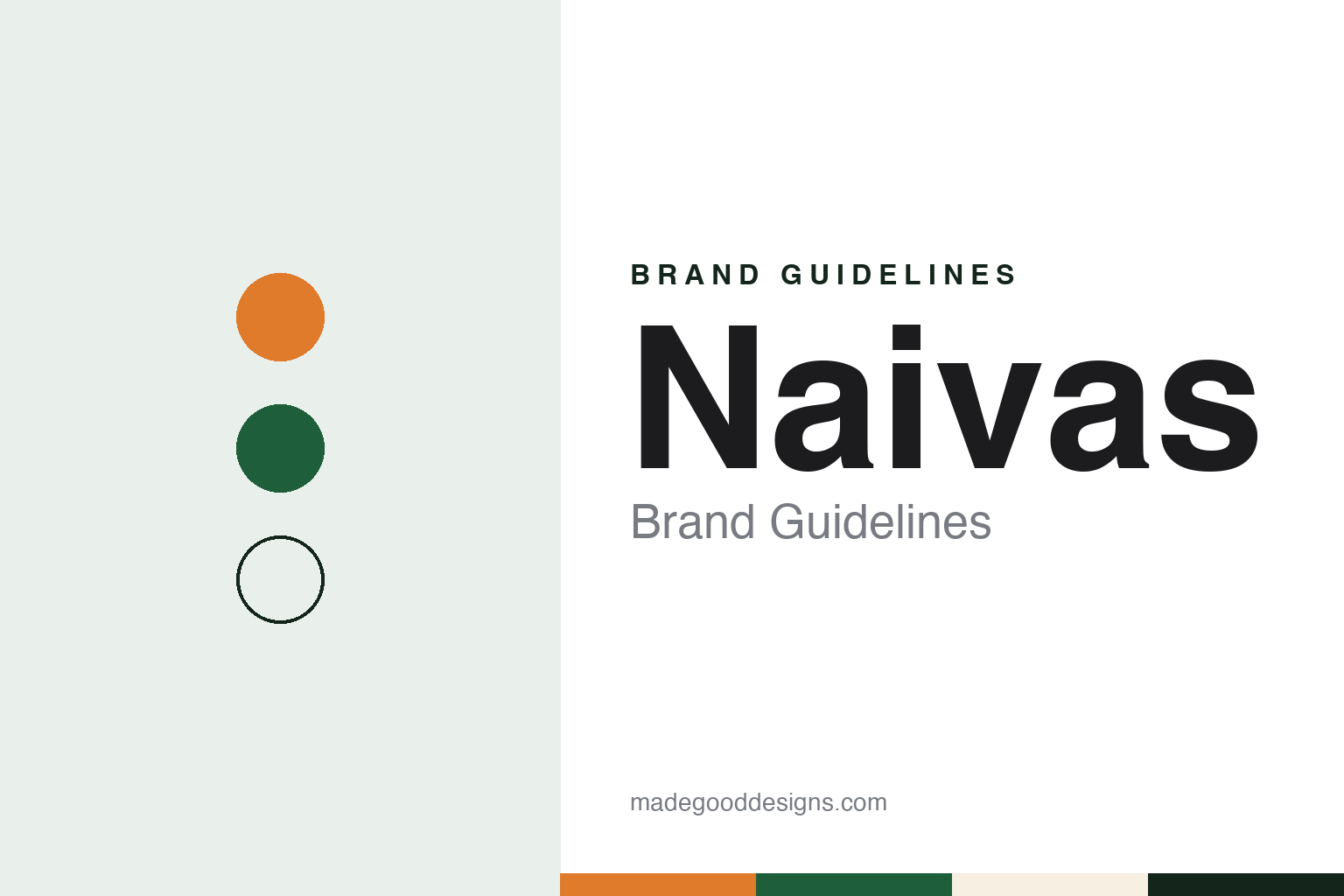
This guide’s Naivas palette is Market orange #E07B2C, Rift green #1F5E3A, Shelf cream #F6EFE2, Night ink #14261C and Paper #FBF9F4. The tones are the guide’s own unofficial interpretation, not official Naivas hex codes.
When was Naivas founded?
Naivas was founded in 1990 (as Gitwe General Stores), in Rongai, Nakuru County, Kenya.
Who founded Naivas?
Naivas was founded by the Mukuha family in 1990 (as Gitwe General Stores).