Uchumi Brand Guidelines
A Nairobi supermarket chain that closed, reopened and kept its name.
Aa
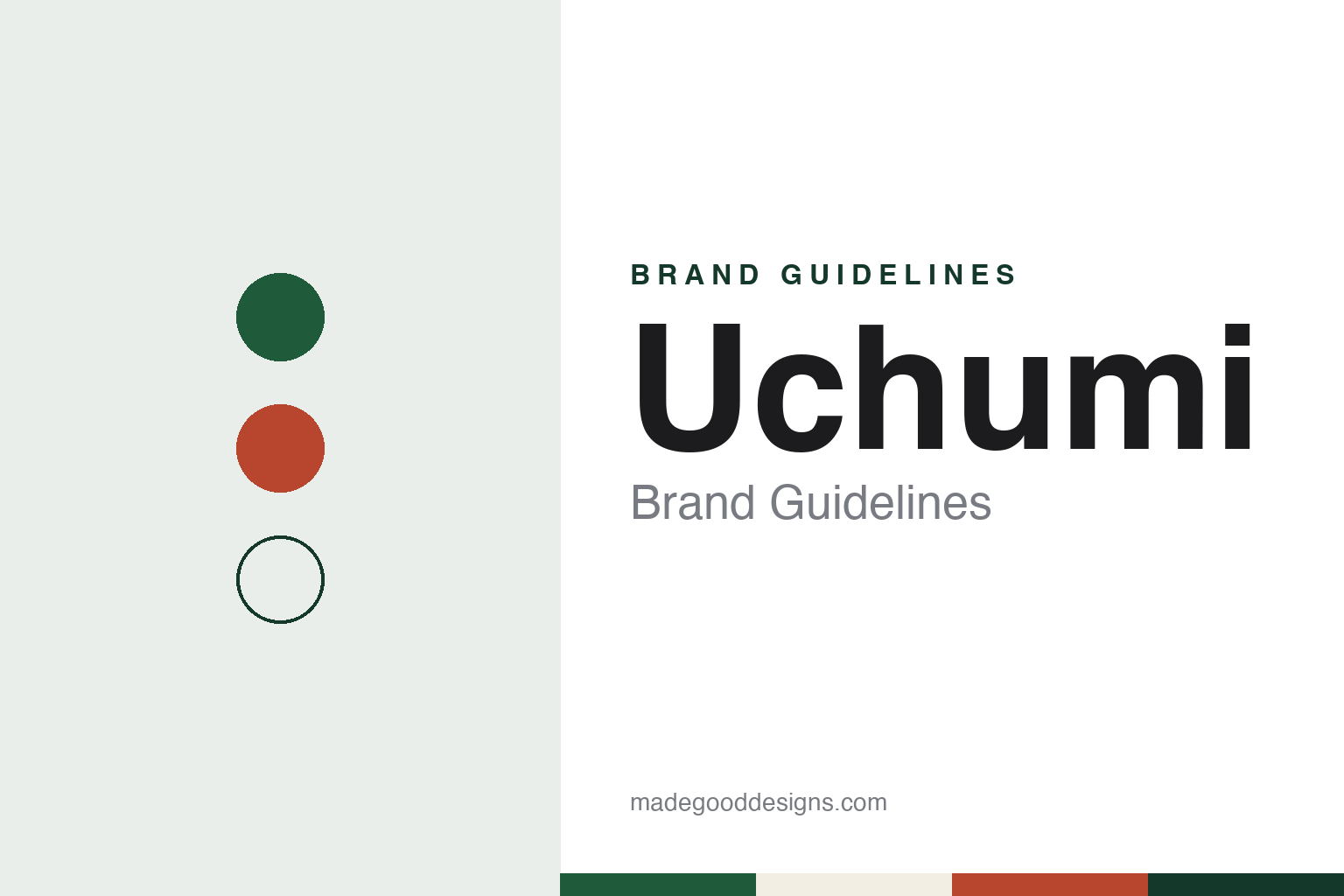
Two constants: an Uchumi green, brick and cream palette and a plain grotesque register. Abstract homage — not an Uchumi asset; no sign, logo or shopfront is reproduced.
A state-backed start
Three public corporations and an Italian manager.
Uchumi is a Kenyan supermarket company. A company profile compiled by Japan’s Institute of Developing Economies (IDE-JETRO), with data collected in the 2008–2009 financial year, says it was incorporated in 1975 as a public limited company under Kenya’s Companies Act.
Its first shareholders were three government-owned corporations: the Industrial and Commercial Development Corporation (ICDC), Kenya Wine Agencies Limited (KWAL) and the Kenya National Trading Corporation (KNTC). On 17 December 1976, according to the company profile published by the Dar es Salaam Stock Exchange and the IDE-JETRO file, those shareholders signed a management contract with Standa, an Italian supermarket group, which was to run the business and train Kenyan staff who would later take it over. The IDE-JETRO file says the first three branches opened in 1976.
The chain grew through the following decades. In the 1990s it added hypermarkets to its supermarkets, the Dar es Salaam profile says, along with specialty shops. Food Business Middle East & Africa reported in January 2026 that Uchumi was listed on the Nairobi Securities Exchange in 1992, and that at its height the company ran stores across Kenya and had a regional presence in Uganda and Tanzania.
The range was broad. The IDE-JETRO profile lists bakery, wines, meat, fish, fruit and vegetables alongside kitchen appliances, furniture, decorations, clothes, toys and audio-visual equipment, and puts staff at about 1,000 people in 2008–2009.
Colour
Receivership in 2006, a relisting in 2011.
The early 2000s were difficult. The Dar es Salaam Stock Exchange profile describes financial and operational problems arising from an expansion strategy and weak internal controls. On 31 May 2006 the board resolved that the company should cease operations; on 2 June 2006 its debenture holders placed it in receivership, and the Capital Markets Authority suspended its listing on the Nairobi exchange.
The closure was short. Under a framework agreement between the Government of Kenya, suppliers and debenture holders, the profile says, Uchumi resumed trading on 15 July 2006 under a specialised receiver manager and interim management. In the 2008–2009 financial year, the IDE-JETRO file counted 15 branches: eleven in Nairobi, three up-country in Karatina, Meru and Eldoret, and one in Kampala, Uganda.
The lending banks lifted the receivership in 2010, and the company was relisted on the Nairobi exchange on 31 May 2011, five years to the day after its suspension, according to the Dar es Salaam profile. Uchumi was also cross-listed outside Kenya: on 19 July 2021 the Uganda Securities Exchange issued a notice suspending trading in its shares, citing failure to meet listing obligations, Food Business Africa reported on 24 July 2021. The exchange said trading would resume only once reinstatement conditions set out in its notice had been met, and the report quoted an exchange official linking the step to the company’s disclosure and reporting obligations.
By then the business was already under a second restructuring. A Company Voluntary Arrangement (CVA), a court-backed framework under which a company keeps trading while settling debts on agreed terms, began in March 2020 and set out a six-year settlement programme running to June 2026, Food Business Middle East & Africa reported in January 2026. The Kenyan business site Khusoko described the CVA as court-approved in July 2025, and reported that the Capital Markets Authority had declined a request from the company to suspend its shares, saying the CVA needed to be carried through.
Typography
The category.
Retailers in Kenya, Nigeria and Egypt present themselves first through the street: the shop sign over a supermarket entrance, the printed carrier bag, the livery on a delivery van or motorbike box. Many of these businesses publish their own histories on corporate pages, and those pages often record brand decisions as plainly as store openings: a change of trading name, a new pair of house colours, a new store format. This guide treats those pages as the companies’ own accounts and sets them beside dated reports in the business press.
The formats vary widely. Some chains began as a single family shop in a market town and grew into national supermarket networks, adding smaller convenience formats along the way. Others are discount grocers built around compact neighbourhood stores, electronics and appliance chains with showrooms, or online marketplaces whose shop front is an app and whose brand travels on parcels rather than signs. Several former chains in this group no longer trade, and their names now survive mainly in press archives.
Ownership is just as varied, and it shapes how a brand is run. Family-owned firms sit beside companies listed on the Nairobi Securities Exchange or abroad, and beside chains in which private-equity funds and development-finance investors hold large or controlling stakes. Mergers sometimes bring two store networks under one name; takeovers and receiverships end others. These are described here as dated facts, with owners named only in their business roles.
Each guide sets out who founded the business, who owns it now and which own brands, loyalty schemes and services it names itself, from loyalty cards to delivery apps. Where a company describes its own colours or formats, that is given as its claim. The palettes and typefaces shown are our own unofficial interpretation, not the companies’ marks.
Aa
A plain grotesque — legible on shelf-edge labels and shopfront fascias. (Specimen set in Archivo, a sans STAND-IN; NOT the Uchumi logo.)
Uchumi
Two Nairobi sites in 2025.
The chain that once ran stores in three countries now trades from a small base. A monitor’s report dated 14 March 2025, cited by Khusoko in July 2025, said Uchumi was operating two locations in Nairobi: Lang’ata and Unicity.
The two sites work differently. At Unicity Mall, on Thika Road near Kenyatta University, Uchumi runs a compact store stocking basic household goods with an in-house bakery; Khusoko dates its reopening to September 2024 and Food Business Middle East & Africa to late 2024. The Lang’ata Hyper site on Lang’ata Road has been turned into a shared commercial property, with Uchumi running a retail section alongside outside tenants, among them the retailer China Square, which began trading there in June 2024. By January 2026 the site hosted eleven tenants, according to the CVA supervisor quoted by Food Business Middle East & Africa. Food Business Middle East & Africa reported that the company announced the reopenings on its own social media channels as a return to serving customers.
The story is one that other Kenyan chains share. When Quickmart and Chandarana opened new branches in early 2022, Food Business Middle East & Africa placed them among a new generation of retailers filling space left by the collapse of Nakumatt, Uchumi and Tuskys. Uchumi differs from Nakumatt and Tuskys in that it still trades and is still listed in Nairobi, under the CVA, as of the most recent reports in 2025 and January 2026.
The name has been carried through several kinds of management. Uchumi was run under a contract with Standa from 1976, by a specialised receiver manager and interim management from 2006, and since 2020 under a CVA overseen by a supervisor from Forvis Mazars Kenya, Food Business Middle East & Africa reported in January 2026. Over that time it has traded from fifteen branches in 2008–2009 and from two Nairobi sites in 2025.
For a design guide, Uchumi shows how a retail name can carry through closure, receivership and restructuring when the stores themselves shrink. Compare Nakumatt and Tuskys, two Kenyan chains whose stories ended differently. For this guide we use a market green, a deep pine, a brick red and cream with a sans, an unofficial interpretation; no product or logo is reproduced.
Explore & save
Keep Uchumi’s identity on hand — save it to a board in the Made Good inspiration library.
Uchumi identity set
Pin the Uchumi green, brick and cream palette and the plain grotesque register to your own board.
Source & notes
Frequently Asked Questions
What font can I use to match the Uchumi look?
This guide describes Uchumi’s type as “A plain grotesque — legible on shelf-edge labels and shopfront fascias”. Its type specimen is set in Archivo from Google Fonts as a stand-in; Archivo is not Uchumi’s own lettering.
What colours are in the Uchumi palette?
This guide’s Uchumi palette is Market green #1F5A3A, Deep pine #14382A, Brick red #B8452E, Shelf cream #F2EEE3 and Paper #FAF8F3. The tones are the guide’s own unofficial interpretation, not official Uchumi hex codes.
When was Uchumi founded?
Uchumi was founded in 1975, in Kenya.