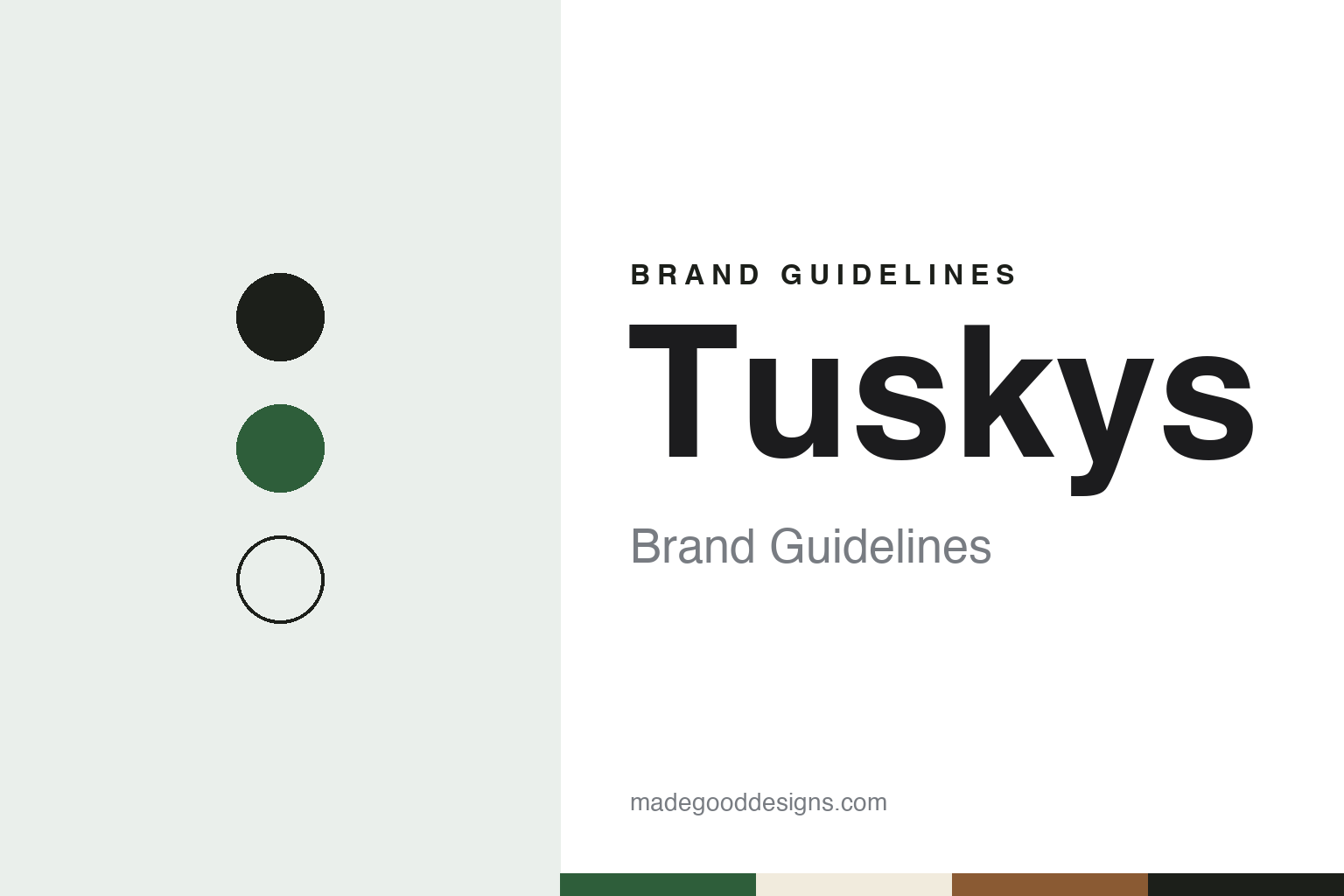
Tuskys Brand Guidelines
The family supermarket chain that grew from a Nakuru shop.
Aa
Two constants: a market green, ivory and earth palette and a sturdy slab serif register. Abstract homage — not a Tuskys product or mark; no logo or shop sign is reproduced.
Magic
A Rift Valley shop that became Tusker Mattresses.
Tuskys was a Kenyan supermarket chain run by a company called Tusker Mattresses. It began in the Nakuru area of the Rift Valley, but sources give different starting points. The Daily Nation reported in January 2021 that it was established in 1985 by Joram Kamau as a small shop called Magic, which later became Tusker Mattresses before taking the Tuskys name; a Nakuru trader quoted in the same article remembered the Magic branch in town opening on Pandit Nehru Road in 1983. Food Business MEA placed the start in the township of Rongai, outside Nakuru, in 1985, and English Wikipedia gives 1990 as the founding year. Citizen Digital reported in March 2023 that the chain marked 25 years in business with a roadshow in 2015.
That Citizen Digital account describes a shop in Rongai, the Magic super store, that first dealt in mattresses before widening its range, and a family supermarket on Pandit Nehru Road in Nakuru town. It says Tuskys shared early links with Nakumatt, another Nakuru business whose founder supported it in its first years, and that its first Nairobi branch opened on Mfangano Street in 1988. Over the following years, the same report says, the company placed many of its stores near bus stations.
Tuskys stayed a family business throughout. English Wikipedia describes it as a wholly Kenyan, privately held company owned by the founder’s seven children, with its head office in Nairobi. Citizen Digital reported that in 2016 three independent executive directors and other professionals joined the business, and that the non-family management team had left by 2017. The company was also admitted to the Nairobi Securities Exchange’s Ibuka programme, a platform for firms preparing for a listing, the same report said; it never listed.
Colour
Sixty stores and a short name.
The chain grew across Kenya and into Uganda. As of August 2018 Tuskys operated sixty supermarkets in the two countries, English Wikipedia says; by July 2018 it had closed four stores in Kampala and kept three, at Makerere, Ntinda and Kitintale. Its workforce was put at more than 6,000 in Kenya by the encyclopedia, which adds about 150 in Uganda, and by the Daily Nation in 2021, which also counted more than 3,000 suppliers doing business with the chain across the country. Peak branch counts differ by source: Khusoko reported 64 branches in 2019, Citizen Digital counted 64 stores in 2020, and The Star wrote in 2023 of nearly 70 outlets in Kenya and Uganda.
The name travelled with the business. The Daily Nation traced it from Magic to Tusker Mattresses and then to Tuskys, the trading name shoppers knew, while court reports on the 2023 liquidation still used the company name, Tusker Mattresses. Nakuru town alone had four Tuskys branches, the paper said, and a shopper interviewed there in 2021 described two decades of collecting the chain’s loyalty points.
Tuskys and Nakumatt stayed close as rivals. In October 2017, as Nakumatt sought administration, Tuskys proposed a merger with it, Reuters reported; Citizen Digital wrote in 2023 that the support did not go ahead after Tuskys disagreed with the administrator’s plans. When Nakumatt fell away, Tuskys expanded further into larger hypermarket stores with department-store goods alongside groceries, the same report said.
Kenya’s competition regulator also became part of its story. Food Business MEA reported in January 2021 that Tuskys came under scrutiny from the Competition Authority of Kenya’s Buyer Power Department, set up after the Nakumatt collapse, and that Tuskys opened an escrow account through which money taken at the tills paid suppliers directly.
Typography
Shop signs, vans and apps.
Retailers in Kenya, Nigeria and Egypt present themselves first through the street: the shop sign over a supermarket entrance, the printed carrier bag, the livery on a delivery van or motorbike box. Many of these businesses publish their own histories on corporate pages, and those pages often record brand decisions as plainly as store openings: a change of trading name, a new pair of house colours, a new store format. This guide treats those pages as the companies’ own accounts and sets them beside dated reports in the business press.
The formats vary widely. Some chains began as a single family shop in a market town and grew into national supermarket networks, adding smaller convenience formats along the way. Others are discount grocers built around compact neighbourhood stores, electronics and appliance chains with showrooms, or online marketplaces whose shop front is an app and whose brand travels on parcels rather than signs. Several former chains in this group no longer trade, and their names now survive mainly in press archives.
Ownership is just as varied, and it shapes how a brand is run. Family-owned firms sit beside companies listed on the Nairobi Securities Exchange or abroad, and beside chains in which private-equity funds and development-finance investors hold large or controlling stakes. Mergers sometimes bring two store networks under one name; takeovers and receiverships end others. These are described here as dated facts, with owners named only in their business roles.
Each guide sets out who founded the business, who owns it now and which own brands, loyalty schemes and services it names itself, from loyalty cards to delivery apps. Where a company describes its own colours or formats, that is given as its claim. The palettes and typefaces shown are our own unofficial interpretation, not the companies’ marks.
Aa
A sturdy, readable slab serif. (Specimen set in Bitter, a serif STAND-IN; NOT the Tuskys logo.)
Tuskys
From sixty-four stores to liquidation.
The trouble became public in 2020. In May that year Tuskys wrote to suppliers, banks and landlords citing constrained cash flows, Citizen Digital reported, and fourteen branches closed between March and October 2020. The company fell behind with payments to suppliers, the reports show. The last branch in Nakuru town, on Kenyatta Avenue, closed in January 2021, the Daily Nation and Food Business MEA reported, ending its presence in the county where it began. Workers carted the branch’s remaining electronic goods to a waiting lorry, the Daily Nation wrote.
By February 2023 four stores remained, Citizen Digital said. In March 2023 the Kenyatta Avenue outlet in Nairobi closed, leaving the Tuskys Imara branch on Tom Mboya Street as the last one, the Daily Nation reported. In June 2023 the High Court ordered the liquidation of Tusker Mattresses, Khusoko reported, on a petition brought by a supplier and backed by other creditors after an insolvency case that had run since 2020. The Star reported on 5 September 2023 that a liquidator had been appointed to sell the remaining assets. Among the assets named in that report were the company’s head office on Mombasa Road in Nairobi and a five-storey building in the city centre that housed one of its last outlets. Tuskys has been in liquidation since 2023, and the chain no longer trades.
For a design guide, Tuskys shows how a family shop could carry a short trading name from one Rift Valley town to some sixty stores in two countries. Compare Nakumatt, its neighbour from Nakuru, and Naivas, another Kenyan supermarket chain. For this guide we use a market green, an ivory and an earth brown with a serif, an unofficial interpretation; no product or logo is reproduced.
Explore & save
Keep Tuskys’s identity on hand — save it to a board in the Made Good inspiration library.
Tuskys identity set
Pin the Tuskys market green, ivory and earth palette and the sturdy slab serif register to your own board.
Source & notes
Frequently Asked Questions
What font can I use to match the Tuskys look?
This guide describes Tuskys’ type as “A sturdy, readable slab serif”. Its type specimen is set in Bitter from Google Fonts as a stand-in; Bitter is not Tuskys’ own lettering.
What colours are in the Tuskys palette?
This guide’s Tuskys palette is Market green #2E5E3A, Ink #1C1F1A, Tusk ivory #F1EBDD, Rongai earth #8A5A33 and Paper #FAF8F3. The tones are the guide’s own unofficial interpretation, not official Tuskys hex codes.
When was Tuskys founded?
Tuskys was founded in 1983, 1985 or 1990 (sources differ), in Nakuru area, Kenya.
Who founded Tuskys?
Tuskys was founded by Joram Kamau in 1983, 1985 or 1990 (sources differ).