Boux Avenue Brand Guidelines
A British lingerie chain built in shopping centres since 2011.
Aa
Two constants: a plum, blush and ivory palette and a boutique serif register. Abstract homage — not a Boux Avenue product or mark; no garment, logo or shopfront is reproduced.
Launched in 2011
A retailer returns to lingerie.
Boux Avenue is a British chain of lingerie shops. Its owner’s group, Theo Paphitis Retail Group, says the chain launched on 1 April 2011, and English Wikipedia, citing Retail Week in April 2011, describes it as a chain owned by the entrepreneur Theo Paphitis, familiar to British television audiences from the BBC business programme Dragons’ Den. Retail Gazette, reporting in November 2026, gives the founding year as 2011 and calls Paphitis the chain’s chairman and owner.
The new chain was not Paphitis’s first lingerie business. English Wikipedia’s article on La Senza says he bought the UK and Ireland franchise of the Canadian chain, known as La Senza UK, expanded it, and in July 2006 sold it to the private-equity firm Lion Capital, citing a FashionUnited report from the time; it adds that he left the board and set up Boux Avenue in spring 2011. Paphitis also owns the stationery chain Ryman, which English Wikipedia says he bought from its administrators, and the hardware and homewares retailer Robert Dyas, which the same encyclopedia, citing The Guardian, says he bought in July 2012.
Boux Avenue opened with a small group of shopping-centre stores. English Wikipedia lists six at launch: Bluewater in Kent, Lakeside in Essex, St Davids in Cardiff, the Trafford Centre in Manchester, Meadowhall in Sheffield and Buchanan Galleries in Glasgow. The group’s own account names Bluewater, Glasgow and Cardiff as its first key stores. Further openings followed at Birmingham’s Bullring in March 2012, at Merry Hill in Dudley later that year and at Churchill Square in Brighton in September 2014, Wikipedia says.
By October 2018 the estate had reached thirty shops. A local report republished on Paphitis’s own website, dated 4 October 2018, says the branch at the Victoria Centre in Nottingham, opened that month, was the chain’s 30th and its first in the East Midlands. In it Paphitis said Nottingham had been tenth on the original opening schedule, but the unit first agreed had fallen through and the same shop was offered again about eighteen months before the opening. The report adds that the business had recently added activewear to its ranges.
Colour
Shopping centres, a website and partner retailers.
Boux Avenue sells lingerie, nightwear and swimwear, and Retail Gazette reported in November 2026 that it does so through its own shops, its website and retail partnerships including John Lewis and TikTok Shop. In April 2025 the same publication reported that the chain, part of Theo Paphitis Retail Group alongside Ryman and Robert Dyas, pointed to supply partnerships with Next, Marks & Spencer, Very and ASOS; the November 2026 report again lists those four among its partner platforms.
The group’s page on the brand sets out how it presents the shops. It says Boux Avenue developed a City & Guilds-accredited training programme for bra fitting that all store staff take, that customers are fitted in rooms with three different light settings, and that it offers complimentary gift-wrapping. It also says the chain launched activewear and opened a new warehouse in late 2018, and brought its product design in-house in early 2019. These are the company’s own descriptions of its service and its design team.
The estate has changed size over the years. In November 2026 Retail Gazette put the chain at 27 stores across the UK.
Recent work on the shops has been relocation and refurbishment. According to Retail Gazette in November 2026, the chain moved its northern flagship at Manchester’s Trafford Centre to a larger unit, moved to a new site within Liverpool ONE, and refurbished its stores at Bluewater, Westfield White City, Guildford and Belfast. The group’s page also mentions a flagship on Oxford Street in London. Collections are presented by season and occasion: the November 2026 report mentions spring lingerie and summer swimwear campaigns, and the group’s site describes a Timeless Lingerie collection of lace and satin designs in a vintage style.
Typography
How lingerie chains present themselves.
Lingerie and underwear chains in Europe and North America present themselves first through their shops. A short name on the fascia, often set in a simple serif or sans, is repeated on bags, boxes, tissue and labels, so the sign on the street and the parcel on the doorstep carry the same mark. Many chains keep their colour schemes to a few soft or dark tones, and when they renew a shop concept they publish the change in terms of lighting, furniture and a new range of colours.
The formats vary widely. Some chains trade from small boutiques in shopping centres and on high streets; others run larger stores built around fitting rooms and a fitting service, and some began as catalogue or online retailers before opening shops of their own, or never opened any. Shop-in-shop areas inside department stores and fashion retailers carry a brand’s fixtures and signs into someone else’s floor, and franchise partners take the same format to markets the owner does not run directly.
Ownership is just as mixed. Some chains are still run by their founders or founding families, some belong to listed retail groups that operate several chains side by side, and others have passed through private-equity owners, administrations and rescue deals. The companies usually describe these changes on corporate pages about their history, founders and owners, while trade and business press record the dates.
Collections are presented by name rather than by number: named lines that return season after season, sleepwear and loungewear ranges, swimwear, sub-brands aimed at younger customers, and services such as loyalty clubs and online shops. For a designer, these chains show how a consistent name, a narrow palette and a recognisable shop format can hold a brand together across many countries and channels.
Aa
A boutique serif for a shopping-centre lingerie chain. (Specimen set in Cormorant Garamond, a serif STAND-IN; NOT the Boux Avenue logo.)
Boux Avenue
One owner, one name, many malls.
Boux Avenue has stayed with the same owner since launch. It is one of the businesses of Theo Paphitis Retail Group, whose website carries the brand’s story next to those of Ryman, Robert Dyas and London Graphic Centre, and Retail Gazette described Paphitis in November 2026 as the chain’s chairman and owner. English Wikipedia gives its headquarters as London.
The retail setting is well documented. The chain has been a shopping-centre retailer from the start, with its launch stores in large regional malls and later shops in centres such as the Bullring, Merry Hill, Westfield White City and Liverpool ONE. The group’s description of the stores centres on the fitting room, gift-wrapping and trained fitting staff rather than on graphics, and the brand also appears in the online ranges of partner retailers, where its name sits beside many other labels. A visual system for a chain like this has to hold together across a mall shopfront, a fitting room, a carrier bag, its own website and a partner’s product page.
For a design guide, Boux Avenue shows how a lingerie chain can be organised around shopping-centre shops, a fitting service and partner retailers under a single owner. Compare La Senza, whose UK franchise Paphitis once owned, and Bravissimo, another British lingerie retailer. For this guide we use a deep plum, a soft blush and a warm ivory with a serif, an unofficial interpretation; no product or logo is reproduced.
Explore & save
Keep Boux Avenue’s identity on hand — save it to a board in the Made Good inspiration library.
Boux Avenue identity set
Pin the Boux Avenue plum, blush and ivory palette and the boutique serif register to your own board.
Source & notes
Frequently Asked Questions
What font can I use to match the Boux Avenue look?
This guide describes Boux Avenue’s type as “A boutique serif for a shopping-centre lingerie chain”. Its type specimen is set in Cormorant Garamond from Google Fonts as a stand-in; Cormorant Garamond is not Boux Avenue’s own lettering.
What colours are in the Boux Avenue palette?
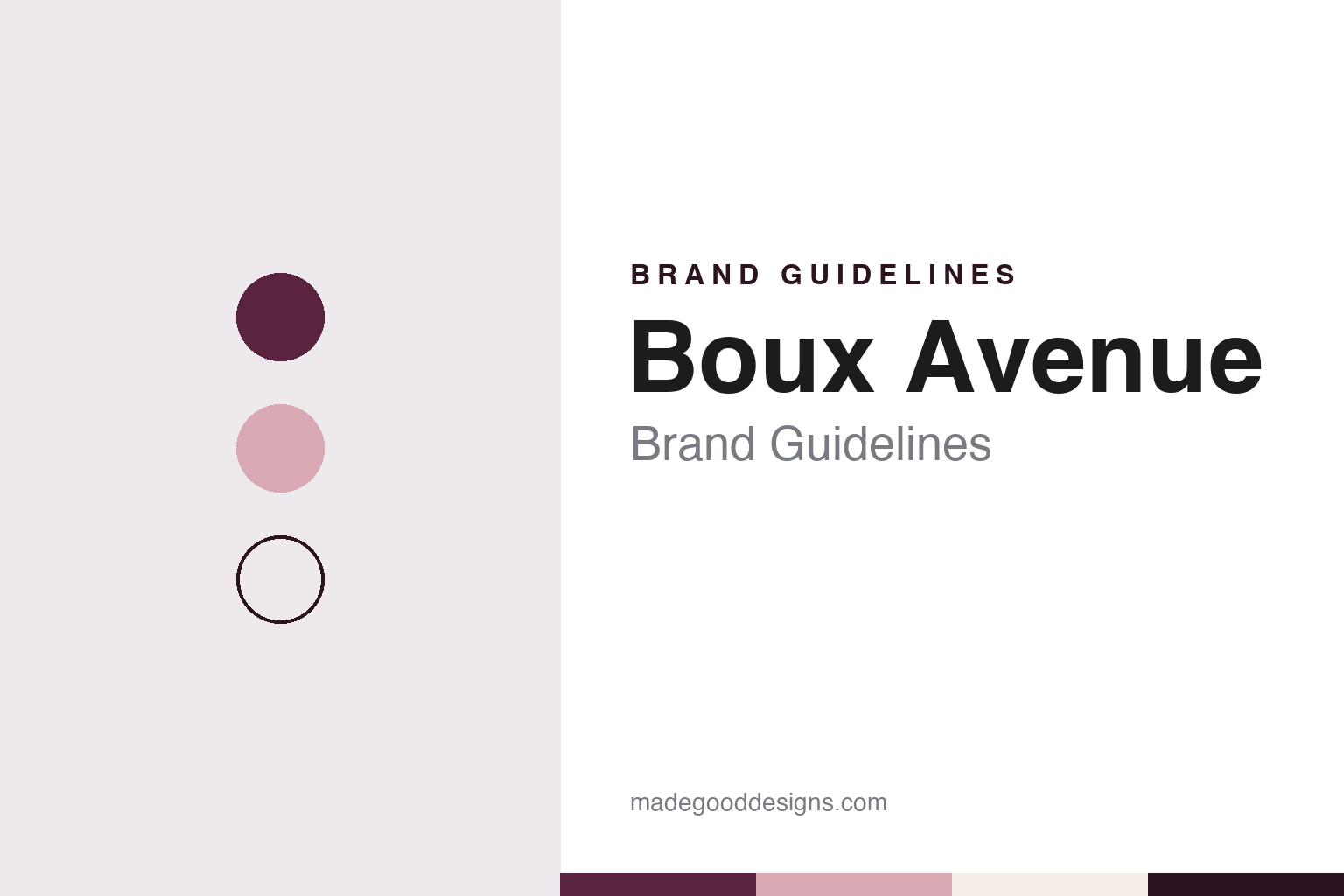
This guide’s Boux Avenue palette is Deep plum #5A2440, Night ink #2B1420, Soft blush #D9A9B4, Warm ivory #F4ECE6 and Paper #FAF7F4. The tones are the guide’s own unofficial interpretation, not official Boux Avenue hex codes.
When was Boux Avenue launched?
Boux Avenue was launched on 1 April 2011, in United Kingdom.
Who founded Boux Avenue?
Boux Avenue was founded by Theo Paphitis on 1 April 2011.
Who owns Boux Avenue?
Boux Avenue is owned by Theo Paphitis Retail Group. This guide dates Boux Avenue to 1 April 2011, in United Kingdom.