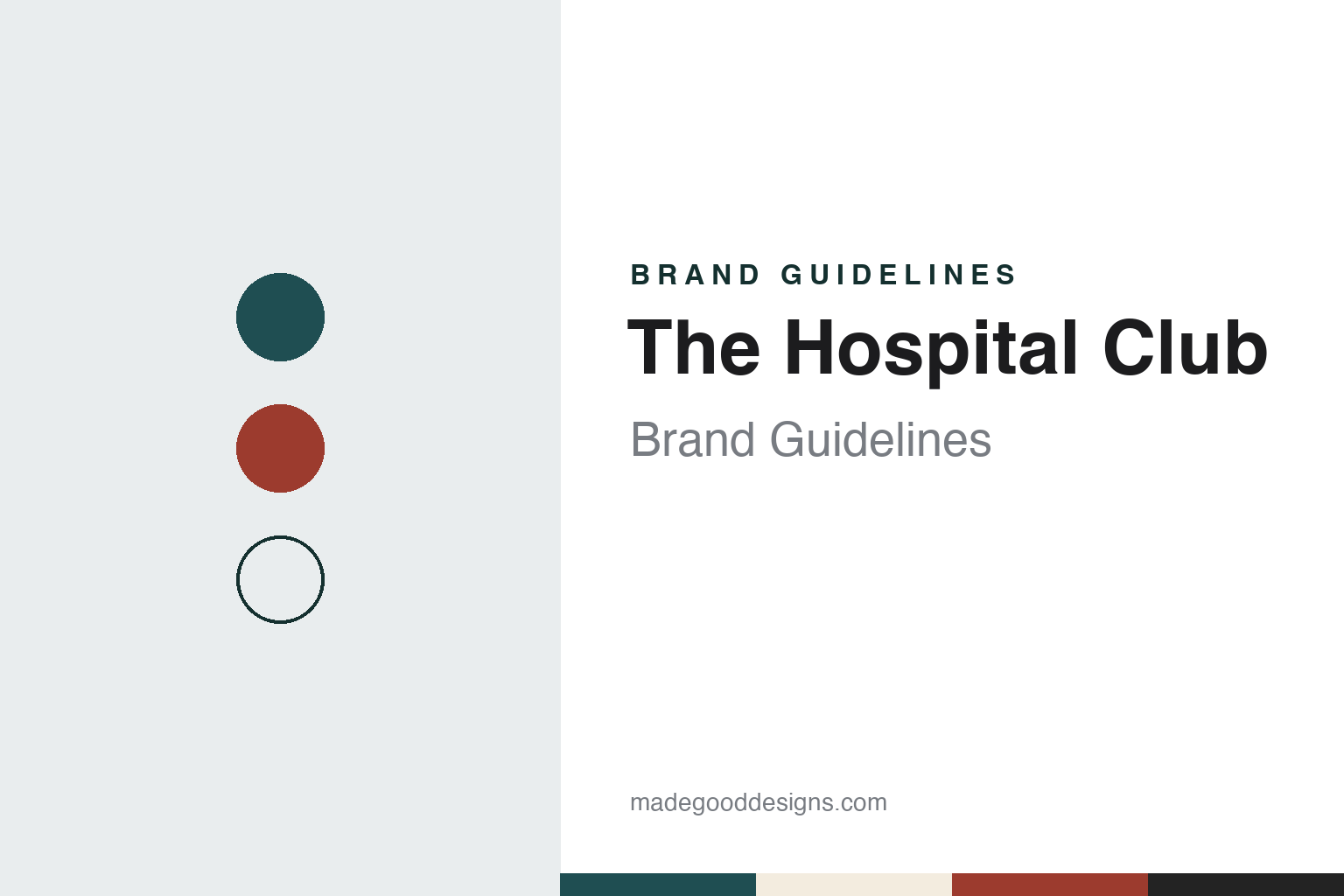
The Hospital Club Brand Guidelines
The Covent Garden club that put studios beside its lounges.
Aa
Two constants: a teal, brick red and cream palette and a grotesque sans register. Abstract homage — not a Hospital Club asset or mark; no sign, logo or interior is reproduced.
Endell Street
A former hospital site turned into a club for creative work.
The Hospital Club opened in Covent Garden, London, in 2004 as a members’ club for people working in the creative industries. Wikipedia says it was founded by Paul Allen, the Microsoft co-founder, through his investment company Vulcan Inc., and the musician Dave Stewart of Eurythmics. The London newspaper Westminster Extra named the same two founders in June 2024, saying they pitched the club to the “creative industries”, and Wallpaper* dated its launch to 2004 in an October 2014 article. The historian Seth Thévoz, in his Clubland newsletter, gives the club’s span as 2002 to 2020.
The name comes from the building. Westminster Extra reported that a hospital stood on the Endell Street site from the 1700s until it closed in 1992, and that Allen bought the site in 1996. According to Wikipedia, the building housed the British Lying-In Hospital from 1749 to 1913, and St Paul’s Hospital moved there from Red Lion Square in 1923. The conversion was slow: the newspaper said it took Allen eight years to win permission, and Wikipedia says the project stalled for several years while a compromise with local residents was worked out.
What opened in 2004 was a club built around production as much as conversation. Wikipedia describes seven floors holding a television studio, called h Studio, a recording studio, a screening room, a live performance space, a restaurant, lounges and a gallery. It places the television studio two floors below ground, at about 2,700 square feet, with room for an audience of around 250 people, and says its sound production room was upgraded with the console maker Solid State Logic. Westminster Extra also singled out the recording studio when it looked back at the club in 2024.
Colour
Sage’s lounges, artist bedrooms and a Hollywood site.
The interiors changed over the years, and the design and travel press recorded some of that work. In October 2014 Wallpaper* reported that the club had brought in the designer Russell Sage, whose earlier work the magazine listed as including the Goring Hotel and Pétrus, to revamp its dormant fourth floor. Sage opened the level into two warm, intimate lounges, the magazine said, alongside the club’s meeting rooms, its television and recording studio, gallery, cinema, restaurants and bars. Sage told the magazine the aim was to bring life to all the spaces and evolve them into the new, fresh face of the club.
Bedrooms followed. Writing for the travel site Fathom in November 2016, Liza Foreman reported that the club had added fifteen bedrooms for members and outside guests in 2015. The rooms were converted from former television offices and dressing rooms, came in four sizes, and were finished with wood panelling, colourful carpets and jewel-toned velvet sofas and chairs. Each room carried artwork by a designated artist under what the club called its Bedroom Art Programme, and the article credited the artists Alec Hardy and Dominic Beattie with collaborating on the room designs. Foreman also described meeting rooms, four bars and lounges, a restaurant and a screening room, and a two-floor music and television studio with a floating floor, a lighting rig, green rooms and a loading bay.
The club also looked abroad. In February 2017 the property news site Bisnow, citing the Los Angeles Times, reported that Allen had bought the Redbury Hotel on Vine Street in Hollywood, near the Capitol Records building, to become an American version of The Hospital Club. The plan it described included a recording studio, lounges and a performance space, three restaurants including one on the roof, a gym, a pool and 36 rooms for rent to the public. Wikipedia records the former Redbury Hotel as the club’s second location.
Typography
Clubs and their buildings.
Private members’ clubs present themselves through a small set of signals. The name often carries the story: The Groucho Club borrows a line attributed to Groucho Marx, ARTnews explained in 2022, while Annabel’s takes its name from Lady Annabel Vane-Tempest-Stewart, The Guardian reported in 2018. Wordmarks, crests and monograms tend to appear quietly, on a website header, an application page or, as Vogue noted at Annabel’s, on china stamped with the club’s crest.
Buildings and interiors do much of the work that advertising does elsewhere. Many London clubs occupy period townhouses, and their refits are credited to named architects and designers in the design press: Wallpaper* has credited Michaelis Boyd and Transit Studio with successive changes at the Groucho Club, and Martin Brudnizki with the rooms Annabel’s moved into at 46 Berkeley Square in 2018. Art collections, murals and wallpaper are often described as part of a club’s character, and this guide names them only where a dated source does.
Printed and practical matter carries the rest of the voice: menus, event brochures, dress codes, signage, membership cards and keys, and the pages that explain how to apply, how to book a tour or how to hire a room. The tone ranges from the dry wit of a Soho club to the formal language of a Mayfair house, and this guide quotes it only from the clubs’ own published pages or from dated reporting.
Owners and groups matter to the identity as well. Clubs are bought, sold and grouped, and they move, close or rename; the Groucho Club passed from private-equity owners to Artfarm in 2022, and Annabel’s is one of The Birley Clubs. The guides in this category state ownership, sites and closures plainly with dates, leave out fees and prices, and never name members or guests.
Aa
A grotesque sans for a club named after its building. (Specimen set in Archivo, a sans STAND-IN; NOT The Hospital Club logo.)
h Club
A shorter name, then a closed door.
In its later years the London club used a shorter name. Westminster Extra reported in June 2024 that the Hospital Club had rebranded itself as the H Club, and The Stage wrote the name in lower case, as “h Club”, in September 2020, matching the lower-case h of the club’s h Studio.
The club did not reopen after 2020. On 10 September 2020 The Stage reported that London’s h Club had announced it was closing permanently. Wikipedia says the London and Hollywood clubs both closed permanently in 2020, and that the contents of the London club were sold at auction on 15 September 2021. In June 2024 Westminster Extra described the Endell Street building as empty for four years, with no name above the door, and named its new owner as the developer Woods Whur 2014. Wikipedia says that the basement television studio has been run since 2023 by Celebro Studios, which took over the studio site after a refit, and that ITV announced several of its daytime programmes would move there from January 2026.
The Hospital Club no longer operates as a members’ club. What remains of its identity is the name it took from the site, the studios it built below ground and the rooms it fitted out with artists.
For a design guide, The Hospital Club shows how a club can take its name and much of its character from the history of its building, then fit production studios and artist-led bedrooms around the lounges. Compare The Groucho Club, another London members’ club in the West End, and Soho House. For this guide we use a deep teal, a brick red, a warm cream and charcoal with a grotesque sans, an unofficial interpretation; no product or logo is reproduced.
Explore & save
Keep The Hospital Club’s identity on hand — save it to a board in the Made Good inspiration library.
The Hospital Club identity set
Pin The Hospital Club teal, brick red and cream palette and the grotesque sans register to your own board.
Source & notes
Frequently Asked Questions
What font can I use to match the The Hospital Club look?
This guide describes The Hospital Club’s type as “A grotesque sans for a club named after its building”. Its type specimen is set in Archivo from Google Fonts as a stand-in; Archivo is not The Hospital Club’s own lettering.
What colours are in the The Hospital Club palette?
This guide’s The Hospital Club palette is Endell teal #1F4E52, Studio charcoal #232323, Brick red #9C3B2E, Brass #B08A4A and Warm cream #F3ECDF. The tones are the guide’s own unofficial interpretation, not official The Hospital Club hex codes.
When did The Hospital Club open?
The Hospital Club opened in 2004, in Covent Garden, London.
Who founded The Hospital Club?
The Hospital Club was founded by Paul Allen (Vulcan Inc.) and Dave Stewart in 2004.