Wild Wadi Brand Guidelines
Jumeirah’s Dubai water park built around Juha and Sinbad.
Aa
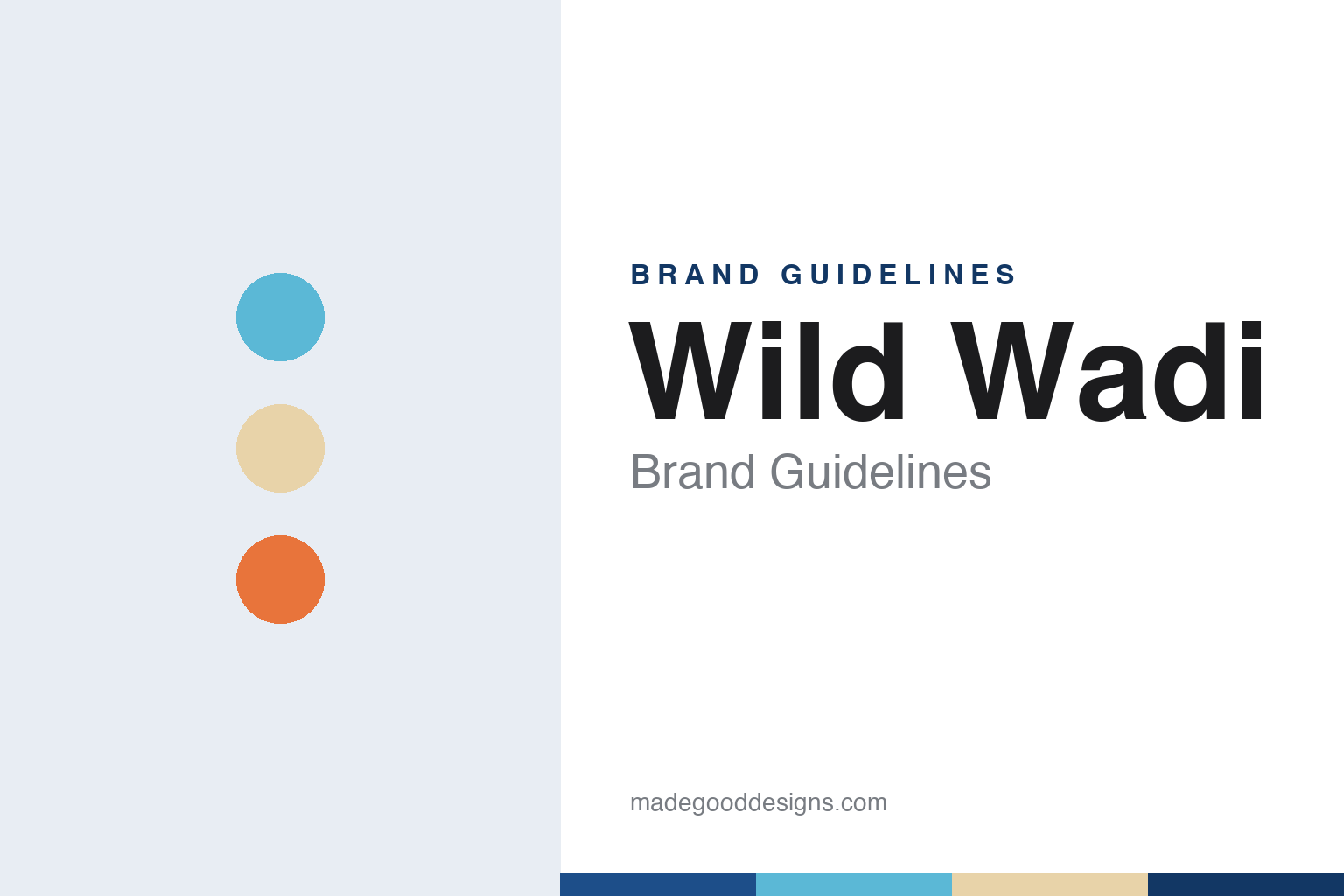
Two constants: a Gulf blue, sand and sunset orange palette and a rounded sans register. Abstract homage — not a Wild Wadi or Jumeirah asset or mark; no ride, character, logo or sign is reproduced.
Jumeirah
A water park between two hotels.
Wild Wadi Waterpark opened in August 1999 on Dubai’s Jumeirah coast, The National reported in January 2012. It sits in Umm Suqeim, between the Burj Al Arab and the Jumeirah Beach Hotel, and the two hotels frame it: in August 2012 The National wrote that riders at the top of its tallest slide look out over the Burj Al Arab and the city skyline, and Gulf News described a view across the Arabian Gulf from the same tower. The park is outdoors, and English Wikipedia lists a wave pool, several slides and two artificial surfing machines among its attractions.
The park belongs to the Jumeirah hotel group. English Wikipedia dates Jumeirah to 1997 and says it became part of the Dubai investment company Dubai Holding in 2004; it also lists Wild Wadi Waterpark among Dubai Holding’s business groups, next to Jumeirah. In 2012 The National named Jumeirah Hotel Group as the park’s management. Today the park is presented on Jumeirah’s own website as an experience of the Jumeirah Beach Hotel, where the company calls it “Dubai’s original waterpark” and writes the name with a trademark sign as Wild Wadi Waterpark.
The park also became a television location. English Wikipedia says it appeared in The Amazing Race 5 and The Amazing Race Asia 1, where teams rode down a steep drop, and later in The Amazing Race Australia 2, where teams rode the surf machine on boogie boards.
Colour
Juha and Sinbad.
The park is designed around a tale from Arabian folklore featuring Juha and his seafaring friend Sinbad, The National wrote in August 2012. The story names its spaces. The lazy river is Juha’s Journey, which English Wikipedia gives as 360 metres long and Jumeirah’s website describes as a gentle loop through the park, and the children’s play area also carries Juha’s name. The rides form a connected system: of the 30 rides the park had in 2012, 13 were interconnected, so that riders could go from one to the next without leaving the water, The National reported.
Its signature is a tower. The Jumeirah Sceirah, a near-vertical free-fall slide, ran from the opening until January 2012. That month The National reported that the park had closed for maintenance on 11 January and that the slide was being taken down, with only its tower kept, after more than twelve years and 30 seasons of use; the general manager said visitors had asked for more “high-throw attractions.” The park’s manager, who had worked there since 1999, told the paper that the tower and slide had become as much a part of the Dubai landscape as any of the buildings around them. The same report called the original the tallest slide outside North America until its removal. The rebuilt Sceirah was unveiled on 4 September 2012, Gulf News reported: two tandem slides starting from a trapdoor 32 metres up, dropping riders down a 120-metre run through a tunnel. Jumeirah’s website still describes a near-vertical free-fall slide from 32 metres, so the tower has carried the same name through two versions of the ride.
The park renewed its family rides the year before. In January 2011 Gulf News reported that Burj Surj and Tantrum Alley had replaced two older family rides near the end of their life span, part of a move to double capacity to about 800 people at one time. The paper said building them took six months and brought nearly 500 contractors on site. Tantrum Alley sends riders through three funnels and Burj Surj through two bowls; the general manager said the new rides could be seen from the rest of the park and from the road. The Burj Surj name came from a public naming competition: the winning entrant told Gulf News she had paired Burj with Surj because the words rhyme, an echo of the towers nearby.
Typography
Water parks and their stories.
Water parks and indoor waterpark resorts sell a day out, a short break or a family holiday, and their identities are built for that job. A park name, a logo and often a mascot or a theme carry across tickets, wristbands, park maps, signage, towels and shop merchandise, and the same marks appear on the operator’s website, booking pages and advertising. On Tenerife, Blooloop reported in 2022, advertising for one family’s parks runs from bus stops and billboards to taxis and litter bins.
Much of the look comes from architecture. Some parks borrow a whole setting, such as a historic kingdom or a myth tied to a host hotel, and build their entrances, shops and restaurants to match. Others are organised around slide towers, whose shapes, names and colour schemes act as landmarks visible from across the site. Indoor resorts put the water park, hotel rooms and restaurants under one roof and one name, so the identity has to work in corridors and rooms as well as at the poolside.
Ownership varies widely. Some parks belong to family companies that also run zoos, aquariums or hotels; others belong to hotel and resort groups, to listed leisure companies or to investment owners that have bought and sold parks over time. Ride makers such as ProSlide and WhiteWater are often credited for the slides, and industry reports such as the Themed Entertainment Association’s annual index publish attendance figures that the trade and national press repeat.
The guides in this group set out what dated sources say about each brand: when and where it opened, who owns and operates it, how it has changed its name or its sites, and how its theme, naming and visual material are presented to visitors. Where a fact rests only on the operator’s own word, the guide says so.
Aa
A rounded sans — soft, friendly and easy to read on a sunny sign. (Specimen set in Fredoka, a sans STAND-IN; NOT the Wild Wadi logo.)
Wild Wadi
Seasons, closures and returns.
The park runs to a seasonal rhythm. In January 2018 What’s On reported that it would close for its annual deep clean from 13 January to 8 February, and counted 30 rides and attractions, including two FlowRider surf rides, a wave pool and a 360-metre lazy river. The same report noted that the Jumeirah Beach Hotel was closing for a makeover that year while the park kept operating. In 2020 the park closed in March and reopened on 10 July 2020, What’s On reported, with revised opening hours and closed days.
Its current form ties it more closely to the hotel next door. In November 2026 Jumeirah’s website said Wild Wadi Waterpark was open for hotel guests, daily from 10:00 to 18:00, and listed among its attractions the lazy river, two FlowRider surf rides, the wave pool and an action river, along with shaded lounges and on-site dining. The page groups the park with the Jumeirah Beach Hotel’s other experiences rather than giving it a separate site, and it keeps the Jumeirah Sceirah and Burj Surj in its list of rides, so the names introduced in 1999 and 2011 still sit at the centre of how the park describes itself.
For a design guide, Wild Wadi shows how a folk tale and a single slide tower can hold a park’s identity together for more than a quarter of a century while the rides beneath them change. Compare Jumeirah, the hotel group that runs it, and Aquaventure, the water park at Atlantis The Palm. For this guide we use Gulf blue, beach sand and a sunset orange with a rounded sans, an unofficial interpretation; no product or logo is reproduced.
Explore & save
Keep Wild Wadi’s identity on hand — save it to a board in the Made Good inspiration library.
Wild Wadi identity set
Pin the Wild Wadi Gulf blue, sand and sunset orange palette and the rounded sans register to your own board.
Source & notes
Frequently Asked Questions
What font can I use to match the Wild Wadi look?
This guide describes Wild Wadi’s type as “A rounded sans — soft, friendly and easy to read on a sunny sign”. Its type specimen is set in Fredoka from Google Fonts as a stand-in; Fredoka is not Wild Wadi’s own lettering.
What colours are in the Wild Wadi palette?
This guide’s Wild Wadi palette is Gulf blue #1D4E89, Sky pool #5BB8D6, Beach sand #E8D3A9, Sunset orange #E8743B and Deep night #123764. The tones are the guide’s own unofficial interpretation, not official Wild Wadi hex codes.
When did Wild Wadi open?
Wild Wadi opened in August 1999, in Jumeirah, Dubai. Wild Wadi is known for Juha and Sinbad theme, Jumeirah Sceirah.
Who owns Wild Wadi?
Wild Wadi is part of Jumeirah Beach Hotel. Wild Wadi is known for Juha and Sinbad theme, Jumeirah Sceirah.