Royal Scotsman Brand Guidelines
Belmond’s Highland touring train, in claret and larch, since 1985.
Aa
Two constants: a claret, heather and larch palette and a country-house serif register. Abstract homage — not a Royal Scotsman or Belmond asset; no crest, carriage, logo or livery is reproduced.
A train of rented carriages
Launched in 1985, rebuilt as a new set in 1990.
The Royal Scotsman is a touring train that carries a small group of guests around Scotland for several nights at a time, stabling at stations in the evening. Belmond’s press kit says the train was launched in May 1985, when its original owners assembled a set of rented carriages and named them The Royal Scotsman. The carriage leases ran for five years. The trade paper TravelMole, reporting in April 2007, also gives 1985 as the year the train entered service.
The owners then bought a different set of carriages built to their own specification. The press kit says they worked with the designer James Park Associates, bought ten Pullman carriages and had all the interior woodwork made by a specialist woodworking firm in Bournemouth, then shipped and fitted. This second train replaced the first in May 1990, the company says. Each cabin gained its own bathroom, capacity rose from 28 to 32 guests, steam heating gave way to electric, and steel carriages replaced the earlier wood-bodied vehicles. In 1997 capacity was raised again, to 36, in 16 twin and four single state cabins.
Ownership moved to the company behind the Venice Simplon-Orient-Express in two steps. In December 2004 Orient-Express Hotels, Trains & Cruises announced an agreement to buy the train from the L&R Group, taking half the shares from April 2005 and the rest later. TravelMole reported on 26 April 2007 that Orient-Express Hotels had acquired the remaining half from L&R; the first 50% had been bought in April 2005, and the second half had originally been planned for January 2008. At the time the train carried 36 passengers with a staff of 18 and ran from April to October, the paper said.
Colour
Pullman cars dressed as a country house.
The press kit describes the train as nine carriages, mostly original Pullman cars from the 1960s, completely overhauled. Two are restaurant cars and five are state cars, with cabin stewards on board. The cabins are described as Edwardian in style, single or twin, decorated with marquetry and prints of Highland chieftains, each with a wardrobe, a dressing table and an en-suite shower room.
At the rear is the observation car, which the company calls the social centre of the train: a long drawing room of sofas, small armchairs and table lamps, with a bar at one end and an open observation deck at the other. The bar, the press kit says, stocks more than 65 whiskies, and live music follows dinner. Dining is split between two restaurant cars, with free seating so that guests sit with different companions each night. Evening dinners follow cocktails in the observation car, and the press kit says many guests wear Highland dress on formal nights, which Belmond can arrange to hire. The menus it gives are Scottish in their sourcing, from Kyle of Lochalsh langoustines to Aberdeen Angus beef and local cheeses with oatcakes.
Journeys start and end at Edinburgh Waverley. Orient-Express’s 2004 announcement listed itineraries from a one-night journey to a seven-night tour, and the press kit describes themed journeys built around whisky and golf, crossing the Forth Bridge and running to Kyle of Lochalsh, Keith and Dundee, as well as an occasional eight-day tour of Great Britain that reaches England and Wales.
The train has added comfort and craft in recent years. Belmond’s press kit says a spa carriage, the Bamford Haybarn Spa, joined in 2017; The Fashion Law reported in January 2025 that the Royal Scotsman introduced a Dior spa carriage in 2024.
Typography
How these trains present themselves.
Luxury, sleeper and scenic trains sell a journey rather than a seat, and their identities are built to match. A train’s name is often its strongest asset: some revive the names of older services, others are named after a route, a region or a landscape. Operators publish these names with crests, monograms and lettering that echo railway signwriting, and many give a train its own livery, so that the colour of the carriages becomes part of the brand. The Venice Simplon-Orient-Express, for example, runs in a blue-and-gold livery, National Geographic Traveller reported in 2018.
Inside, the identity moves into materials. Carriage interiors carry marquetry, glass, upholstery and fittings, and on trains that use restored rolling stock the pages on history and individual carriages, with their build years and builders, become a large part of what the operator publishes. Newer interiors are often credited to named designers, studios and craft workshops.
The printed and digital pieces around a journey do much of the remaining work. Menus, cabin cards, tickets, luggage labels and welcome letters repeat the same names and lettering; route maps and timetables show where a train runs, how many nights a journey takes and which stations it stops at; and dress codes, music and dining arrangements are described as part of the experience.
Behind the names sit owners and operators that change over time: state railways, regional railway companies, private operators and international hotel groups. This guide states those owners and operators plainly, with dates, and attributes descriptions of carriages, suites and routes to the operator or to a named, dated source. It does not cover fares, and it makes no record claims.
Aa
A country-house serif for menus, cabin cards and itineraries. (Specimen set in Libre Baskerville, a serif STAND-IN; NOT the Royal Scotsman logo or lettering.)
A Belmond train
Tweeds, tartans and Pictish motifs in the new suites.
Orient-Express Hotels was renamed Belmond in 2014, The Fashion Law reports, and the train is now presented as part of Belmond’s collection of hotels and trains. Belmond itself was bought by the French luxury group LVMH, in a deal completed in April 2019, according to the same report and LVMH’s release of 17 April 2019.
In TravelMole’s 2007 report the Royal Scotsman was one of three Orient-Express tourist trains in Britain, alongside the British Pullman in the south of England and the Northern Belle, based in Manchester. Other Scottish rail names, such as the overnight Caledonian Sleeper, are separate services run by other operators.
The most recent interior work leans hard on Scottish materials. Wallpaper* reported in June 2025 that, to mark four decades of the train, Belmond had added grand suites to the classic double, twin and single cabins. The Magpie Grand Suites, which the magazine says made their debut the previous spring, were designed by the French interior architect Tristan Auer, layering Pictish stone motifs and Celtic symbols with bespoke tweeds, tartans and mahogany marquetry. The newer Heron Grand Suite has marquetry by the heritage studio A. Dunn & Sons, with patterns that echo Highland valleys, jacquard fabrics in mossy greens and warm beiges from the Scottish textile house Araminta Campbell, and ceramic basins by a Galloway potter. Both suites have a double bed with an embossed headboard and a Scottish larch dining table, the magazine says, and guests board along a red carpet to the sound of bagpipes.
For a design guide, the Royal Scotsman shows how a touring train can borrow the language of a Scottish country house, from marquetry and tartan to Highland dress at dinner, while staying a single, small train. Compare Venice Simplon-Orient-Express, its sister train on the continent, and Caledonian Sleeper, a Scottish overnight service. For this guide we use claret, heather and larch tones with a serif, an unofficial interpretation; no product or logo is reproduced.
Explore & save
Keep Royal Scotsman’s identity on hand — save it to a board in the Made Good inspiration library.
Royal Scotsman identity set
Pin the claret, heather and larch palette and the country-house serif register to your own board.
Source & notes
Frequently Asked Questions
What font can I use to match the Royal Scotsman look?
This guide describes Royal Scotsman’s type as “A country-house serif for menus, cabin cards and itineraries”. Its type specimen is set in Libre Baskerville from Google Fonts as a stand-in; Libre Baskerville is not Royal Scotsman’s own lettering.
What colours are in the Royal Scotsman palette?
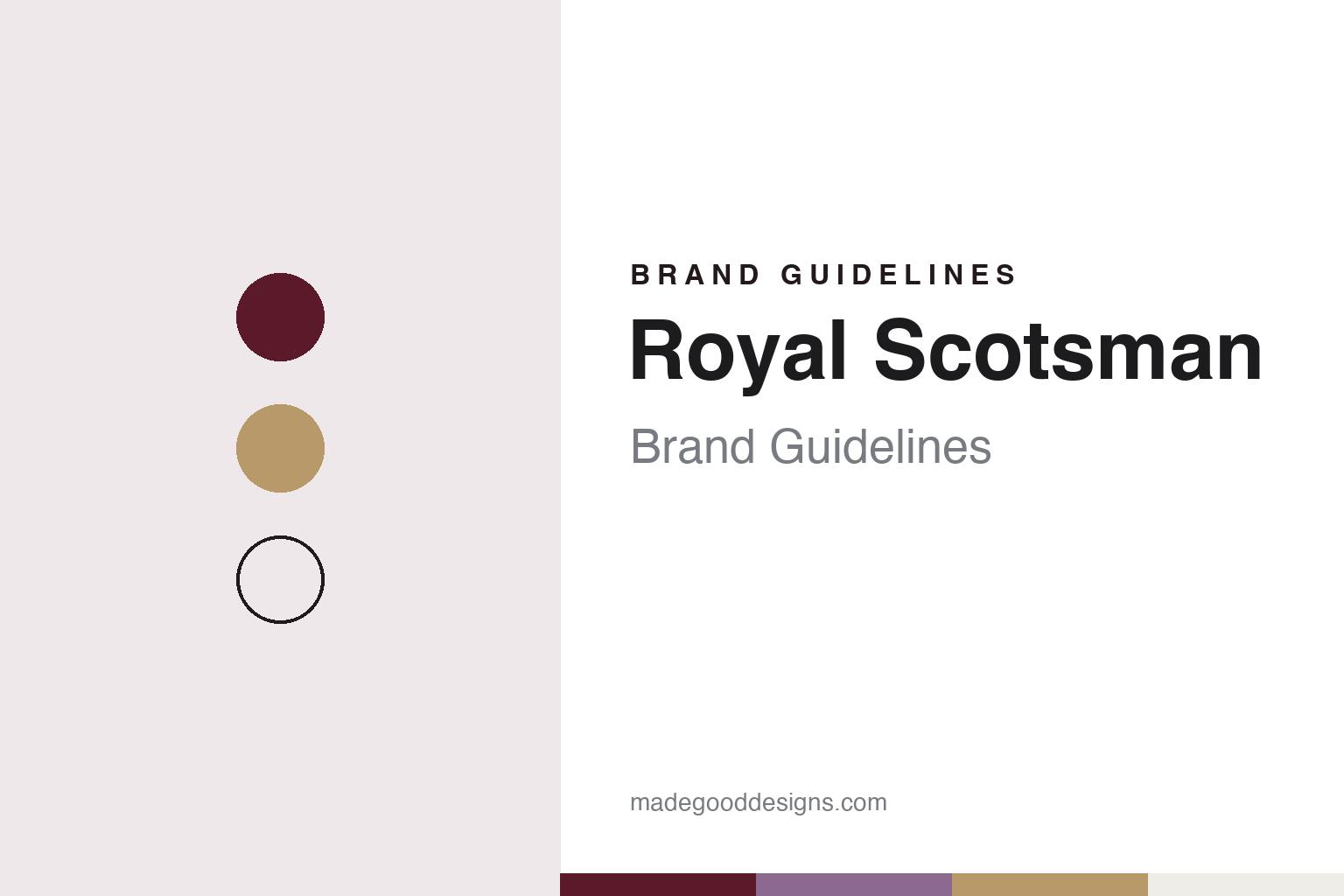
This guide’s Royal Scotsman palette is Claret #5B1A2A, Peat #24191A, Heather #8C6A8F, Larch #B89A6A and Mist #EFEDE8. The tones are the guide’s own unofficial interpretation, not official Royal Scotsman hex codes.
When was Royal Scotsman launched?
Royal Scotsman was launched in May 1985, in Scotland. This guide gives Edinburgh Waverley as where Royal Scotsman is based.
Where is Royal Scotsman based?
Royal Scotsman is based in Edinburgh Waverley. This guide dates Royal Scotsman to May 1985, in Scotland.