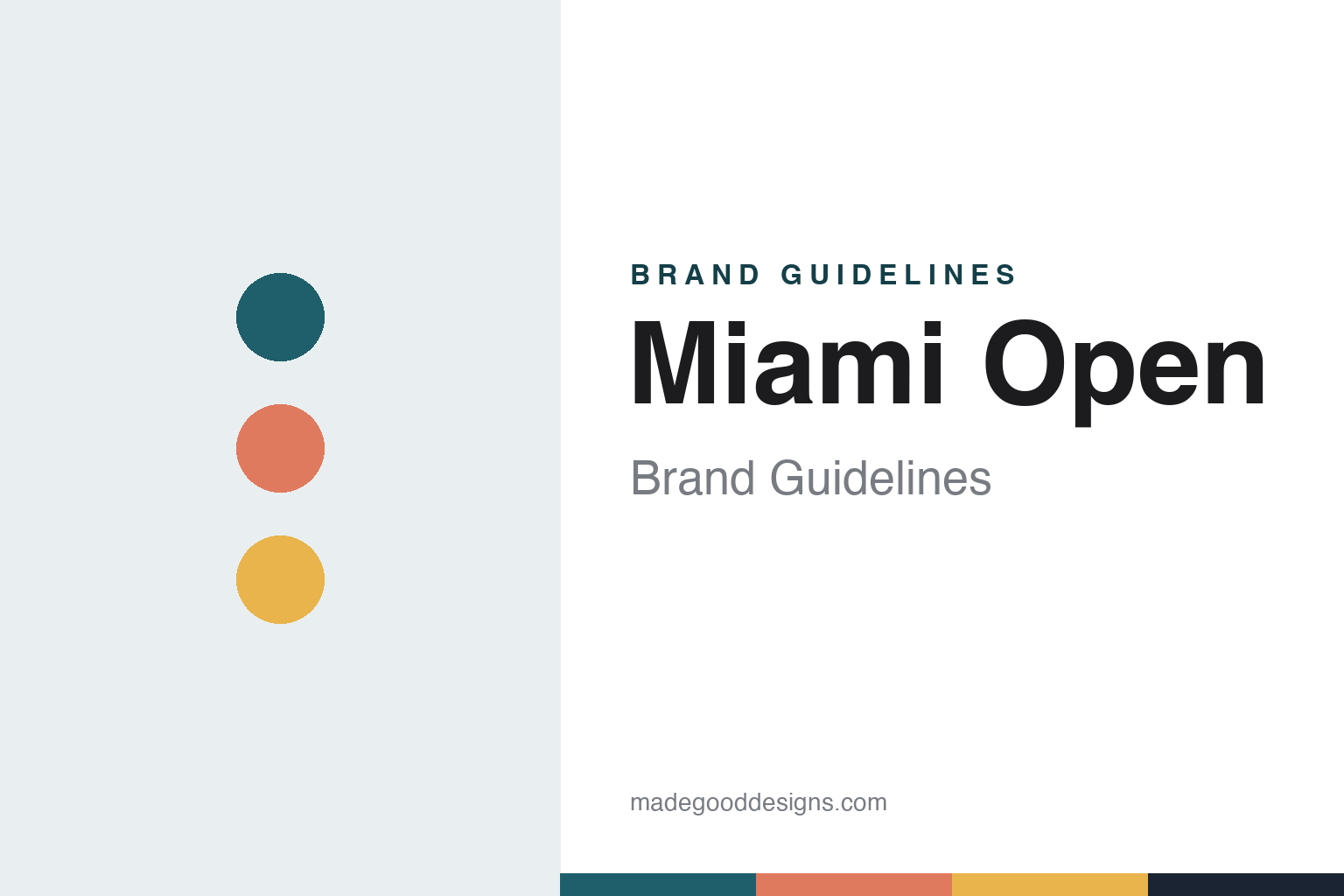
Miami Open Brand Guidelines
A tournament that moved from a resort to an island park and into a football stadium.
Aa
Two constants: a bay teal, coral and sunset gold palette and a geometric sans register. Abstract homage — not a Miami Open asset; no logo, trophy or court graphic is reproduced.
Winter Wimbledon
A founder’s plan for an early-season event.
The Miami Open is a combined men’s and women’s tournament played in late March and early April at Hard Rock Stadium in Miami Gardens, Florida. English Wikipedia names its founder as Butch Buchholz, a former player who was executive director of the ATP in the 1980s, and says he called the event the “Winter Wimbledon”: the plan was an early-season tournament with a format modelled on the Grand Slam events. In return for funding the event and sharing ticket and television income with the ATP and WTA, he won the right to run it for 15 years, English Wikipedia says.
The opening edition was held in February 1985 at Laver’s International Tennis Resort in Delray Beach. The tournament’s own history describes a 128-player singles format for men and women, with doubles and mixed doubles, broadcast by ABC. Buchholz brought in Alan Mills, the Wimbledon referee, as head referee, and Ted Tinling, the tennis fashion designer, as director of protocol, according to English Wikipedia. The title sponsor was the Thomas J. Lipton Company, and the event was called the Lipton International Players Championships.
In 1986 the tournament moved to the Boca West Resort and Club in Boca Raton, and in 1987 it reached Miami, at the Tennis Center at Crandon Park on Key Biscayne. English Wikipedia credits the Dade County manager of the time with helping the move. The tournament says Miami-Dade County dedicated a permanent 14,000-seat stadium there in February 1994. In 1999 Buchholz sold the event to IMG, the sports and talent agency, English Wikipedia says; IMG later became part of Endeavor, and the tournament’s own history for 2019 describes Endeavor as the parent company of IMG, “which owns the Miami Open.”
In November 2017 the tournament signed an agreement with Miami-Dade County to move, and the 2018 edition was the last on Key Biscayne. Ground was broken at the new site in March 2018, the tournament says.
Colour
A tennis centre inside a football stadium.
The tournament opened at Hard Rock Stadium, home of the NFL’s Miami Dolphins, in 2019, its 35th edition. The layout is unusual: English Wikipedia describes a modified seating arrangement with temporary grandstands inside the football stadium serving as the centre court, which keeps the same number of seats as the old Crandon Park stadium but adds access to the stadium’s suites and luxury seating. New permanent courts, including a grandstand court, were built on the stadium’s car parks. When it broke ground in 2018, the tournament described a site of 30 show and practice courts.
The event was not held in 2020. In 2021 it was played with limited attendance and without using the stadium bowl, English Wikipedia says, and the tournament says its Stadium Court inside Hard Rock Stadium returned in 2023, on a revamped site with more green space.
English Wikipedia counts the Miami Open among a small number of tour events, beyond the four majors, whose singles draws exceed 64 players and run beyond one week: 96 men and 96 women play singles, and 32 teams play in each doubles event, over 12 days. It is an ATP 1000 and WTA 1000 event, and since 2026 it has also been a WT500 event on the ITF Wheelchair Tennis Tour, English Wikipedia says. Winning Indian Wells and Miami in the same year is known as the “Sunshine Double.”
Names have followed sponsors from the start. After the Lipton years the event was renamed the Ericsson Open in 2000 and the NASDAQ-100 Open in 2002, English Wikipedia says; in 2007 it became the Sony Ericsson Open, and the tournament’s history uses the name Sony Open for 2013 and 2014. After the 2014 edition the Brazilian bank Itaú became presenting sponsor, and the event took the name Miami Open presented by Itaú, which the ATP and WTA websites and the tournament’s advertising logo have used since 2015, English Wikipedia notes. The tournament says Itaú renewed its sponsorship in 2024.
Typography
Tournaments, sponsors and venues.
Professional tennis events present themselves through a small set of repeated elements: an event name, a logo, a trophy and a venue. Organisers publish these on their own websites, alongside pages on the event’s history, its past champions and the cities it has called home. Many tournaments have moved more than once, and their published histories often read as a list of venues and dates as much as a list of results.
Names change more often than places. A title sponsor’s name usually leads the event name, and when a partner changes, the name changes with it: the Miami tournament has carried the names of a tea company, a telecoms firm, a stock index and a bank since 1985, and the Indian Wells event has been named for an airline, a magazine, an insurer and a bank. Some events add a presenting partner after the main title rather than before it. Sanctioning bodies, such as the ATP, the WTA and the ITF, and the companies or federations that own each event are part of the record and are named here plainly.
Much of the visual identity sits on the site itself. Court colours are chosen for the event and sometimes explained by the surface supplier; signage around the court, scoreboards, branded balls and towels, and the uniforms of officials and ball kids carry the event and sponsor marks into broadcast pictures. Merchandise extends the same colours and logos to visitors.
This guide looks at those elements as organisers and independent sources describe them: names, owners, venues, sponsors and documented design choices. It leaves out results, scores and money, and treats each sponsor’s own identity as a separate subject.
Aa
A geometric sans for a city name and a sponsor line. (Specimen set in Montserrat, a sans STAND-IN; NOT the Miami Open logo.)
Miami Open
A sponsor’s name and a city’s colours.
The presenting sponsor has shaped the look as well as the name. According to the tournament’s own history, Itaú’s graphic designers created the 2015 Miami Open logo in bright, vivid colours chosen to mirror the city and its culture. That year Lacoste became official outfitter, dressing the line judges and ball kids and selling a co-branded collection, and the tournament replaced asphalt beside the stadium with sand for a beach area, it says.
Ownership changed again in 2025. In April that year the trade site Sportcal, citing Bloomberg, reported that a group led by Endeavor’s chief executive, Ari Emanuel, was set to buy the Miami Open and the Madrid Open from Endeavor, as part of Endeavor’s move to private ownership; IMG itself had passed to TKO in February. On 8 October 2025 Fox Business reported that Emanuel had launched a holding company, MARI, with IMG’s portfolio of tennis events, including the Miami and Madrid tournaments, under its control, and that the ownership group of the Miami Dolphins, led by Stephen Ross, had joined as an investor. Fox Business added that the deals were finalised at the launch.
For a design guide, the Miami Open shows how an event can carry a city’s name through a run of sponsors and a change of venue: from a resort in Delray Beach to an island park and then into a football stadium. Compare BNP Paribas Open, the other half of the March double, and Mutua Madrid Open, which passed to the same owner. For this guide we use a bay teal, a coral and a sunset gold with a geometric sans, an unofficial interpretation; no product or logo is reproduced.
Explore & save
Keep Miami Open’s identity on hand — save it to a board in the Made Good inspiration library.
Miami Open identity set
Pin the Miami Open bay teal, coral and sunset gold palette and the geometric sans register to your own board.
Source & notes
Frequently Asked Questions
What font can I use to match the Miami Open look?
This guide describes Miami Open’s type as “A geometric sans for a city name and a sponsor line”. Its type specimen is set in Montserrat from Google Fonts as a stand-in; Montserrat is not Miami Open’s own lettering.
What colours are in the Miami Open palette?
This guide’s Miami Open palette is Bay teal #1F5F6B, Coral #E07A5F, Sunset gold #E9B44C, Night navy #1B2433 and Paper #F6F4EF. The tones are the guide’s own unofficial interpretation, not official Miami Open hex codes.
Who founded Miami Open?
Miami Open was founded by Butch Buchholz. This guide lists MARI (since 2025; IMG from 1999) as its owner.
Who owns Miami Open?
Miami Open is owned by MARI (since 2025; IMG from 1999).