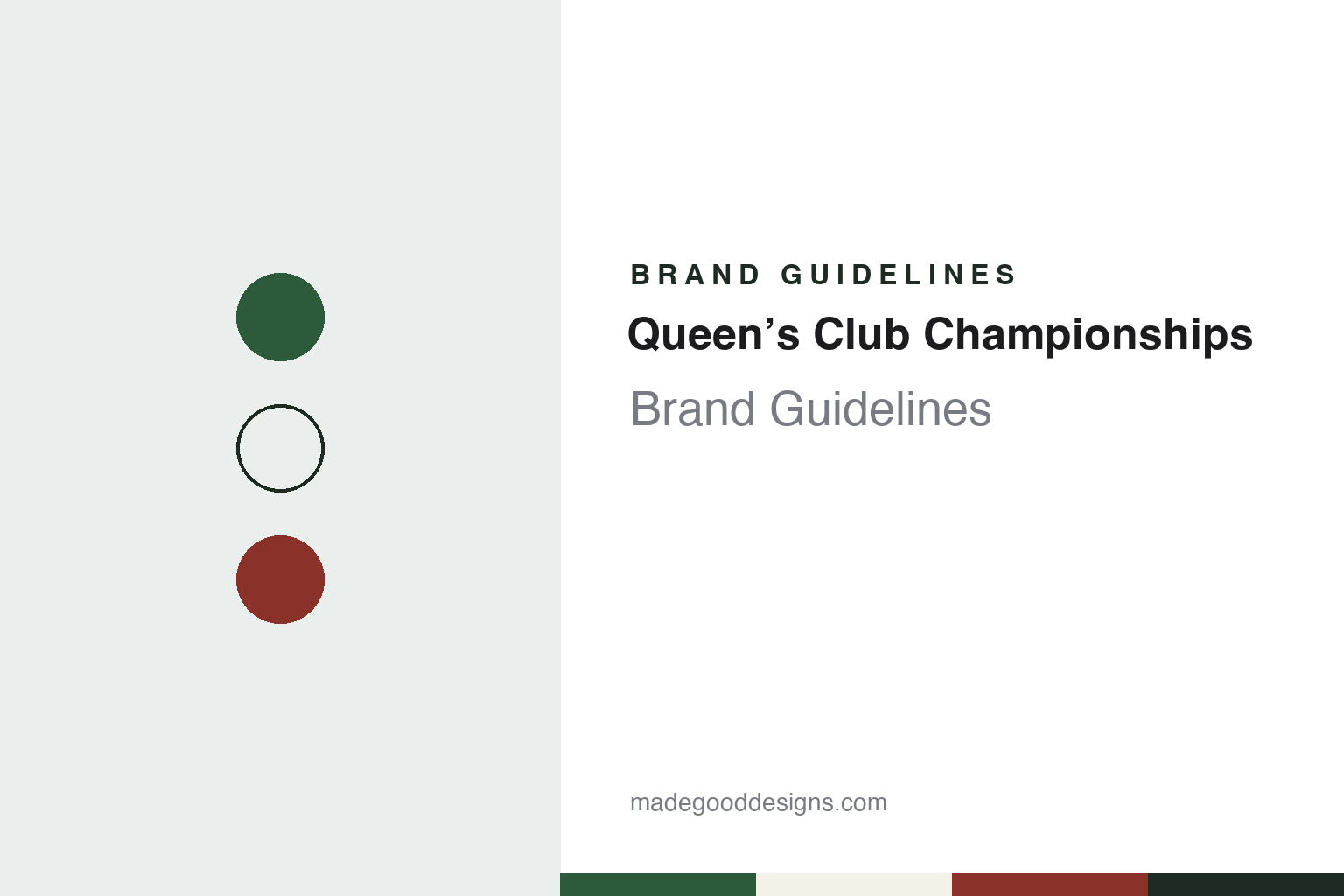
Queen’s Club Championships Brand Guidelines
A west London club, a grass fortnight and a name that changes with its sponsor.
Aa
Two constants: a lawn green, chalk and pavilion red palette and a clubhouse serif register. Abstract homage — not a Queen’s Club Championships asset; no logo, trophy or sponsor mark is reproduced.
From Fulham to West Kensington
An athletic-club tournament that found a permanent home in 1890.
The Queen’s Club Championships is a grass-court tennis tournament held each June at the Queen’s Club in West Kensington, London. English Wikipedia, citing T. Todd’s 1979 history The Tennis Players, traces its origins to the London Athletic Club tournament, first played in 1881 at Stamford Bridge in Fulham, which took the title Championship of London in 1885. In 1890 the event moved to the Queen’s Club, its home ever since, with a men’s singles and a women’s singles event.
The programme grew in stages, according to the same account: men’s doubles were added in 1903, mixed doubles in 1905 and women’s doubles in 1915. The tournament was not held from 1915 to 1918 or from 1940 to 1945, during the two world wars. From 1970 to 1989 it was part of the Grand Prix circuit, the men’s professional tour of that period.
The 1970s brought a pause and a new name. The women’s event was dropped after 1973, and no men’s tournament was held from 1974 to 1976, Wikipedia says, citing The Sydney Morning Herald of April 1974. By then the event was known as the London Grass Court Championships; it has been called the Queen’s Club Championships since 1977. Wikipedia records Andy Murray’s five men’s singles titles, won between 2009 and 2016, as the record for the event.
The setting is part of the character. The Guardian noted in June 2026 that the Queen’s Club works as a private tennis club for about 49 weeks of the year, and that Barons Court Underground station sits about 150 metres from its entrance, so that each tournament begins with crowds queuing at the station barriers.
Colour
Stella Artois, Aegon, Fever-Tree, cinch and HSBC.
For most of its modern life the tournament has carried a sponsor’s name. From 1979 until 2008 it was the Stella Artois Championships, according to Wikipedia, citing PRWeek of March 2008. In 2009 it became the Aegon Championships, under a wider deal between the Lawn Tennis Association (LTA) and Aegon that also renamed the LTA’s grass-court events at Birmingham and Eastbourne. The drinks brand Fever-Tree became its sponsor in 2018, and the car-selling website cinch held the title from 2021 to 2024.
On 23 January 2025 the LTA announced HSBC as title sponsor under a four-year partnership running to 2028, the Queen’s Club reported on its website that day. The event became the HSBC Championships and, the announcement said, would undergo “a comprehensive rebrand and refresh” to suit its new status as a women’s and men’s tournament. The bank is a separate subject with its own guide: HSBC.
That new status was the main change of the decade. BBC Sport reported on 16 May 2024 that a women’s tournament would return to the Queen’s Club in 2025 for the first time in more than 50 years, played in the week immediately after the French Open, with both the women’s and the men’s events holding 500 status; the club had not staged a women’s tournament since 1973, the BBC noted. The LTA described the 2025 edition as the first two-week HSBC Championships: a WTA 500 week followed by the ATP 500 week, on the same courts.
The men’s event belongs to the ATP Tour 500 series; Wikipedia, citing an ATP calendar announcement of February 2014, says it moved up from the 250 level in 2015. In a review published on 30 June 2025, the LTA said the women’s week drew more than 62,000 spectators and that the men’s week sold out on all seven days, with an attendance of 71,000. The Guardian reported in June 2026 that general-sale tickets for that year’s men’s tournament sold out in less than a day.
Typography
How tennis events present themselves.
Professional tennis events present themselves through a small set of repeated elements: an event name, a logo, a trophy and a venue. Organisers publish these on their own websites, alongside pages on the event’s history, its past champions and the cities it has called home. Many tournaments have moved more than once, and their published histories often read as a list of venues and dates as much as a list of results.
Names change more often than places. A title sponsor’s name usually leads the event name, and when a partner changes, the name changes with it: the Miami tournament has carried the names of a tea company, a telecoms firm, a stock index and a bank since 1985, and the Indian Wells event has been named for an airline, a magazine, an insurer and a bank. Some events add a presenting partner after the main title rather than before it. Sanctioning bodies, such as the ATP, the WTA and the ITF, and the companies or federations that own each event are part of the record and are named here plainly.
Much of the visual identity sits on the site itself. Court colours are chosen for the event and sometimes explained by the surface supplier; signage around the court, scoreboards, branded balls and towels, and the uniforms of officials and ball kids carry the event and sponsor marks into broadcast pictures. Merchandise extends the same colours and logos to visitors.
This guide looks at those elements as organisers and independent sources describe them: names, owners, venues, sponsors and documented design choices. It leaves out results, scores and money, and treats each sponsor’s own identity as a separate subject.
Aa
A clubhouse serif for a grass-court tournament. (Specimen set in Playfair Display, a serif STAND-IN; NOT the Queen’s Club Championships or HSBC Championships logo.)
A fortnight before Wimbledon
A calendar slot that shapes the event.
The tournament’s place in the calendar defines it. It is played in June, starting a week after the clay-court French Open and finishing a week before Wimbledon, which is about four miles away, Wikipedia says. Until 2014 the break between Paris and Wimbledon was only two weeks, and the Queen’s Club event began the day after the French Open men’s final; the gap widened when Wimbledon moved back a week to lengthen the grass season, Wikipedia says, citing an Associated Press report of November 2013.
Since 2025 the club has hosted two consecutive weeks of tour-level tennis under one sponsor name, with the women’s week first and the men’s week second. The BBC’s 2024 report said the change also moved the LTA’s other grass events: the women’s tournament at Nottingham shifted back a week to follow Queen’s, Edgbaston Priory in Birmingham took over the Challenger events in the opening week of the grass season, and the women’s event at Eastbourne moved to 250 status.
For the identity, the constant is the venue rather than the title. Each sponsor has put its own name on the event — Stella Artois for three decades, then Aegon, cinch and HSBC — while the club, its grass courts and its June slot have stayed the same since 1890. The 2025 announcement treated the HSBC change as a full rebrand, not a simple swap of names.
For a design guide, the Queen’s Club Championships shows how a tournament can keep a single place name at the centre while its official title follows each sponsor in turn. Compare Wimbledon, the grass-court championship that follows a week later, and the HSBC guide for the bank itself. For this guide we use a lawn green, a chalk white and a deep pavilion red with a serif, an unofficial interpretation; no product or logo is reproduced.
Explore & save
Keep Queen’s Club Championships’s identity on hand — save it to a board in the Made Good inspiration library.
Queen’s Club Championships identity set
Pin the lawn green, chalk and pavilion red palette and the clubhouse serif register to your own board.
Source & notes
Frequently Asked Questions
What font can I use to match the Queen’s Club Championships look?
This guide describes Queen’s Club Championships’ type as “A clubhouse serif for a grass-court tournament”. Its type specimen is set in Playfair Display from Google Fonts as a stand-in; Playfair Display is not Queen’s Club Championships’ own lettering.
What colours are in the Queen’s Club Championships palette?
This guide’s Queen’s Club Championships palette is Lawn green #2E5A3C, Clubhouse ink #1D2B22, Chalk line #F3F1E8, Pavilion red #8A3129 and Net cord #CFC8B4. The tones are the guide’s own unofficial interpretation, not official Queen’s Club Championships hex codes.
When was Queen’s Club Championships founded?
Queen’s Club Championships was founded in 1881 (London Athletic Club tournament, Stamford Bridge).