Milan Fashion Week Brand Guidelines
The Milan shows that grew from a 1958 trade association and a 1970s move from Florence.
Aa
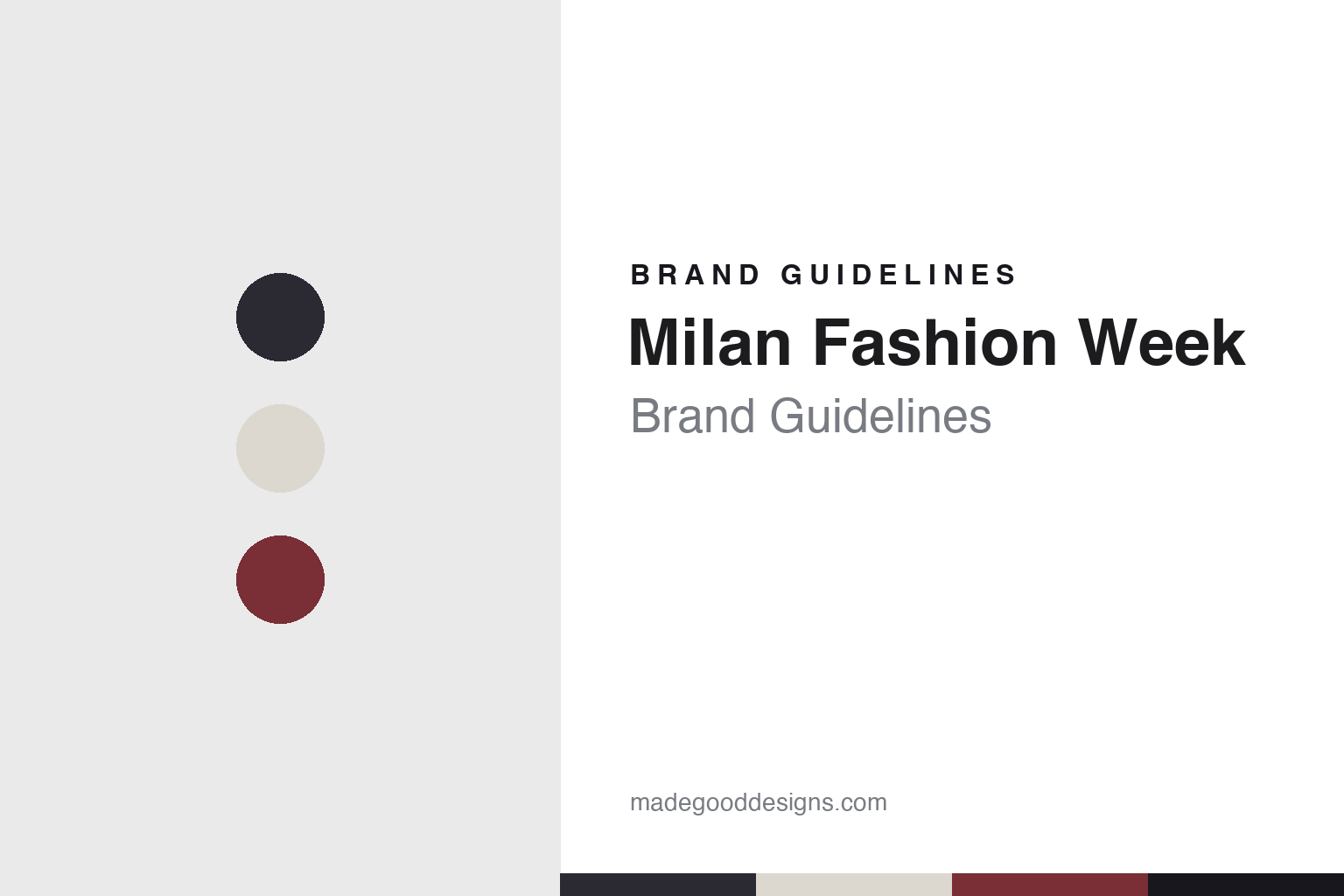
Two constants: a graphite, pale marble and oxblood palette and a runway serif register. Abstract homage — not a Milan Fashion Week mark; no logo, campaign or show image is reproduced.
From Florence to Milan
A trade association, 1958.
The body behind Milan Fashion Week dates from 1958. The historical archive of Bocconi University in Milan, which has held the association’s papers since 2014, says it was established that year in Rome as the Camera sindacale della moda italiana, and that it opened an office in Milan in 1987. English Wikipedia dates the memorandum of association to 11 June 1958 and says couturiers, fashion-house owners and the Florentine organiser Giovanni Battista Giorgini were among those present. Il Post wrote in September 2025 that in 1958 the body worked as a kind of trade association for companies in the sector. Today it is the Camera Nazionale della Moda Italiana (CNMI), a non-profit association; Italian Wikipedia says it represents more than 200 companies in clothing, accessories, leather goods, footwear and distribution.
Italian runway shows began in another city. On 12 February 1951 Giorgini presented the collections of a group of Italian houses to American buyers and journalists at his home, Villa Torrigiani in Florence, according to the history published by Pitti Immagine. Il Post reported that he had first hoped to stage the show in the United States with the department store B. Altman & Co., and that he took his cue from the Press Week held in New York in 1943. From 1952 the Florentine shows moved into the Sala Bianca of Palazzo Pitti. In 1967, Pitti Immagine says, the Florence organisers and the Camera Nazionale della Moda signed an agreement under which high fashion shows went to the ateliers of Rome, while boutique and knitwear collections stayed in Florence.
Until the 1970s, Il Post wrote, Italy had no single fashion capital. Shows were spread across Florence, Rome and Milan, and cities kept their own specialities: leather goods in Florence, yarns such as wool and silk in Biella and tailoring in Naples. The move to Milan came with ready-to-wear. The paper reported that the designer Walter Albini moved his show from Florence to Milan at the start of the 1970s; his collection, which included accessories, shoes and bags of his design, was produced by five companies, all but one based in Lombardy. Milan was Italy’s most industrialised city and home to many firms making clothes that were not made to measure, and Vogue Italia had arrived there in 1962. The decisive step, by Il Post’s account, came in March 1976, when the main Italian designers moved their shows to Milan and several houses set up their headquarters there. Italian Wikipedia gives 1975 as the year of the first Milan fashion week, while English Wikipedia dates the week to 1958, the year of the chamber.
Colour
Two seasons, many palazzi.
Milan Fashion Week runs twice a year. English Wikipedia says autumn/winter collections are shown in February or March and spring/summer collections in September or October, with separate weeks for women and for men. The women’s editions have gone under names such as Milano Moda Donna and the men’s under Milano Moda Uomo. In the international calendar Milan follows New York and London and comes before Paris. The collections are for the following season, Italian Wikipedia notes, and are shown well ahead so that pieces can be produced and ordered by shops.
The show spaces have moved around the city. Italian Wikipedia says the week was traditionally held at the Fiera di Milano grounds on Via Gattamelata and was staged at a Fashion Hub in 2010; its article on the chamber also mentions a tensile structure at the Castello Sforzesco. English Wikipedia names Palazzo Reale and Palazzo Serbelloni among the venues and puts the number of shows at more than 40 each season. L’Unione Sarda, previewing the September 2026 edition, listed a brand anniversary at Bocconi University, another at Palazzo Serbelloni, a show in a public garden and a celebration on Via Sammartini, alongside a dinner at Palazzo Reale.
The chamber’s structure is set out in its statutes, as Wikipedia summarises them: a board of eleven to eighteen members manages the association, and a presidential committee of the president and four vice-presidents handles day-to-day business. Carlo Capasa was named president in April 2015, succeeding the previous president, English Wikipedia says. Not every show is part of the chamber’s programme: Wikipedia notes that some houses have shown outside it. In July 2020 an edition took place only online, from 14 to 17 July, under the name Milano Digital Fashion Week, and Italian Wikipedia cites a page on the chamber’s cameramoda.it site for it.
The September 2026 edition ran from 22 to 28 September, showing spring/summer 2027 collections. L’Unione Sarda reported on 22 September 2026 that the programme carried 203 events, including 61 fashion shows, with Prada opening the schedule. A dinner at Palazzo Reale on 23 September marked the opening of an exhibition titled “Dalí and Fashion”, the paper wrote, and it quoted Capasa as president of the chamber.
Typography
Seasons, chambers and venues.
A fashion week usually takes its name from a city, and that name is the one part of its identity that rarely changes. The rest follows a calendar. In New York the shows run in February and September, and Wallpaper* described the September 2026 week as the start of a month of shows that moved on to London, Milan and Paris. Each round carries a season label, spring/summer or autumn/winter, set roughly six months ahead of the clothes reaching shops.
Behind most weeks sits an organising council or trade body that keeps the official schedule. In New York that is the Council of Fashion Designers of America, which took over the official schedule in 2014; other cities have their own councils and chambers, each with a formal name that is often longer and less familiar than the week it runs. Production companies, venues and sponsors work alongside them, and the division of roles differs from city to city.
Sponsors have often put their names in front of the city. From 2007 to 2015 the New York shows produced by IMG were billed as Mercedes-Benz Fashion Week New York, and FashionUnited reported in January 2015 that the car maker also backed weeks in Sydney, Istanbul and Berlin. When a title sponsor leaves, the week usually returns to its plain city name, so the same event can appear under several names in its own history.
Venues and visual material change even faster. A week may move from tents in a park to a performing-arts campus to a studio building within a few years, while individual houses stage shows in rooms of their own choosing. Invitations, schedules and season campaign images are made new for each round, and a gala such as the Met Gala sets a fresh theme and dress code every May. The guides in this collection trace those changing parts around a name that stays the same.
Aa
A high-contrast serif for a week that changes venue every season. (Specimen set in Bodoni Moda, a serif STAND-IN; NOT the Milan Fashion Week logo.)
Milan Fashion Week
A chamber, a calendar, a city.
Milan Fashion Week has no single venue. Its constants are the city, the two seasons and the chamber that publishes the calendar. The name itself appears in several forms: Milan Fashion Week in English, Settimana della moda di Milano in Italian, and the Milano Moda Donna and Milano Moda Uomo titles for the women’s and men’s weeks. The organiser’s name has changed too, from the Camera sindacale della moda italiana of 1958 to the Camera Nazionale della Moda Italiana, often shortened to CNMI.
The chamber’s work reaches beyond the Milan shows. Italian Wikipedia says it also organises tailoring presentations in Rome under the AltaRomAltaModa name and works on training young Italian designers. Its archive for the years 1958 to 1989, held at Bocconi University, includes show programmes, fashion sketches, fabric samples attached to promotional material, photographs and press cuttings; an inventory of it was published in 2018 by Italy’s General Directorate of Archives. That paper trail shows how the Italian schedule was built, city by city and season by season, before Milan became its centre.
The move north was gradual. Il Post places the start in the early 1970s with Albini’s first Milan show, and the main shift in March 1976. Florence kept its own calendar of trade fairs, including the menswear fair Pitti Uomo, while Rome kept high fashion. The result is a week that belongs to Milan but carries traces of Florence and Rome in its history.
For a design guide, Milan Fashion Week shows how an event can be held together by a calendar rather than a building: the venues are palazzi, gardens and showrooms that change each season, while the city name, the two dates and the chamber stay fixed. Compare Pitti Uomo, the Florence menswear fair, and Prada, the Milan house that opened the September 2026 schedule. For this guide we use a graphite, a pale marble grey and a deep oxblood with a high-contrast serif, an unofficial interpretation; no product or logo is reproduced.
Explore & save
Keep Milan Fashion Week’s identity on hand — save it to a board in the Made Good inspiration library.
Milan Fashion Week identity set
Pin the Milan Fashion Week graphite, pale marble and oxblood palette and the runway serif register to your own board.
Source & notes
Frequently Asked Questions
What font can I use to match the Milan Fashion Week look?
This guide describes Milan Fashion Week’s type as “A high-contrast serif for a week that changes venue every season”. Its type specimen is set in Bodoni Moda from Google Fonts as a stand-in; Bodoni Moda is not Milan Fashion Week’s own lettering.
What colours are in the Milan Fashion Week palette?
This guide’s Milan Fashion Week palette is Graphite #2B2A33, Night #18171D, Pale marble #DCD8D0, Oxblood #7A2E35 and Paper #F5F3EF. The tones are the guide’s own unofficial interpretation, not official Milan Fashion Week hex codes.