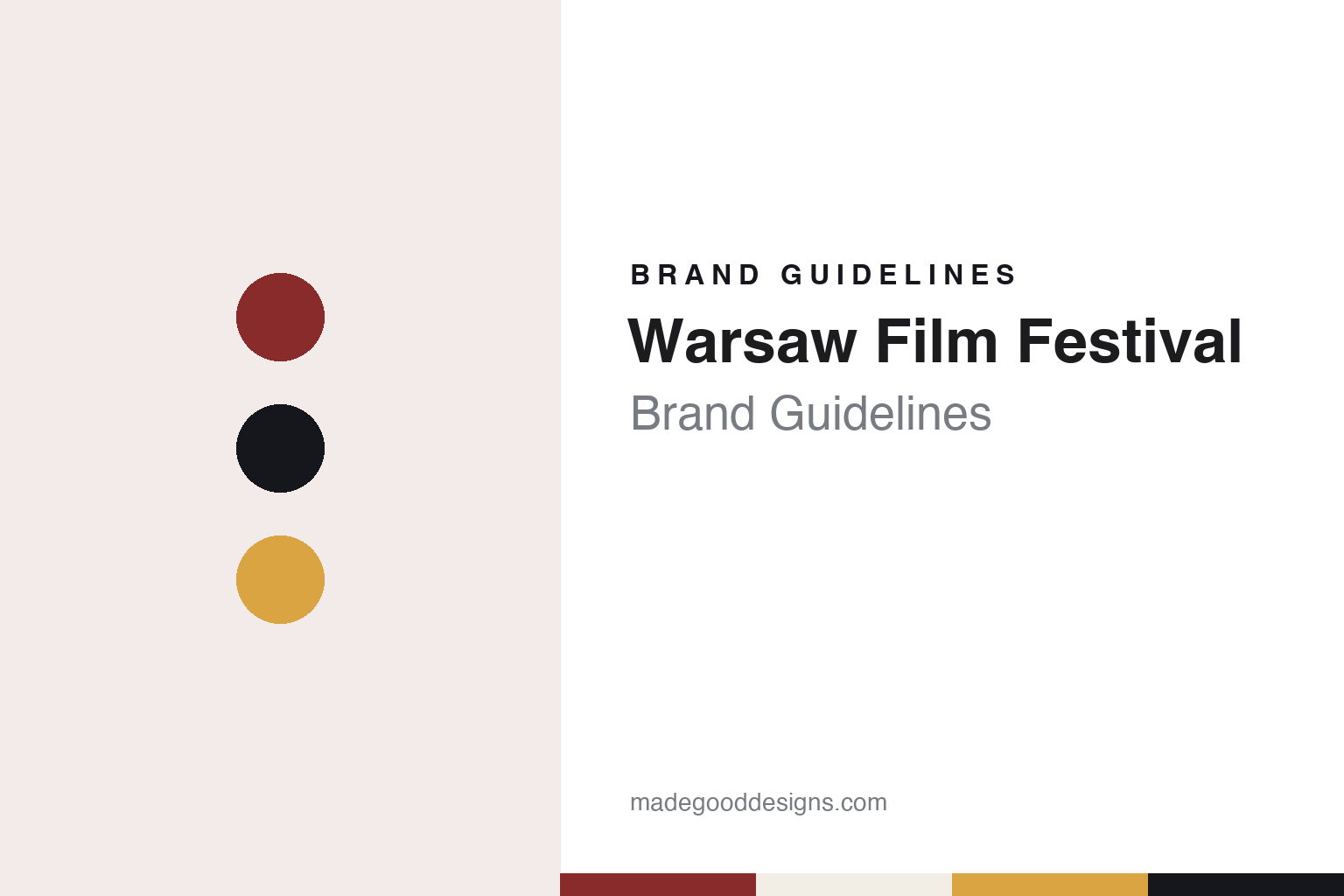
Warsaw Film Festival Brand Guidelines
From a 1985 film week to an October festival across eight Warsaw venues.
Aa
Two constants: a curtain red and projector amber palette and a Festival sans register. Abstract homage — not a Warsaw Film Festival poster or mark; no logo, poster or film still is reproduced.
Warsaw Film Week
A film club’s week in 1985.
The Warsaw Film Festival began in 1985 as Warsaw Film Week. Polish Wikipedia gives its Polish name as Warszawski Tydzień Filmowy and says it was organised by the film discussion club at Hybrydy, a Warsaw student club. A 2010 report for FIPRESCI, the international federation of film critics, says that the club’s member Roman Gutek founded the week and became its first director, and that Hybrydy belonged to the federation of Polish film clubs set up in the mid-1950s. Polish Wikipedia says Gutek led it until 1990.
The name changed twice. In 1991, the FIPRESCI report says, Stefan Laudyn took over and renamed the event the Warsaw Film Festival; in 2000 it changed its name again, to the Warsaw International Film Festival. English Wikipedia, in its timeline, dates the move to the present organiser to 1995, when the Warsaw Film Foundation (Warszawska Fundacja Filmowa) ran the festival for the first time; Polish Wikipedia gives the same year. Laudyn led the festival from 1991 for more than three decades, according to Polish Wikipedia.
The names still sit side by side. English Wikipedia uses “Warsaw Film Festival” and the short form WFF, and gives “Warsaw International Film Festival” as an alternative; Polish Wikipedia’s article is titled Warszawski Międzynarodowy Festiwal Filmowy. In November 2026 the festival’s own website, at wff.pl, was titled “WIFF – Warszawski Międzynarodowy Festiwal Filmowy”, and Polskie Radio’s English service used WIFF in October 2025. This guide uses the name Warsaw Film Festival, with WFF and WIFF as the two short forms in use.
The festival is held every October. English Wikipedia gives the 40th edition as 11 to 20 October 2024, and Polskie Radio reported that the 41st opened on Friday 10 October 2025 and ran until 19 October. The same report, written for the 26th edition in 2010, noted that few international festivals were then held in capital cities, which made Warsaw’s case unusual among the events he compared.
Colour
Competitions, a public vote and eight venues.
The programme is organised in competitions and non-competitive strands. English Wikipedia lists the International Competition; the 1–2 Competition, for first and second features; the Free Spirit strand for independent fiction and documentary; a Documentary Competition; and a Shorts Competition for narrative, documentary and animated films of up to 40 minutes. Its main award is the Warsaw Grand Prix: Polskie Radio reported in October 2025 that fifteen premiere titles were competing for it in the International Competition.
The 2025 edition added new strands. The Argentine film magazine Caligari reported a line-up of 112 features and 56 shorts, and named Encounters, a section of titles from other festivals such as Cannes, Venice, Locarno and Toronto; Animus. Cinema of Values, a new strand of films on social responsibility; Cinema in the Clouds, screenings on the 46th floor of the Varso Tower; Boom Generation screenings for older audiences; a Family Film Weekend; and a concert of Polish film music played by the ensemble DesOrient. It also reported that the festival launched Warsaw Industry Days, from 13 to 18 October 2025, with co-production forums, workshops and networking for Central and Eastern European filmmakers.
Encounters has a local echo. In an interview with Rzeczpospolita on 10 October 2025, the festival’s programme director, Bartek Pulcyn, said the Polish name of the section, Konfrontacje, refers back to the older Warsaw review screenings of that name, which showed a season’s much-discussed films within a week. The 2010 FIPRESCI report also described those Konfrontacje screenings and said that the Warsaw Film Week had no link to them; the 2025 section borrows the name, not the organisation.
The festival is spread across the city centre. Pulcyn told Rzeczpospolita that the 2025 edition used eight venues: four screens at Kinoteka, in the Palace of Culture and Science; three at the Atlantic cinema; two at Luna; the Kinomuzeum at the Museum of Modern Art, used for industry events and the Free Spirit strand; the Sala pod Pelikanem on Krakowskie Przedmieście, for the screenings for older viewers; and the Iluzjon cinema, for a strand of classics chosen by guests. The festival club, he said, is Kulturalna, close to Kinoteka. Pulcyn had worked at the festival from 2002 to 2013 as a programmer and head of the short-film competition, he said.
Typography
The organiser behind the name.
Many film festivals carry the name of a city, but the identity often comes from the organiser behind it: a foundation, a film society, a film archive, a trust or a city cinema. That body decides the dates, the sections and the venues, and it tends to stay in place while directors, posters and slogans change from one edition to the next. Several festivals in this group began small, as a film club’s week of screenings or a national short-film festival, and widened their names and their programmes over the decades.
A recurring motif helps a festival hold together across years of changing designs. It may be an animal carried by a prize or a mascot, a statuette handed out at the closing night, a single word used as a tagline, or one colour that returns on every poster. The motif gives audiences something to recognise before they read the year or the edition number.
The annual poster and the trailer or ident shown before each screening are where the identity is renewed. Some festivals invite an artist, an illustrator or a filmmaker to make them each year; others work with a design studio on a system that lasts several editions. Venues also become part of the image: historic cinemas, open-air screens in squares, city-centre picture houses and, in some cases, rooms high up in new buildings.
Behind the image sits a practical layer that audiences use every day of a festival: the programme book or online schedule, the division into competitions and open sections, the pass or ticket system, the streaming window that some festivals now add after the cinema run, and the signage that takes people from one venue to the next. This guide looks at how each festival handles those elements, described from dated sources, without rankings or winners.
Aa
A festival sans — WFF and WIFF. (Specimen set in Archivo, a sans STAND-IN; NOT the Warsaw Film Festival logo.)
Warsaw Film Festival
A new look in 2025.
The festival changed its look for the 41st edition. Polish Wikipedia, citing Rzeczpospolita, describes a broad programme, organisational and visual reform in 2025, with new sections and a refreshed identity; Caligari called it a “completely renewed visual identity” alongside a new leadership team. Pulcyn told Rzeczpospolita that the change covered not only the poster and the website but the festival’s whole communication on social media. He also said the volunteer programme was redesigned, with volunteers looking after guests, screening rooms and the press office, and that they would include older people as well as students. The sources read for this guide do not name a designer or studio for the 2025 identity, so none is credited here.
Two images frame the festival in the sources. English Wikipedia illustrates its article with a photograph of the Palace of Culture and Science carrying a large Warsaw Film Festival poster on its façade, and the festival’s main screens at Kinoteka are inside that building. The 2025 Cinema in the Clouds strand, high up in the Varso Tower, added a second skyline image. For the audience, the practical layer is spread across the city: a festival club near the main screens, a programme split between competitions and open strands, and screenings in several cinemas within walking distance of the Palace of Culture.
Its short names also do design work. The festival has been Warsaw Film Week, the Warsaw Film Festival and the Warsaw International Film Festival, and WFF and WIFF now appear side by side in its own communication and in the press. Any graphic system for the festival has to carry both a Polish and an English name, as its website does, and a short form that reads in either language.
For a design guide, the Warsaw Film Festival shows how a festival that grew out of a film club can keep its October slot and city-centre cinemas while renewing its look. Compare the Krakow Film Festival, the Polish festival for documentary and short film, and the Karlovy Vary International Film Festival, another Central European festival with an industry programme for the region. For this guide we use a curtain red, a projector amber and a near-black with a sans, an unofficial interpretation; no product or logo is reproduced.
Explore & save
Keep Warsaw Film Festival’s identity on hand — save it to a board in the Made Good inspiration library.
Warsaw Film Festival identity set
Pin the Warsaw Film Festival curtain red and projector amber palette and the Festival sans register to your own board.
Source & notes
Frequently Asked Questions
What font can I use to match the Warsaw Film Festival look?
This guide describes Warsaw Film Festival’s type as “A festival sans — WFF and WIFF”. Its type specimen is set in Archivo from Google Fonts as a stand-in; Archivo is not Warsaw Film Festival’s own lettering.
What colours are in the Warsaw Film Festival palette?
This guide’s Warsaw Film Festival palette is Curtain red #8A2B2B, Screening-room night #16161D, Projector amber #D9A441, Programme paper #F2EEE6 and Concrete grey #8C8A86. The tones are the guide’s own unofficial interpretation, not official Warsaw Film Festival hex codes.
When was Warsaw Film Festival founded?
Warsaw Film Festival was founded in 1985 (as Warsaw Film Week), in Warsaw, Poland.
Who founded Warsaw Film Festival?
Warsaw Film Festival was founded by Roman Gutek and Hybrydy film club in 1985 (as Warsaw Film Week).