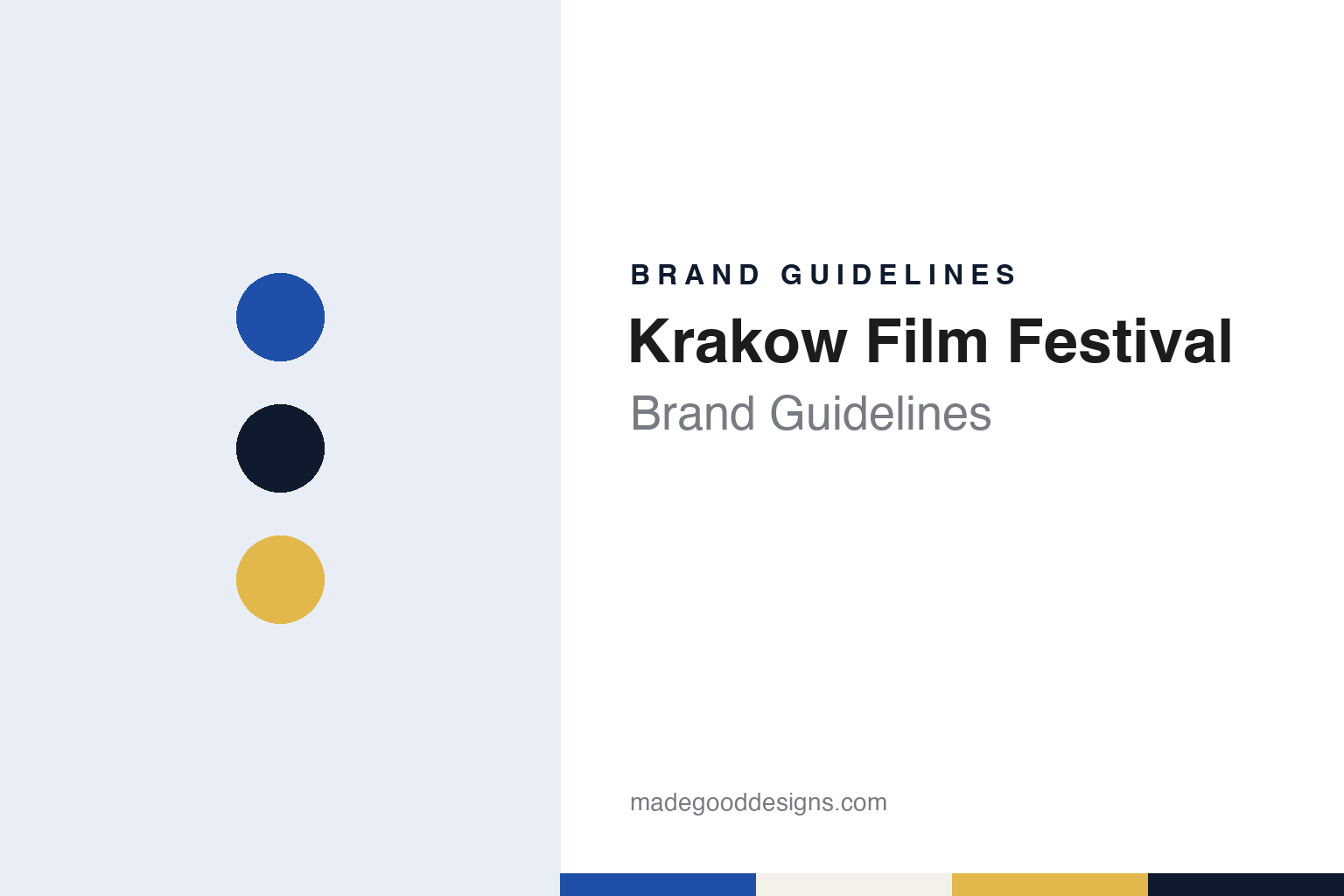
Krakow Film Festival Brand Guidelines
Documentary and short film in Kraków every year since 1961.
Aa
Two constants: a journey blue and dragon gold palette and a Layered grotesk register. Abstract homage — not a Krakow Film Festival poster or mark; no logo, poster or film still is reproduced.
A short-film festival
From a national short-film festival in 1961.
The Krakow Film Festival has been held in Kraków every year since 1961, English Wikipedia says. It is devoted to documentary, animation and short film. Its Polish name is Krakowski Festiwal Filmowy, shortened to KFF, and the festival uses both the English spelling “Krakow” and the Polish “Kraków” in its own English pages.
It began under another name. Polish Wikipedia, citing Gazeta Wyborcza in 2003, says the first edition, in 1961, was called the Ogólnopolski Festiwal Filmów Krótkometrażowych — the National Short Film Festival — and that an international competition was added three years later. The cover of a programme folder for the 28th edition, in 1991, carried the name Międzynarodowy Festiwal Filmów Krótkometrażowych, the International Short Film Festival, according to Polish Wikipedia. The national competition was paused in the early 1990s and returned in 1997, and the festival has used its present name since 2001, Polish Wikipedia says.
Its organiser is the Krakow Film Foundation (Krakowska Fundacja Filmowa), which Polish Wikipedia names as the body behind the festival; the festival’s own pages describe the foundation’s year-round work with films after the festival week. Its long-time artistic director, responsible for the film selection, was Krzysztof Gierat, Polish Wikipedia says; Interia quoted him as festival director in April 2025. In September 2025 the festival announced Barbara Orlicz-Szczypuła as director and Anita Piotrowska as artistic director, according to Polish Wikipedia, which cites the announcement.
The festival is held at the turn of May and June. Interia Film, in an article on 18 April 2025, gave the dates of the 65th edition as 25 May to 1 June 2025 in cinemas, with an online run on the festival’s streaming service, KFF VOD, from 30 May to 15 June. The festival says the 66th edition ran in cinemas from 31 May to 7 June 2026 and on KFF VOD from 5 to 18 June.
Colour
Four competitions and Kraków’s arthouse cinemas.
The programme is built around competitions. Polish Wikipedia lists four as of 2025: a documentary competition, a short-film competition, DocFilmMusic, for music documentaries, and a Polish competition. Its rules for 2025, as Polish Wikipedia summarises them, put films of up to 30 minutes into the short-film competition and films of more than 30 minutes into the documentary and DocFilmMusic competitions, while Polish documentaries of any length can enter the national one. Interia Film reported in April 2025 that nine music documentaries were selected for DocFilmMusic that year. The festival’s main award for its international short-film competition is the Golden Dragon (Złoty Smok), Polish Wikipedia says.
Around the competitions sit retrospectives, film-school screenings, student films and themed blocks, as well as concerts, workshops, debates, conferences and exhibitions, Polish Wikipedia says. In 2024 the festival’s accompanying events included an exhibition of photographs by cinematographers of the Polish Society of Cinematographers at the Academy of Fine Arts. Since 2006 the festival has run a film market for industry guests, KFF Market, according to Polish Wikipedia, to present documentaries, animation and short films to festivals, broadcasters and distributors.
The 66th edition, in 2026, gives a sense of scale. The festival says it showed 185 films in four competitions and thirteen themed sections at 207 screenings in Kraków’s arthouse cinemas, with a further 86 titles online, and that more than 33,000 people attended; a section called The Balkans in Focus brought documentaries and short films from that region.
Its venues are the city’s own cinemas. On the opening day of the 66th edition, 31 May 2026, the festival opened at 18:00 at Kino Kijów with the documentary Synthetic Sincerity, and screened competition programmes at Kino ASP, Kino Mikro and Kino Pod Baranami, where its listings name a Red Screening Room and a Blue Screening Room. The same day’s programme listed meetings with filmmakers, concerts, exhibitions and open-air cinema.
Typography
The organiser behind the name.
Many film festivals carry the name of a city, but the identity often comes from the organiser behind it: a foundation, a film society, a film archive, a trust or a city cinema. That body decides the dates, the sections and the venues, and it tends to stay in place while directors, posters and slogans change from one edition to the next. Several festivals in this group began small, as a film club’s week of screenings or a national short-film festival, and widened their names and their programmes over the decades.
A recurring motif helps a festival hold together across years of changing designs. It may be an animal carried by a prize or a mascot, a statuette handed out at the closing night, a single word used as a tagline, or one colour that returns on every poster. The motif gives audiences something to recognise before they read the year or the edition number.
The annual poster and the trailer or ident shown before each screening are where the identity is renewed. Some festivals invite an artist, an illustrator or a filmmaker to make them each year; others work with a design studio on a system that lasts several editions. Venues also become part of the image: historic cinemas, open-air screens in squares, city-centre picture houses and, in some cases, rooms high up in new buildings.
Behind the image sits a practical layer that audiences use every day of a festival: the programme book or online schedule, the division into competitions and open sections, the pass or ticket system, the streaming window that some festivals now add after the cinema run, and the signage that takes people from one venue to the next. This guide looks at how each festival handles those elements, described from dated sources, without rankings or winners.
Aa
A layered grotesk — KFF and INSIDER. (Specimen set in Space Grotesk, a sans STAND-IN; NOT the Krakow Film Festival logo.)
Krakow Film Festival
INSIDER, film stills and a vivid blue.
The festival documents its own visual identity in some detail. On 18 March 2026 it presented a new identity created with the Kraków design studio Weird Gentlemen. It said the graphic design was rooted in the INSIDER concept, a word it says it has used to describe the festival since 2022, and that the new design uses film stills to spark curiosity, with the Insider tagline inviting the audience into the stories on screen. In the same announcement, Piotrowska described a vivid blue as the main colour of the palette and a motif of the journey, meant to invite audiences to discover places, characters and aesthetics through cinema. The studio’s concept, the festival said, rests on layers in the image, with a tension between flatness and depth.
Its posters have their own history. The same 2026 announcement mentions an anniversary mural in Kraków composed of posters from past editions, which the festival cites as evidence of a recognisable visual character over the years. Polish Wikipedia illustrates its article with a photograph of festival banners on Kraków’s Main Market Square in 2011. Its pass names follow the same word: for the 66th edition it sold a limited Valentine’s offer of LOVE_INSIDER packages, and its 2026 photographs show a festival café in the Małopolska Garden of Arts and audiences, called Insiders, at the Kijów cinema.
The festival also works outside its June week. It says films from its competitions travel to Gdynia under a programme called “KFF na fali,” that Polish documentaries tour arthouse cinemas across Poland under “insider w trasie,” and that it runs a podcast, KFF Talks, and a European network for teenage audiences called Docs4Teens. For audiences, the practical layer is a programme split into competitions and themed sections, a streaming window after the cinema run, and a set of venues that are Kraków’s own arthouse cinemas rather than a single festival centre.
For a design guide, the Krakow Film Festival shows how a festival can tie its identity to one word, one colour and an archive of posters built up over more than six decades. Compare the Warsaw Film Festival, the October festival in Poland’s capital, and Hot Docs, another festival built around documentary film. For this guide we use a journey blue, a dragon gold and a deep navy with a sans, an unofficial interpretation; no product or logo is reproduced.
Explore & save
Keep Krakow Film Festival’s identity on hand — save it to a board in the Made Good inspiration library.
Krakow Film Festival identity set
Pin the Krakow Film Festival journey blue and dragon gold palette and the Layered grotesk register to your own board.
Source & notes
Frequently Asked Questions
What font can I use to match the Krakow Film Festival look?
This guide describes Krakow Film Festival’s type as “A layered grotesk — KFF and INSIDER”. Its type specimen is set in Space Grotesk from Google Fonts as a stand-in; Space Grotesk is not Krakow Film Festival’s own lettering.
What colours are in the Krakow Film Festival palette?
This guide’s Krakow Film Festival palette is Journey blue #1F4FA8, Night screening #0F1A2E, Dragon gold #E2B84C, Poster paper #F4F1EA and Brick red #A4442F. The tones are the guide’s own unofficial interpretation, not official Krakow Film Festival hex codes.
When was Krakow Film Festival founded?
Krakow Film Festival was founded in 1961, in Kraków, Poland.