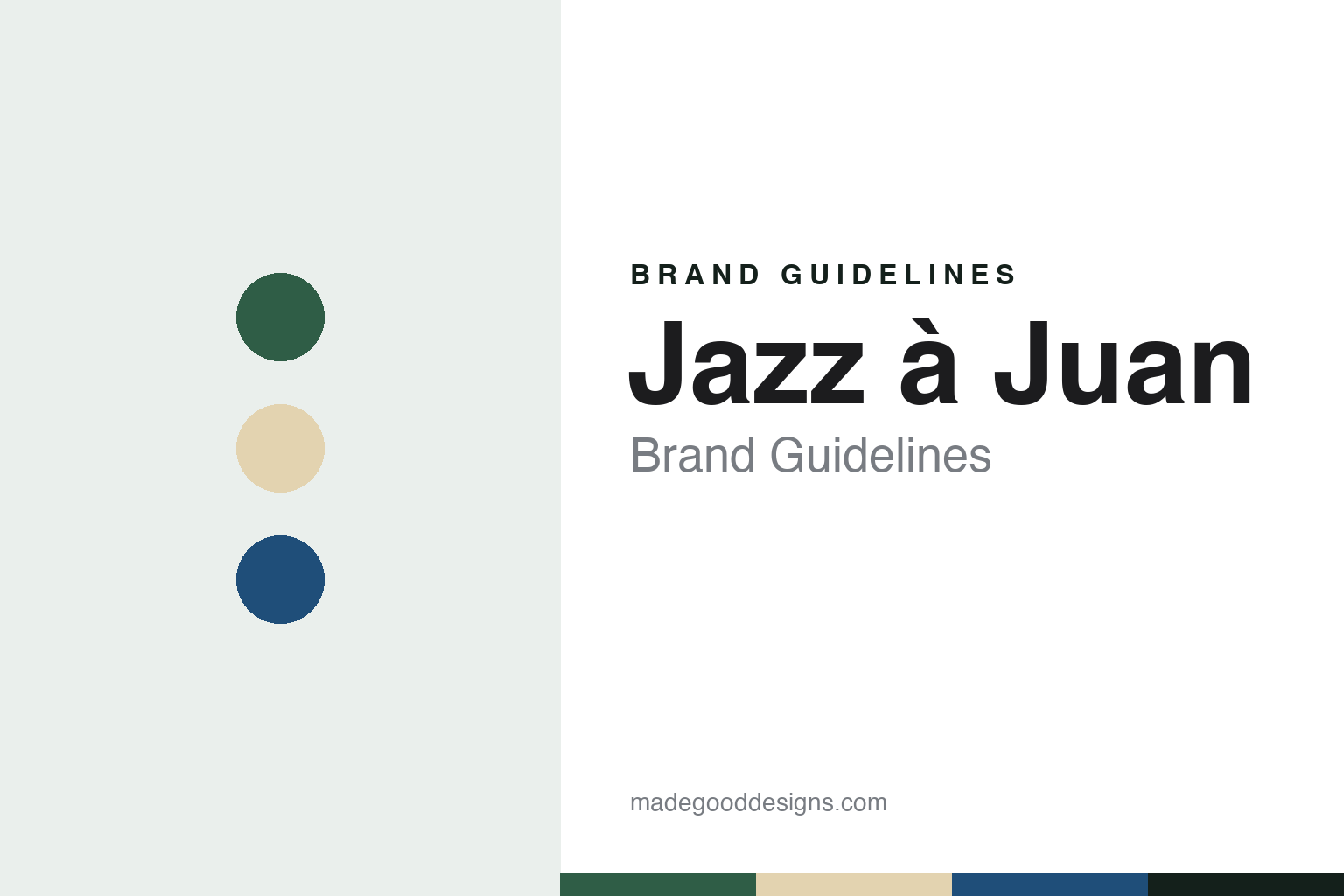
Jazz à Juan Brand Guidelines
A July jazz festival under the pines, with the Mediterranean behind the stage since 1960.
Aa
Two constants: a pine green, shore sand and bay blue palette and a geometric sans register. Abstract homage — not a Jazz à Juan poster or mark; no logo, artwork or handprint tile is reproduced.
A European festival in 1960
Two founders, a competition and a concert under the pines.
The festival now called Jazz à Juan opened on 7 July 1960 in Antibes Juan-les-Pins, on the coast between Nice and Cannes. Its founders were Jacques Souplet and Jacques Hebey, working with the support of the town’s mayor, according to both the festival’s history page and the national audiovisual archive INA. INA’s regional archive keeps an ORTF television report broadcast on 20 July 1970, at the eleventh festival, in which Hebey, described as co-organiser, recalls how the festival was set up in 1960 and presents that year’s programme.
The first edition had a different name and a different format. INA’s accompanying essay says it was first called the Premier Festival Européen du Jazz and brought together orchestras from thirteen European countries competing to be named the top European jazz group, with the United States as guest of honour, represented by musicians including Charles Mingus and Dizzy Gillespie. French Wikipedia adds that the first festival ran over nine evenings and included the final of an amateur jazz tournament organised by French radio and television; English Wikipedia gives the early name as “Festival Européen de Jazz” and says the concerts were recorded and broadcast on radio each evening. Mingus’s 1960 set, the local magazine Riviera Buzz wrote in June 2025, is preserved on the album Mingus at Antibes.
The site was settled in that first summer. The festival says the 1960 concerts were held at two places at once, the Fort Carré stadium in Antibes and the Pinède Gould, a pine grove in Juan-les-Pins, and that from a concert on 10 July 1960 given in homage to the saxophonist Sidney Bechet, the pine grove became the place musicians and organisers preferred. From the second edition the festival was held only in Juan-les-Pins, it says, with a few concerts over the years moved to the town’s Palais des Congrès. In 2025 the festival described the grove as having 3,000 seats.
Colour
The tourist office as organiser, and a programme spread across the town.
The festival’s years in the early 1970s are briefly told. INA’s essay says that the 1971 and 1972 editions were held by Nice and that from 1973 the festival was back in Juan and its pine grove; the festival’s own history says simply that it was not held in the early 1970s. French Wikipedia records that in 1973 it was relaunched in Juan-les-Pins by the producer Norbert Gamsohn as artistic director, who widened the range of styles on the bill and began television broadcasts of the concerts.
The organiser is a public tourism body. The festival says that since 1971 its management has been entrusted to the town’s Maison du Tourisme, which became the Office de Tourisme et des Congrès of Antibes Juan-les-Pins and is the producer and organiser of the whole event; the festival website is published by that tourist office. French Wikipedia records how the artistic side has been run under it: in 2001 the office put the artistic direction out to tender; in 2010, the fiftieth anniversary, the contract for organising the festival went to SAMES, an entertainment subsidiary of the Société des Bains de Mer de Monaco; and since 2021 a trio of artistic advisers has shaped the programme.
The festival is held over about ten days in mid-July. The 64th edition ran from 10 to 20 July 2025, according to the festival’s 2025 announcement on the Europe Jazz Network site and Riviera Buzz, and the 2026 programme ran from 9 to 20 July. The festival says it was not held in 2020. English Wikipedia notes that during the 61st festival, in 2022, New Orleans became a sister city of Antibes.
Around the main stage the programme reaches across the town. The 2026 schedule lists the Jammin’Summer session, an early-evening concert of a young or lesser-known group each night at the Petite Pinède, a smaller pine grove nearby, with two evening concerts on the Plateau de la Garoupe on Cap d’Antibes added in 2026; morning concerts and talks at the Médiathèque Albert Camus in Antibes; and a late Jazz Club after the main concerts. Many of those young groups, the festival says, were first heard at Jammin’Juan, the professional jazz market that French Wikipedia says the tourist office created in 2017 and that is held in the autumn.
Typography
Design and documentation.
A jazz festival rarely owns the ground it stands on, yet the ground often does most of the work of making it recognisable. An open-air amphitheatre, a grove of pines by the sea, a park beside a river, a village square under a marquee or a whole small town handed over for a week in summer: audiences remember the setting long after a particular evening’s line-up has blurred, and the festival name tends to fuse with the name of the place.
Inside that setting, stages are given names of their own, after a garden, a building, a street or a hall, and those names become part of the vocabulary regulars use when they plan a day. The annual poster does a similar job over time. Many festivals commission a different illustrator, painter or designer every year, so a run of posters becomes a visual archive that collectors keep and that the festival itself often reprints, exhibits or sells.
Behind the name there is usually a founder or a small founding group, and later an organisation that keeps it going: a non-profit association, a foundation, a tourist office or a public cultural body linked to the town. Changes in that structure seldom change what audiences see, but they shape who books the music, who commissions the poster and who looks after the archive of past editions.
Then there is the practical layer, the part visitors handle with their own hands. Printed programme books and day-by-day schedules, wristbands and passes, site maps, information points, signs that point from one stage to the next, and now festival apps all carry the same name, colours and lettering. This guide looks at how each festival’s identity holds together across those pieces, and keeps to what dated sources record about them.
Aa
A geometric sans for stage names and day schedules. (Specimen set in Josefin Sans, a sans STAND-IN; NOT the Jazz à Juan logo.)
Pines, sea and handprints
A stage under the trees and a pavement of handprints.
In the festival’s own telling, the setting carries much of its image. Its history page describes the main stage as sitting under century-old pines with the Mediterranean behind it, and its access guide places the Pinède Gould about ten minutes’ walk from Juan-les-Pins station. The name of the grove, the festival and the town have travelled together for more than six decades: English Wikipedia notes that the festival, later named Jazz à Juan, was long referred to in the press as the Antibes Jazz Festival, and many of the live albums listed on the festival’s own history page carry the name Antibes or Juan-les-Pins in their titles.
A second image is the line of handprints. French Wikipedia says that between 1992 and 2000 moulds were taken of visiting musicians’ hands, an idea of the then director of the tourist office, who, it says, was also behind the stars’ handprints at the Palais des Festivals in Cannes; the practice was revived in 2021 for the 60th festival. English Wikipedia describes the result: ceramic tiles with the handprints of more than 50 musicians set into the pavement of the Boulevard Édouard Baudoin, which runs behind the seaside stage. The festival’s 2025 announcement links the two images, saying that artists have left on the pine grove not only memories but their handprints.
The festival also keeps its own lineage in view. Its history page lists the recordings made at its concerts since the 1960s, and quotes the founder of the Montreux Jazz Festival as saying that Montreux would not exist if he had not passed through Antibes.
The practical layer follows the town’s geography. The festival’s schedule is organised by stage, from the Pinède Gould to the Petite Pinède, the Plateau de la Garoupe and the Médiathèque, and its access pages direct visitors by train, bus and bicycle to the entrance of the grove, where bicycle parking is provided.
For a design guide, Jazz à Juan shows how a festival can be carried by a single outdoor site, a pine grove by the sea, with a pavement of handprints turning its history into something visitors walk over. Compare Cannes Film Festival, whose Palais des Festivals has its own handprints of stars, and Jazz à Vienne, another French summer jazz festival with an open-air main stage. For this guide we use a pine green, a shore sand and a bay blue with a sans, an unofficial interpretation; no product or logo is reproduced.
Explore & save
Keep Jazz à Juan’s identity on hand — save it to a board in the Made Good inspiration library.
Jazz à Juan identity set
Pin the pine green, shore sand and bay blue palette and the geometric sans register to your own board.
Source & notes
Frequently Asked Questions
What font can I use to match the Jazz à Juan look?
This guide describes Jazz à Juan’s type as “A geometric sans for stage names and day schedules”. Its type specimen is set in Josefin Sans from Google Fonts as a stand-in; Josefin Sans is not Jazz à Juan’s own lettering.
What colours are in the Jazz à Juan palette?
This guide’s Jazz à Juan palette is Pine green #2F5D46, Night ink #14201B, Shore sand #E3D3B0, Bay blue #1F4E79 and Paper #F6F4EE. The tones are the guide’s own unofficial interpretation, not official Jazz à Juan hex codes.
When was Jazz à Juan founded?
Jazz à Juan was founded in 1960, in Antibes Juan-les-Pins, France.
Who founded Jazz à Juan?
Jazz à Juan was founded by Jacques Souplet and Jacques Hebey in 1960.


