Lumiere Brand Guidelines
Durham’s biennial light festival, produced by Artichoke from 2009 to 2025.
Aa
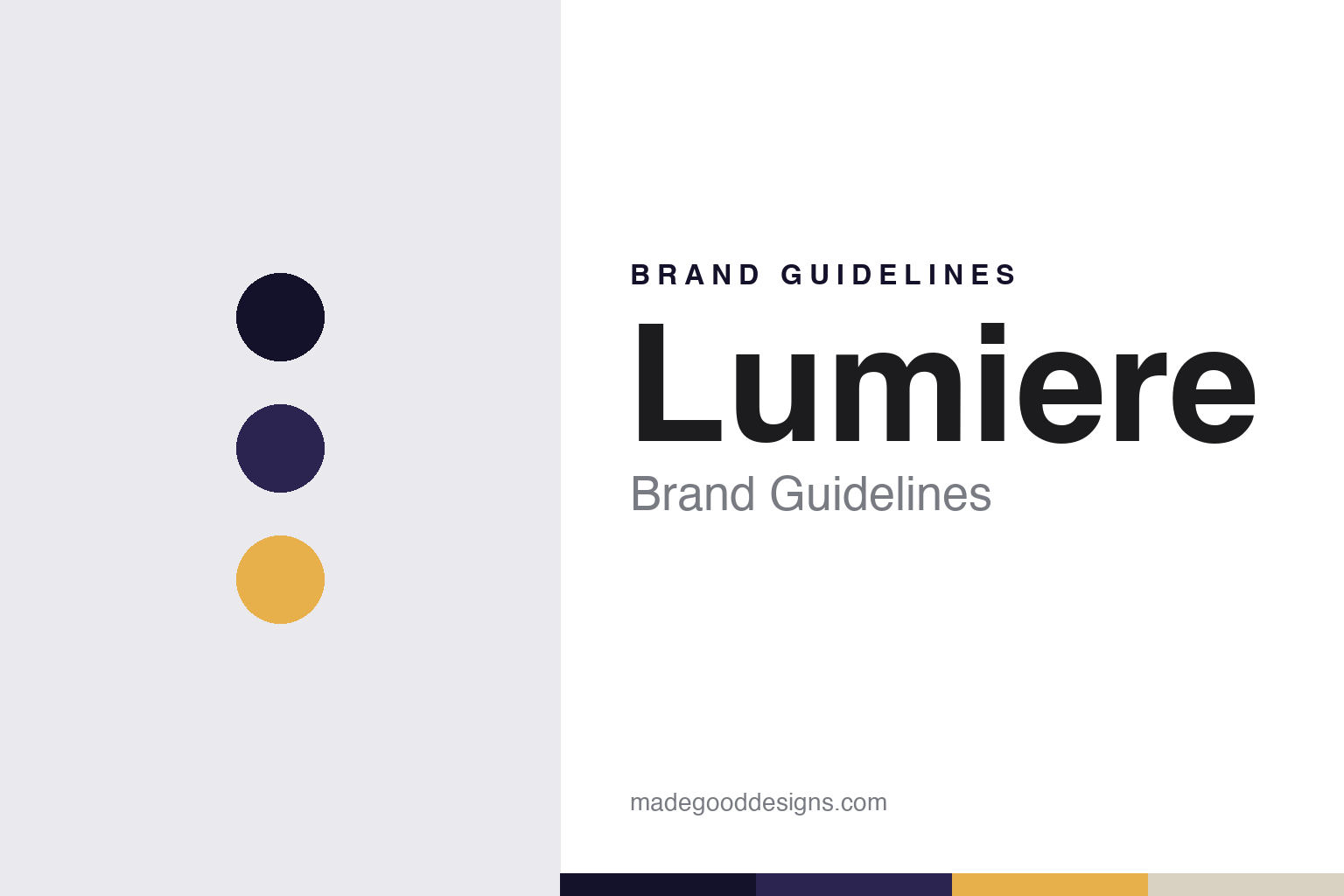
Two constants: a night indigo, lantern gold and stone palette and a lantern serif register. Abstract homage — not a Lumiere poster, artwork or mark; no logo, photograph or installation is reproduced.
A light festival for a medieval city
Planned as a one-off, it became a biennial.
Lumiere was a light festival in Durham, in the north-east of England, produced by the arts producer Artichoke and commissioned by Durham County Council. Artichoke’s own project pages title each edition “Lumiere Durham” followed by the year, and that is the form often used to tell the Durham event apart from its touring editions. The festival was free to attend and took place in winter, over three or four evenings in November, English Wikipedia says; that article also says it was partly inspired by Lyon’s Fête des Lumières.
The first edition ran from 12 to 16 November 2009. Artichoke says it was part of the 2009 Sky Arts Artichoke Season and was originally planned as a one-off. It counts 22 installations that year, among them neon works, projections and fire, and puts attendance at about 75,000. The centrepiece was a son et lumière projection on Durham Cathedral, Crown of Light, which Artichoke says drew on the Lindisfarne Gospels; inside the cathedral the London studio United Visual Artists swung eight large pendulums beneath the vaulted ceiling, and the Durham University Botanic Garden held a separate trail of works.
The festival came back in November 2011, and from then on ran every other year. Artichoke lists 35 installations for that second edition across the city’s buildings, streets and bridges, including a colour-changing waterfall of light on Kingsgate footbridge and a giant snow globe placed over a statue in the Market Place, with the French company Compagnie Carabosse bringing flame-lit structures into the cathedral grounds. The same year saw the start of BRILLIANT, an open call that invited people from the region to propose light installations of their own; Artichoke says four proposals were selected in 2011, and the scheme continued at later editions. English Wikipedia notes a 3D projection of a walking elephant over Elvet Bridge at the 2013 edition.
Colour
Durham, Derry~Londonderry and London.
Durham editions followed in 2013, 2015, 2017, 2019, 2021 and 2023, each in mid-November, according to Artichoke’s list of projects. English Wikipedia says that in 2021, for the first time, artworks were spread across County Durham rather than gathered in the city centre. In 2023 Artichoke added a “Spotlight on Bishop Auckland” strand in the county; it lists 40 artworks from 15 countries for that edition and an estimated 160,000 visitors. The 2023 programme included Liquid Geometry by the Spanish artist Javier Riera, an abstract work projected across Durham Cathedral and the buildings beside it.
The festival also travelled. From 28 November to 1 December 2013 it went to Derry~Londonderry, commissioned as the closing event of the city’s year as UK City of Culture. Artichoke lists 17 artworks there; one, by a British artist, spelled out the words “A Stitch in Time” on the roof of the Rosemount Shirt Factory as a reference to the city’s shirt-making industry, and Compagnie Carabosse built a fire garden in St Columb’s Park, a work English Wikipedia also records.
Lumiere London followed from 14 to 17 January 2016, supported by the Mayor of London. Artichoke lists 30 installations across the West End and King’s Cross, with Regent Street and Oxford Circus closed to traffic for works strung between buildings, and colour projected onto the west front of Westminster Abbey. A second London edition ran from 18 to 21 January 2018; English Wikipedia says it put more than 50 works on show across King’s Cross, Fitzrovia, Mayfair, the West End, Westminster, Victoria, the South Bank and Waterloo.
Across all these editions the pattern was the same: a short run of evenings, a walking route through a historic centre, projections on the main landmark, and smaller works in streets, gardens, courtyards and on bridges. Community commissions ran alongside the invited artists, from lanterns made with schools to the BRILLIANT works chosen from public proposals.
Typography
Light festivals as a genre.
Light festivals usually name themselves in one of two ways. Some join a city’s name to a word for light, as Lyon’s Fête des Lumières and the Festival of Lights in Berlin do; others use a coined word, as Vivid Sydney and GLOW Eindhoven do, with the city added alongside. Most are held on autumn or winter evenings, when it is dark early: Lyon’s festival runs over four evenings around 8 December, while Sydney’s takes place in May and June, the start of the southern winter.
The organisers are mostly public bodies. The Fête des Lumières is organised by the City of Lyon, and Vivid Sydney is owned, managed and produced by Destination NSW, the New South Wales Government’s tourism and major events agency. Other festivals are run by foundations, non-profit organisations or production companies working with their city.
The format is broadly shared. Visitors follow a route of installations through a city centre, usually on foot, and the largest works are projections on landmark buildings: a cathedral, a town hall, an opera house. The works come from invited artists, lighting designers and studios, and many festivals name each work and its makers in a printed or online programme and on a map of the route.
Each edition brings new works and, often, a new theme, poster or campaign image, so a festival’s look can change completely from year to year while its name, its route and its main buildings stay the same. This guide sets out what can be checked about each festival: who started it and when, who organises it now, where it takes place and how its works and imagery are described in dated sources.
Aa
A warm, lantern-lit serif for a festival of evenings in a cathedral city. (Specimen set in Fraunces, a serif STAND-IN; NOT the Lumiere logo or festival typeface.)
The final edition
Three nights in November 2025.
The ninth and last Durham edition ran from 13 to 15 November 2025, a night shorter than most earlier editions. In October 2025 the organisers announced that it would be the final Lumiere, after a review by Durham County Council, The Art Newspaper reported on 14 November 2025, describing a run of 16 years and nine festivals, all free to attend. Helen Marriage, the director of Artichoke, spoke to the paper about the decision. Artichoke says the 2025 edition showed about 30 artworks by artists from 11 countries and drew an estimated 120,000 visitors over its three nights; The Art Newspaper gives an estimate of 1.3 million visitors across all nine Durham festivals.
The 2025 programme was built around Durham as a place of sanctuary, Artichoke says. Its works included Elysium Garden, a large forest of illuminated flowers and plants by the UK studio Jigantics, set in front of the cathedral; a light-and-sound piece inside the cathedral; and As Water Falls by the Canadian studio Iregular, a work that had also been shown at Prague’s Signal Festival in 2023. A further strand went to Shildon, where three installations were set around the Locomotion railway museum in the year of the 200th anniversary of the passenger railway. The Art Newspaper noted that several works from earlier editions remain in Durham as permanent installations.
Visually, Lumiere was carried less by a fixed logo than by its images: photographs of the cathedral washed in projected colour, crowds on the river bridges and single works glowing against old stone. Artichoke’s pages credit each photograph to its photographer and each work to its artist, and present the festival edition by edition, with dates, a lead image and a short list of figures. The name itself, the French word for light written without an accent, was used for every edition, with the host city added after it.
For a design guide, Lumiere shows how a festival identity can rest on one city’s skyline and a steady name while every edition changes its artists. Compare the Fête des Lumières in Lyon and Signal Festival in Prague. For this guide we use night indigo, lantern gold and a pale stone with a serif, an unofficial interpretation; no product or logo is reproduced.
Explore & save
Keep Lumiere’s identity on hand — save it to a board in the Made Good inspiration library.
Lumiere identity set
Pin the Lumiere night indigo, lantern gold and stone palette and the lantern serif register to your own board.
Source & notes
Frequently Asked Questions
What font can I use to match the Lumiere look?
This guide describes Lumiere’s type as “A warm, lantern-lit serif for a festival of evenings in a cathedral city”. Its type specimen is set in Fraunces from Google Fonts as a stand-in; Fraunces is not Lumiere’s own lettering.
What colours are in the Lumiere palette?
This guide’s Lumiere palette is Night indigo #2B2350, Midnight #14112A, Lantern gold #E8B04A, Cathedral stone #D9D2C3 and Paper #F7F4EE. The tones are the guide’s own unofficial interpretation, not official Lumiere hex codes.