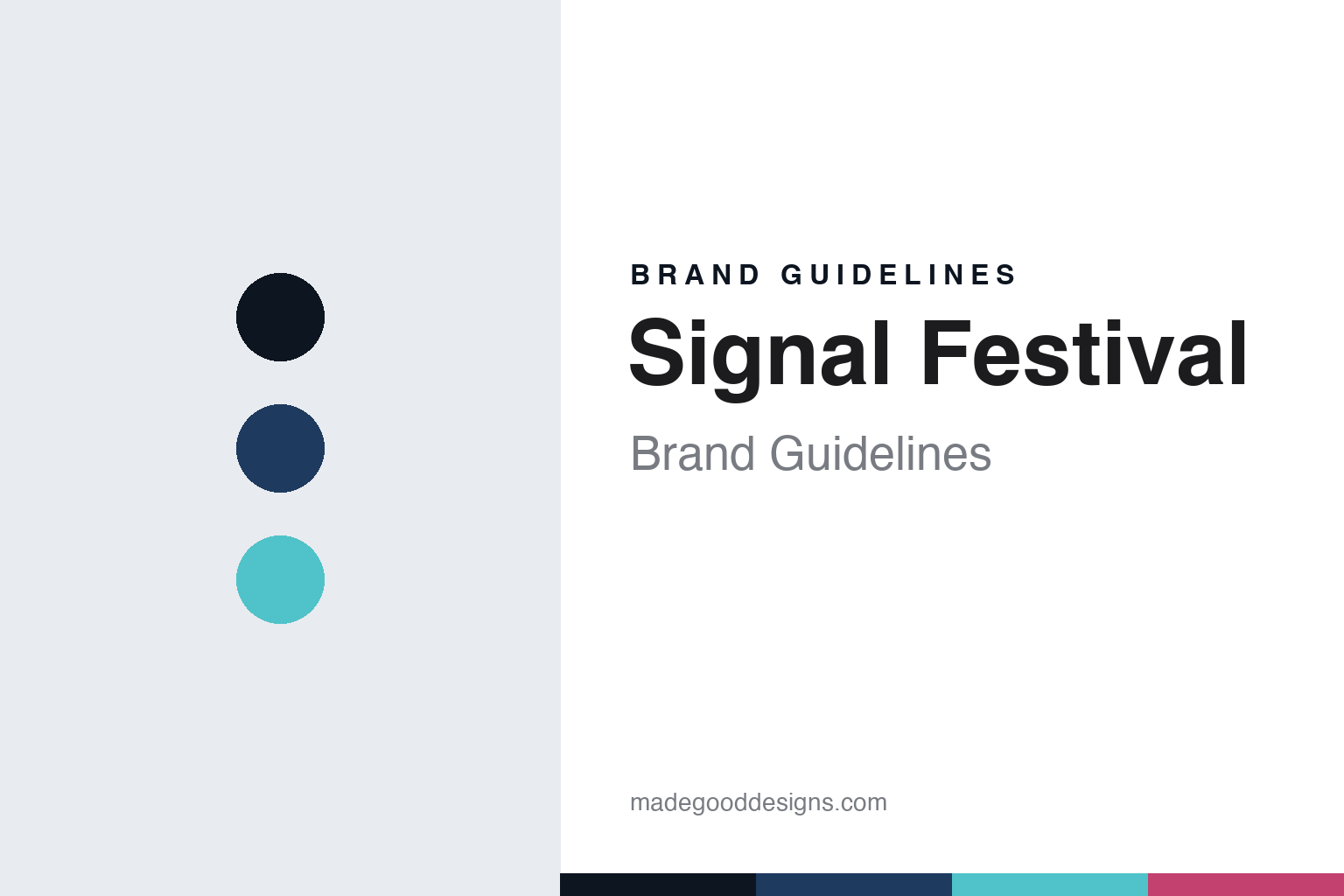
Signal Festival Brand Guidelines
Prague’s October festival of light and digital art, since 2013.
Aa
Two constants: a night blue, cyan and magenta palette and a grotesque sans register. Abstract homage — not a Signal Festival poster, artwork or mark; no logo, photograph or installation is reproduced.
From a clock to a festival
A 2010 videomapping led to a festival.
Signal Festival is a festival of light and digital culture held in Prague for four days each October, every year since 2013, Czech Wikipedia says. The festival describes itself as a showcase of digital and creative culture that turns the city into an open-air gallery of contemporary art, with works in light design, visual and digital art and conceptual art. It is organised by the Prague company Signal Production, which also runs the festival’s website and newsletter.
The festival was founded by the producer Martin Pošta, the curator Jan Rolník and the artist Amar Mulabegovič. The festival’s own history names Mulabegovič’s art group as The Macula; Czech Wikipedia names it as Hyperbinary. Both sources trace the idea to a videomapping made in 2010 for the 600th anniversary of the Prague Astronomical Clock on the Old Town Square, after which the founders set out to present light art in the Czech Republic through a festival. Czech Wikipedia says preparations for the first edition took about three years, with support from the City of Prague and the city districts of Prague 1 and Prague 2.
The first edition, in 2013, spread across 32 places in the centre of Prague, according to Czech Wikipedia, with four videomappings and 34 further light installations, and drew more than a quarter of a million visitors by the same account. Czech artists made up much of that first programme. In 2014 the festival ran from 16 to 19 October, each evening from seven until midnight, and in 2015 from 15 to 18 October, with 21 light installations and three videomappings, among them a 3D work by the Turkish studio OUCHHH, Czech Wikipedia says.
Colour
Routes, districts and a gallery zone.
The festival grew by adding routes and districts. In 2016, held from 13 to 16 October, it added a daytime programme for children for the first time, Czech Wikipedia says, with 23 installations mainly in Prague 1 and smaller groups in Prague 2 and 3. In 2017 it ran on two routes, one through the Old Town and New Town and one through Vinohrady, and introduced Signal Calling, a section chosen from an open call to show work by emerging Czech artists. That year it also replayed earlier videomappings on the Church of St Ludmila on Náměstí Míru, a façade that recurs in the festival’s history. In 2018 a third route opened in Karlín.
The 2019 edition took “revolution” as its theme. The 2020 edition did not take place. The festival returned from 14 to 17 October 2021 under the theme “Plan C”, with routes in Karlín, the Old Town and, for the first time, Holešovice, and about 15 street installations alongside works in augmented reality, by Czech Wikipedia’s account. In 2022 the French collective AV Extended opened the festival with a projection on the basilica of St Ludmila, and 15 installations ran on two routes, Centre and Vinohrady–Vršovice.
In 2024, from 10 to 13 October, the festival used the grounds of Prague Castle for the first time, with one route through Hradčany and another in the city centre, and 22 installations, seven of them in a ticketed Gallery Zone, Czech Wikipedia says. One videomapping was projected on the Archbishop’s Palace on Hradčany Square, another on the Municipal Library, and the London studio United Visual Artists showed a multimedia installation at the Kunsthalle Praha.
The 2025 edition, the thirteenth, ran from 16 to 19 October. Brno Daily reported on 8 October 2025 that it would have two routes, Centre and Vinohrady, with 13 free outdoor installations and seven ticketed works in a new indoor programme, Signal INSIDE, set in interiors such as a former riding hall, the St Agnes Convent and a school chapel. The Italian studio MammasONica projected a work across the roughly 70-metre tower of the Old Town Hall, and the Spanish collective V.P.M. returned to the basilica of St Ludmila, Expats.cz and Brno Daily reported. The 2026 edition ran from 15 to 18 October on two routes, Dejvice and the centre, under the theme “Dream On!”.
Typography
Light festivals as a genre.
Light festivals usually name themselves in one of two ways. Some join a city’s name to a word for light, as Lyon’s Fête des Lumières and the Festival of Lights in Berlin do; others use a coined word, as Vivid Sydney and GLOW Eindhoven do, with the city added alongside. Most are held on autumn or winter evenings, when it is dark early: Lyon’s festival runs over four evenings around 8 December, while Sydney’s takes place in May and June, the start of the southern winter.
The organisers are mostly public bodies. The Fête des Lumières is organised by the City of Lyon, and Vivid Sydney is owned, managed and produced by Destination NSW, the New South Wales Government’s tourism and major events agency. Other festivals are run by foundations, non-profit organisations or production companies working with their city.
The format is broadly shared. Visitors follow a route of installations through a city centre, usually on foot, and the largest works are projections on landmark buildings: a cathedral, a town hall, an opera house. The works come from invited artists, lighting designers and studios, and many festivals name each work and its makers in a printed or online programme and on a map of the route.
Each edition brings new works and, often, a new theme, poster or campaign image, so a festival’s look can change completely from year to year while its name, its route and its main buildings stay the same. This guide sets out what can be checked about each festival: who started it and when, who organises it now, where it takes place and how its works and imagery are described in dated sources.
Aa
A grotesque sans with a technical edge, for a festival of projections and screens. (Specimen set in Space Grotesk, a sans STAND-IN; NOT the Signal Festival logo or festival typeface.)
Signal beyond October
A gallery in the Old Town Market Hall.
In October 2025 the festival opened Signal Space, a permanent gallery of digital and immersive art in the former Old Town Market Hall in central Prague, Czech Wikipedia says; Expats.cz described the market hall as a 19th-century building and the gallery as a year-round space. The festival says the Signal name now also covers Signal Forum, an educational programme with regular conferences, and Signal Creative, a creative agency through which festival works have been shown abroad. It says it has commissioned more than seventy original site-specific works for the festival.
Works also travel between festivals. The Canadian studio Iregular showed As Water Falls at Signal Festival in 2023, according to the festival’s photo credits, and the same work later appeared at Durham’s Lumiere in 2025, according to its producer, Artichoke. The festival says Pošta has also curated events in cities including Bucharest, Helsinki and Miami.
Visually, Signal presents itself through photographs of its works at night: façades covered in projected pattern, sculptures of light in squares and parks, and interiors filled with screens. The festival’s website shows each edition with a photo report and credits every image to its photographer and every work to its artist or studio, followed by the edition’s routes and installations. The name stays short and plain, used with the year, and each edition carries its own theme, from “revolution” in 2019 to “Plan C” in 2021 and “Dream On!” in 2026, with the festival’s name in English on both its Czech and English pages.
For a design guide, Signal Festival shows how a light festival can lean on digital art and projection while keeping a historic city as its frame. Compare Lumiere in Durham and Lux Helsinki. For this guide we use a night blue, a projection cyan and a magenta with a sans, an unofficial interpretation; no product or logo is reproduced.
Explore & save
Keep Signal Festival’s identity on hand — save it to a board in the Made Good inspiration library.
Signal Festival identity set
Pin the Signal Festival night blue, cyan and magenta palette and the grotesque sans register to your own board.
Source & notes
Frequently Asked Questions
What font can I use to match the Signal Festival look?
This guide describes Signal Festival’s type as “A grotesque sans with a technical edge, for a festival of projections and screens”. Its type specimen is set in Space Grotesk from Google Fonts as a stand-in; Space Grotesk is not Signal Festival’s own lettering.
What colours are in the Signal Festival palette?
This guide’s Signal Festival palette is Vltava blue #1E3A5F, Night #0D1520, Projection cyan #4FC3C9, Signal magenta #C2416E and Paper #F5F5F2. The tones are the guide’s own unofficial interpretation, not official Signal Festival hex codes.
When was Signal Festival founded?
Signal Festival was founded in 2013, in Prague, Czech Republic.
Who founded Signal Festival?
Signal Festival was founded by Martin Pošta, Jan Rolník and Amar Mulabegovič in 2013.