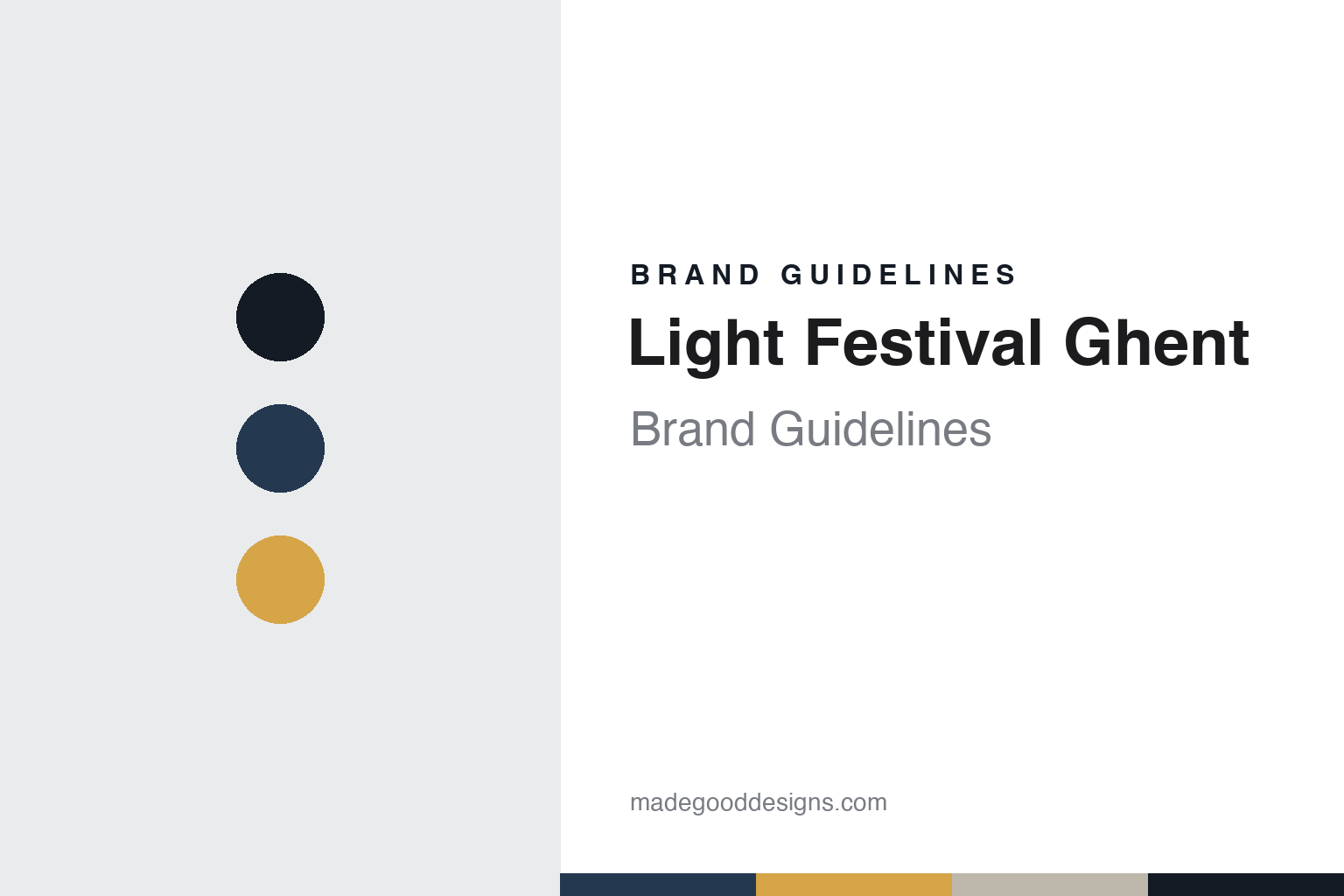
Light Festival Ghent Brand Guidelines
A city lighting plan turned into a festival.
Aa
Two constants: a night blue, lamp amber and stone palette and a lamplit serif register. Abstract homage — not a Light Festival Ghent asset; no artwork, poster or logo is reproduced.
A lighting plan
From city lighting to a festival route.
Light Festival Ghent — in Dutch, Lichtfestival Gent — grew out of a lighting plan rather than a festival tradition. The City of Ghent says it began an integrated Lichtplan for the inner city in 1998, lighting streets, squares, monuments and defining buildings in a coherent way, with the accent on architectural detail, so that each street and square gains its own character after dark. Dutch Wikipedia says the plan was designed by the lighting office of Roland Jéol of Lyon, and that the festival was announced when new lighting was switched on at the Court of Appeal on the Koophandelsplein, with the aim of putting the lighting plan itself in the spotlight.
The first edition ran from 27 to 29 January 2011. The city describes it as a complement to the lighting plan: a free event in which visitors follow a route through the city past light installations and original artworks, meeting light art and art in public space in an easy, open way. A different part of the city is lit at each edition, the city says, so the route changes every time. Dutch Wikipedia lists 21 installations on a five-kilometre route in 2011, and the city gives 200,000 visitors for that first year.
A second edition followed a year later, from 26 to 29 January 2012, with 29 installations according to Dutch Wikipedia. The festival then settled into a longer rhythm: the third edition ran from 29 January to 1 February 2015 and the fourth from 31 January to 4 February 2018, by which time the route had grown to 6.6 kilometres. VRT NWS, the Flemish public broadcaster’s news service, described it in January 2024 as an event that takes place every three years.
Colour
Routes, docks and returning favourites.
The fifth edition, marking ten years since the first, took place from 10 to 14 November 2021, from seven in the evening until midnight. VRT NWS reported in September 2021 that it was organised by the City of Ghent, Ghent University (UGent) and the network operator Fluvius, free and entirely in the open air, on a route of 7.2 kilometres — longer than before — with several starting points and installations outside the busy centre. Four favourites from earlier editions returned, the broadcaster said, among them “La Cattedrale di Luce” from 2012, a tunnel of light; “Cloud” from 2015, a rain cloud made of 6,000 light bulbs; and “Museum of the Moon” from 2018, a large lit replica of the moon.
The sixth edition ran from 31 January to 4 February 2024. VRT NWS counted 31 light artworks along a loop of 7.2 kilometres through the inner city and the old docks, walked in one direction, with nearly half of the productions from Belgium. The route set out to bring the city’s harbour past into view, the broadcaster said, and the old harbour cranes were lit. Among the works it picked out were a giant snow globe around the statue of Jacob van Artevelde on the Vrijdagmarkt; an 18-metre catwalk of stained-glass silhouettes under the Stadshal, made by a visual artist with an old Belgian glass studio; a whole street, the Sleepstraat, turned into one light installation developed with students of the KASK art school and local residents; and a projection on water mist at Portus Ganda.
The city’s own round-up, published on 5 February 2024, gave 600,000 visitors over the five days. It named the blue light and analogue projections of the artist Claudia Reh in the Sleepstraat and at Sint-Salvatorskerk, made with images that neighbours had prepared with her beforehand, alongside the colourful water screen “Monad” at the Sint-Jorisbrug and a field of fireflies in the Baudelohof.
Some works outlast their edition. Dutch Wikipedia says that the “Blue Birds,” shown at the 2012 festival, were installed permanently on the Predikherenlei in 2016, joining other light artworks the city has placed in its streets.
Typography
How light festivals present themselves.
Light festivals usually name themselves in one of two ways. Some join a city’s name to a word for light, as Lyon’s Fête des Lumières and the Festival of Lights in Berlin do; others use a coined word, as Vivid Sydney and GLOW Eindhoven do, with the city added alongside. Most are held on autumn or winter evenings, when it is dark early: Lyon’s festival runs over four evenings around 8 December, while Sydney’s takes place in May and June, the start of the southern winter.
The organisers are mostly public bodies. The Fête des Lumières is organised by the City of Lyon, and Vivid Sydney is owned, managed and produced by Destination NSW, the New South Wales Government’s tourism and major events agency. Other festivals are run by foundations, non-profit organisations or production companies working with their city.
The format is broadly shared. Visitors follow a route of installations through a city centre, usually on foot, and the largest works are projections on landmark buildings: a cathedral, a town hall, an opera house. The works come from invited artists, lighting designers and studios, and many festivals name each work and its makers in a printed or online programme and on a map of the route.
Each edition brings new works and, often, a new theme, poster or campaign image, so a festival’s look can change completely from year to year while its name, its route and its main buildings stay the same. This guide sets out what can be checked about each festival: who started it and when, who organises it now, where it takes place and how its works and imagery are described in dated sources.
Aa
A lamplit serif for a festival of facades and quays. (Specimen set in Fraunces, a serif STAND-IN; NOT the Light Festival Ghent logo.)
Light Festival Ghent
A city production on a changing route.
The festival is a city production. Its website says it is an organisation of the City of Ghent, in cooperation with District09, and it is published in Dutch, English, French and German. The city says the festival has worked with local partners since its first edition: Ghent artists and students from creative courses help shape it, mixing young talent with more established names, and calls go out to residents to contribute to artworks, under projects such as “hier licht Gent” and “It’s a question of blue.”
The lighting plan remains the year-round backdrop. The city offers a free lighting-plan walk through the inner city, five kilometres long and taking about two hours, which it presents as a way to see what light can do for a city. At the time of writing, the festival website states that no date is yet known for a next edition.
The material the festival works with, as its sources describe it, is the city’s own fabric. The Vrijdagmarkt statue, the Stadshal, Sint-Salvatorskerk, the Sint-Jorisbrug, the quays of the old docks and the harbour cranes have all carried works at recent editions, and each edition has drawn a new line through the city on its map.
For a design guide, Light Festival Ghent shows how a festival can grow out of a municipal lighting plan and keep returning to it. Compare Fête des Lumières in Lyon, the city whose lighting office designed Ghent’s plan, and Amsterdam Light Festival, another winter light route in the Low Countries. For this guide we use a night blue, a lamp amber and a quay-stone grey with a serif, an unofficial interpretation; no product or logo is reproduced.
Explore & save
Keep Light Festival Ghent’s identity on hand — save it to a board in the Made Good inspiration library.
Light Festival Ghent identity set
Pin the Light Festival Ghent night blue, lamp amber and stone palette and the lamplit serif register to your own board.
Source & notes
Frequently Asked Questions
What font can I use to match the Light Festival Ghent look?
This guide describes Light Festival Ghent’s type as “A lamplit serif for a festival of facades and quays”. Its type specimen is set in Fraunces from Google Fonts as a stand-in; Fraunces is not Light Festival Ghent’s own lettering.
What colours are in the Light Festival Ghent palette?
This guide’s Light Festival Ghent palette is Leie night #24384F, Ink #141B24, Lamp amber #D6A548, Quay stone #BDB7AC and Paper #F6F4EF. The tones are the guide’s own unofficial interpretation, not official Light Festival Ghent hex codes.
When was Light Festival Ghent founded?
Light Festival Ghent was founded in 2011, in Ghent, Belgium.