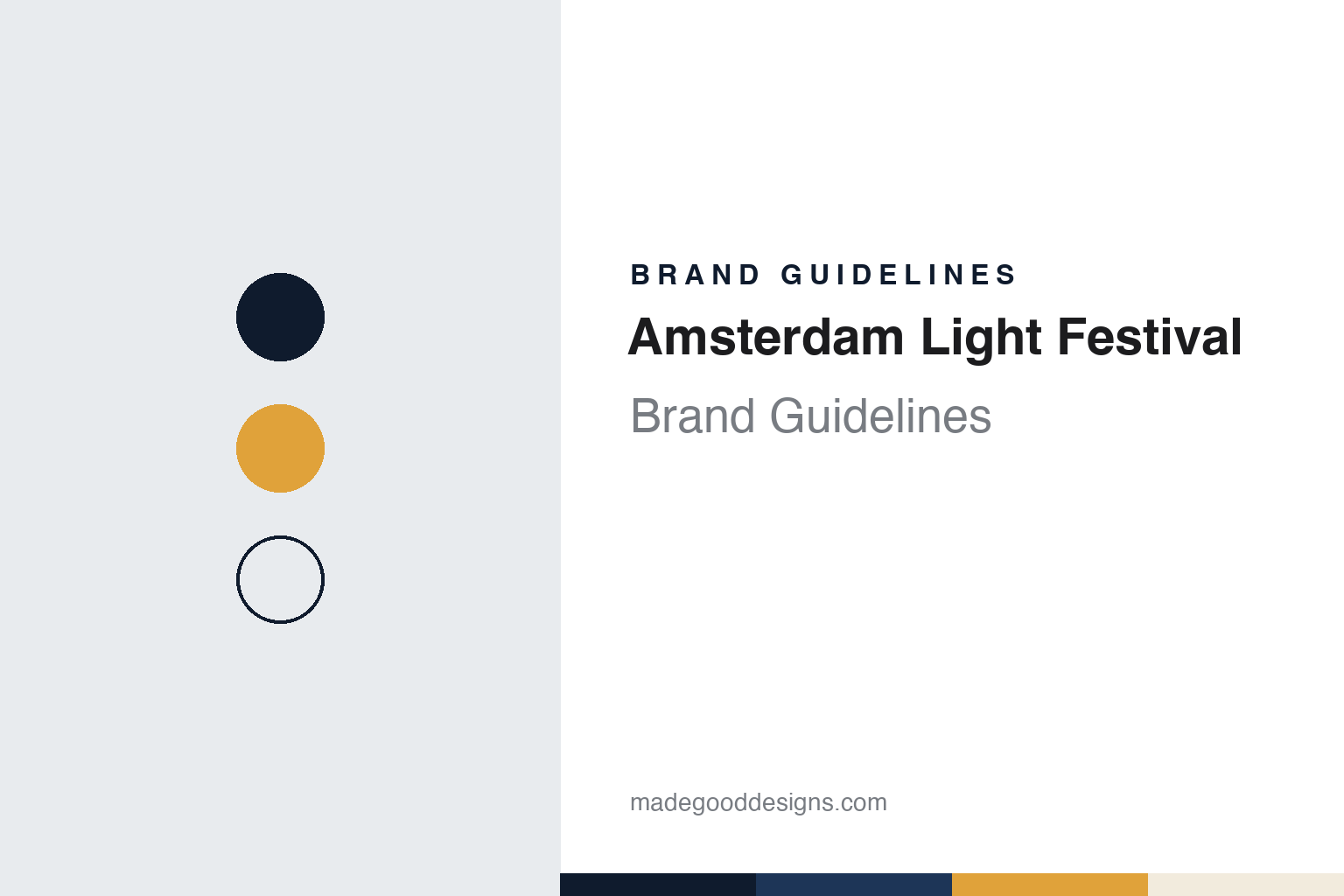
Amsterdam Light Festival Brand Guidelines
A winter route of light art on Amsterdam’s canals.
Aa
Two constants: a canal-night blue and lantern amber palette and a grotesque sans register. Abstract homage — not an Amsterdam Light Festival artwork or mark; no logo, poster or installation is reproduced.
From canal parade to light festival
A boat parade, a lit bridge and a new focus.
Amsterdam Light Festival is a winter festival of light art in the centre of Amsterdam. Dutch Wikipedia describes it as an annual festival held since 2012, around the turn of the year in December and January, with light artworks and installations made for the occasion by contemporary artists, designers and architects from the Netherlands and abroad. Each edition has a different theme.
The festival did not start as a light festival. Its own history page and Dutch Wikipedia both trace it to the Christmas Canal Parade, a boat parade first held in 2009. In 2010 the same group of organisers staged Winter Magic Amsterdam, which combined the boat parade with other activities. That winter the lighting designer Rogier van der Heide lit the Magere Brug, known in English as the Skinny Bridge, for three weeks, and suggested that the event should concentrate on light art from then on. The festival says this led to the new focus and to the name Amsterdam Light Festival.
At the first edition, according to the festival, visitors could follow a route of light artworks on the canals by boat for seven weeks, while large installations stood along the Amstel. Among them was 1.26 Amsterdam by the American artist Janet Echelman. A separate walking route through the Plantage neighbourhood, called Illuminade, ran over the Christmas holidays. The water route later took the name Water Colors, and private boat owners joined the canal cruise companies on it.
By December 2016 the festival was in its fifth year. DutchNews.nl reported that the edition had 35 installations across the city, chosen from close to 2,000 applications, and that it could be seen from canal boats from 1 December 2016 to 22 January 2017, with walking tours added from 15 December. Van der Heide, then in his final year as artistic director, told the paper that the large works on the water route were chosen by an international panel, while smaller, more experimental works near the zoo and the opera house gave younger artists a platform.
Colour
Water, land and a theme each winter.
The festival’s basic form has stayed the same: a route on the water, seen from boats, and a route on land, walked on foot. Its website offers covered and heated canal boats, open boats with a guide or skipper, and cruises with drinks, and it sells access to the route map in an app for people sailing their own boats. The walking route comes with an audio guide and a separate Kids Walk.
The route has moved over the years. The festival says the walking route went to the Marineterrein after the fifth edition, and that the eighth edition moved to the eastern part of the centre. designboom reported in December 2019 that this eighth edition, called DISRUPT!, ran from 28 November 2019 to 19 January 2020, opened a new route and showed works by twenty artists from sixteen countries, chosen from 650 entries, every evening from 5pm to 11pm by boat, bike or on foot.
In 2020 there was no large boat and walking route; the festival says seven artworks were placed around the city under the theme When Nature Calls. The tenth edition, Celebrate Light, brought back favourites from earlier years. Local broadcaster AT5 reported in November 2022 that the eleventh edition, from 1 December to 22 January, had twenty light artworks on the theme Imagine Beyond, devised by the curator Jin Choi. In November 2023 AT5 reported that the twelfth edition, from 30 November to 21 January, had 24 works, twenty of them on the water route, which ran again along the Herengracht, and that the theme was artificial intelligence and technology; the festival titled it LOADING… Revealing Art, AI and Tech.
The festival says the thirteenth edition, Rituals, coincided with Amsterdam’s 750th anniversary and added three projection works on the Oosterdok, and that the fourteenth, Legacy, from 27 November 2025 to 18 January 2026, showed work by twenty artists. The fifteenth edition opened on 26 November 2026 with nineteen light artworks, the festival’s website says.
Works come in through an open call. The festival invites creatives from around the world to submit an idea or an existing light artwork for the canals, and says selected makers receive technical and financial support; a separate call asks makers based in the Netherlands who are new to light art for works for walking visitors.
Typography
How light festivals present themselves.
Light festivals usually name themselves in one of two ways. Some join a city’s name to a word for light, as Lyon’s Fête des Lumières and the Festival of Lights in Berlin do; others use a coined word, as Vivid Sydney and GLOW Eindhoven do, with the city added alongside. Most are held on autumn or winter evenings, when it is dark early: Lyon’s festival runs over four evenings around 8 December, while Sydney’s takes place in May and June, the start of the southern winter.
The organisers are mostly public bodies. The Fête des Lumières is organised by the City of Lyon, and Vivid Sydney is owned, managed and produced by Destination NSW, the New South Wales Government’s tourism and major events agency. Other festivals are run by foundations, non-profit organisations or production companies working with their city.
The format is broadly shared. Visitors follow a route of installations through a city centre, usually on foot, and the largest works are projections on landmark buildings: a cathedral, a town hall, an opera house. The works come from invited artists, lighting designers and studios, and many festivals name each work and its makers in a printed or online programme and on a map of the route.
Each edition brings new works and, often, a new theme, poster or campaign image, so a festival’s look can change completely from year to year while its name, its route and its main buildings stay the same. This guide sets out what can be checked about each festival: who started it and when, who organises it now, where it takes place and how its works and imagery are described in dated sources.
Aa
A grotesque sans for a festival of routes and dates. (Specimen set in Archivo, a sans STAND-IN; NOT the Amsterdam Light Festival logo.)
Amsterdam Light Festival
A foundation, a slogan and an edition number.
Amsterdam Light Festival is run by a foundation. Dutch Wikipedia calls it a public-private partnership housed in a foundation; the festival itself describes a cultural non-profit foundation and a private initiative that works closely with the municipality, cultural organisations and businesses, and says it receives no structural funding. Its history page names the people involved at the start, among them Van der Heide and the festival’s long-time chairman, and says Van der Heide stepped down as artistic director after five years. Dutch Wikipedia adds that well-received works are later shown in other cities, and the festival says its team produced the first edition of the light festival in Norrköping, Sweden.
The current website presents each year as a numbered edition, with the fifteenth shown as “Edition 15” and the dates written as day, month and year separated by points. Its homepage line is “See the city in a new light.” The site credits Gedachtegoed with its design and Mediacode with building it. Beyond those credits, the festival’s logo, typeface and colours are not described in the sources used for this guide, so the identity here is our own reading of the subject: dark canal water, lit bridges and gables, and a warm light on the water.
For a design guide, Amsterdam Light Festival shows how a festival can be built around a route rather than a venue, with the city’s canals as the fixed frame and a new theme and set of artworks each winter. Compare GLOW Eindhoven, the Dutch light festival that Dutch Wikipedia sets beside it, and I amsterdam, the city’s own slogan. For this guide we use a deep canal blue, a lantern amber and a cream with a sans, an unofficial interpretation; no product or logo is reproduced.
Explore & save
Keep Amsterdam Light Festival’s identity on hand — save it to a board in the Made Good inspiration library.
Amsterdam Light Festival identity set
Pin the Amsterdam Light Festival canal-night blue and lantern amber palette and the grotesque sans register to your own board.
Source & notes
Frequently Asked Questions
What font can I use to match the Amsterdam Light Festival look?
This guide describes Amsterdam Light Festival’s type as “A grotesque sans for a festival of routes and dates”. Its type specimen is set in Archivo from Google Fonts as a stand-in; Archivo is not Amsterdam Light Festival’s own lettering.
What colours are in the Amsterdam Light Festival palette?
This guide’s Amsterdam Light Festival palette is Canal night #0F1B2D, Bridge blue #1D3557, Lantern amber #E0A23A, Gable cream #F2EBDD and Paper #F8F7F5. The tones are the guide’s own unofficial interpretation, not official Amsterdam Light Festival hex codes.