The Santa Fe Opera Brand Guidelines
Opera in an open-sided theatre facing the western sky.
Aa
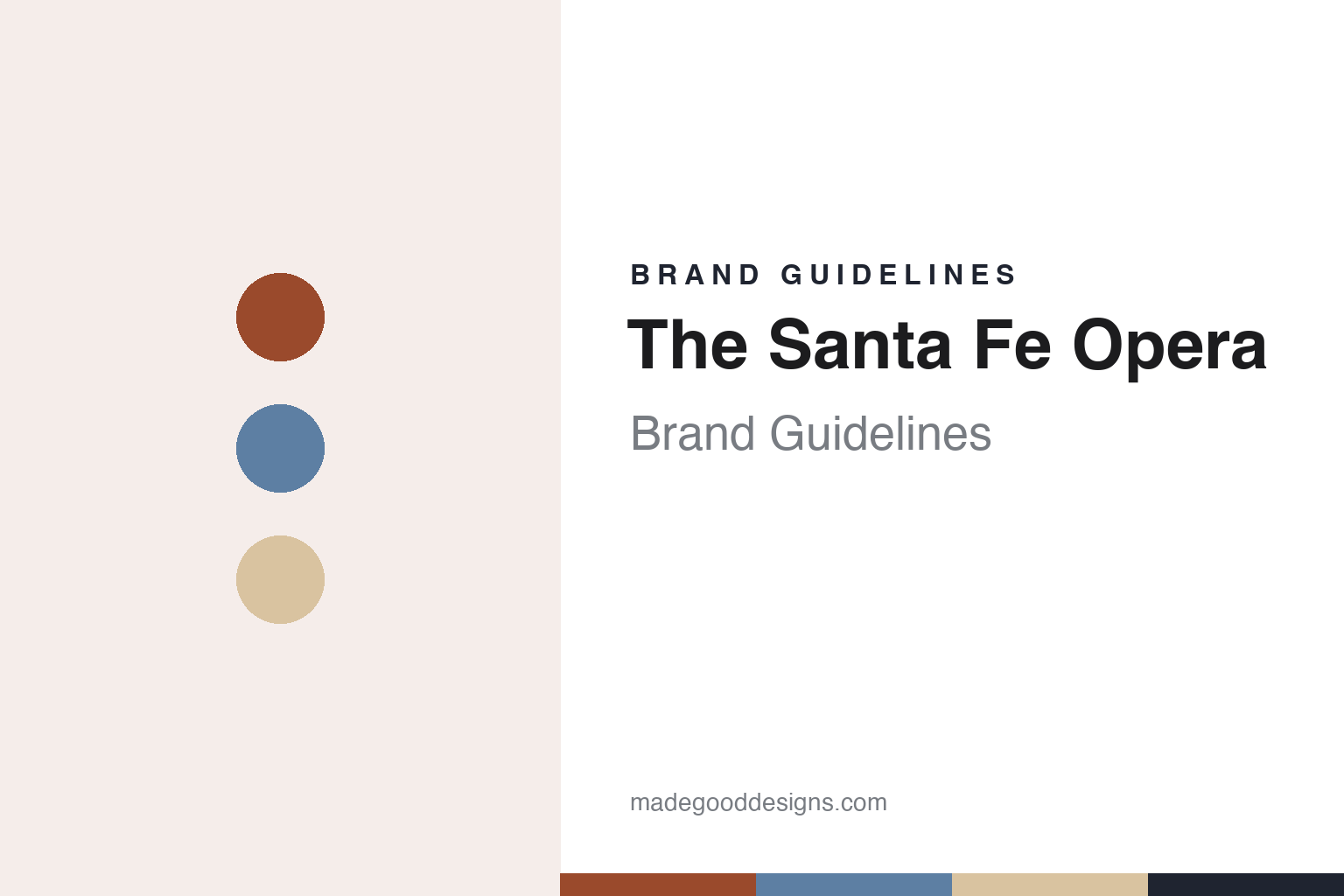
Two constants: an adobe terracotta, desert sky and mesa sand palette and a geometric sans register. Abstract homage — not a Santa Fe Opera poster or mark; no logo or programme cover is reproduced.
A ranch north of Santa Fe
A conductor, a guest ranch and a summer of five operas.
The Santa Fe Opera traces its start to 1956, when the New York conductor John Crosby created the Opera Association of New Mexico, according to English Wikipedia. The company says Crosby took over the San Juan Ranch, a guest ranch north of Santa Fe, in September 1956 on an initial three-year lease, with backing from his parents, and that he and an acoustician chose a natural sound “bowl” on the land in which to site the theatre. The first season opened on July 3, 1957, with Puccini’s Madama Butterfly, in an open-air theatre of about 480 seats.
English Wikipedia says one aim was to give American singers time to learn and perform new roles, with ample rehearsal, inside a summer festival of five operas in repertory. In that first season Crosby also created the Apprentice Singer Program, under which young singers sang in the chorus and covered larger roles; a programme for theatre technicians followed in 1965. The company gives a figure of more than 1,500 aspiring singers who have taken part, while English Wikipedia puts it at over 2,000 and says that in 2025 almost 40 singers and 85 technical apprentices worked at the opera.
Crosby led the company as general director until 2000. Two further general directors followed before Robert K. Meya, previously the opera’s director of external affairs, became the fourth in 2018, the company says; in the autumn of 2023 it announced an extension of his contract through 2028. In 2018 the company also created the post of artistic director, according to English Wikipedia.
Colour
Three theatres on one mesa.
Three theatres have stood on the same mesa-top site, each with the audience facing west. The original open-air house of 1957, by local architects working with the acoustics firm Bolt, Beranek and Newman, sat in a west-facing basin chosen for its acoustics and its views over the valley, the Guide to New Mexico Architecture wrote in 2022. A second open-air theatre, seating 1,889, opened on June 26, 1968, again with Madama Butterfly, English Wikipedia says.
The present house dates from 1998. The auditorium of the 1968 theatre was taken down after the 1997 season and its successor built in about ten months, ready for July 1998, according to the architecture guide; the stage and backstage buildings stayed in place, English Wikipedia adds. The design came from the New York firm Polshek and Partners, now Ennead Architects, with Ove Arup & Partners as structural engineers. Tucson Weekly, reviewing the 1998 season, the company’s 42nd, described a large swooping roof that now covered every seat, faced inside with narrow wooden slats and helped by acoustic reflectors over the stage, while the sides stayed open and the back of the stage still opened onto the landscape, so that the lights of Los Alamos could be seen on clear nights.
The 2022 guide explains the structure: the old columns were reused to carry a roof plane with an internal steel frame and upper rigging that holds up its cantilevered edges, while the balcony roof hangs from masts and cables and a clerestory joins the two roofs. Baffles that the guide likens to paper lanterns line the south side of the seating. The company says the curves of the roof follow the reflections of sound from stage to audience, and that the roofs also collect rainwater for the grounds. The house, now called the Crosby Theatre, seats about 2,100 — the company gives 2,126 seats plus 106 standing places — and each position has a small seat-back screen with translations in English and Spanish. English Wikipedia says the seat-back system was installed in 1999, the second of its kind after the Metropolitan Opera’s in 1995, and the company says a new generation arrived in 2019.
Typography
Opera festivals and their image.
Opera festivals usually present themselves through a place or a person. Many take the name of their town with the word “festival” or “opera” attached, as Aix-en-Provence does; others carry the name of a composer, as the Rossini Opera Festival in Pesaro does, or the name of a house or estate. The name, the town and the stage often become the identity before any logo does.
Most run for a few weeks in summer. The Festival d’Aix-en-Provence takes place principally in July and the Rossini Opera Festival in August, each over a few weeks. Behind them stand non-profit bodies of different kinds: charities, associations and foundations, often with a city council or regional authority among their founders or members. The festival in Pesaro, for example, was set up by its city council in 1980 and became a foundation in 1994.
The settings vary as much as the names. Some festivals perform in castle or palace courtyards under the open sky, as Aix has done in the courtyard of its former archbishop’s palace since 1948; others use country-house theatres, historic Italian-style opera houses, purpose-built modern theatres or converted halls. Many festivals use more than one stage, and the list of venues is often part of how a festival describes itself.
Programmes commonly mix new productions with revivals, concerts and training. Academies and young-artist schemes, such as the Académie in Aix and the Accademia Rossiniana in Pesaro, put early-career singers, directors and musicians on the festival’s own stages. A poster, programme cover or season image is usually made anew for each edition, and Aix, for one, has worked with the same graphic designer since 2019. This guide describes those identities plainly, using our own unofficial colours and type.
Aa
A geometric sans with the clean lines of the mesa-top theatre. (Specimen set in Jost, a sans STAND-IN; NOT The Santa Fe Opera logo.)
The Santa Fe Opera
Five operas, a sunset start and a campus called the Ranch.
The season runs from late June or early July to the third week of August, with five operas in rotating repertory, according to English Wikipedia; performances begin close to sunset, because the theatre is open at the sides. The programme, as that source describes it, has long combined popular titles with an American or world premiere and a rarely performed work. The company counts some 2,000 performances of 180 operas by 90 composers, including 19 world premieres and 45 American premieres; recent premieres include Cold Mountain in 2015, The (R)evolution of Steve Jobs in 2017 and The Righteous in 2024.
The campus around the theatre adds to the picture. The company says the property covers 155 acres, with the theatre, the Stieren Orchestra Hall of 2001 — also designed by Polshek and Partners — and parking on the mesa, and offices, rehearsal halls and gardens on lower ground called “The Ranch,” a nod to the San Juan Ranch guest resort that once stood there. The company’s own description of its setting dwells on views of the Jemez Mountains to the west and the Sangre de Cristo Mountains to the east.
For a design guide, The Santa Fe Opera shows how a theatre’s setting — a west-facing stage, an open-sided house and a roof shaped around sound — can become the core of a company’s image. Compare The Glimmerglass Festival, another American summer company built around its own theatre, and the Metropolitan Opera, whose seat-back titles came before Santa Fe’s. For this guide we use adobe terracotta, desert sky and mesa sand with a sans, an unofficial interpretation; no product or logo is reproduced.
Explore & save
Keep The Santa Fe Opera’s identity on hand — save it to a board in the Made Good inspiration library.
The Santa Fe Opera identity set
Pin The Santa Fe Opera adobe terracotta, desert sky and mesa sand palette and the geometric sans register to your own board.
Source & notes
Frequently Asked Questions
What font can I use to match the The Santa Fe Opera look?
This guide describes The Santa Fe Opera’s type as “A geometric sans with the clean lines of the mesa-top theatre”. Its type specimen is set in Jost from Google Fonts as a stand-in; Jost is not The Santa Fe Opera’s own lettering.
What colours are in the The Santa Fe Opera palette?
This guide’s The Santa Fe Opera palette is Adobe terracotta #9A4A2C, Desert sky #5D7FA3, Mesa sand #D9C3A0, Night blue #1F2430 and Lime plaster #F6F2EA. The tones are the guide’s own unofficial interpretation, not official The Santa Fe Opera hex codes.
When was The Santa Fe Opera founded?
The Santa Fe Opera was founded in 1956 (first season 1957), in Santa Fe, New Mexico, USA.
Who founded The Santa Fe Opera?
The Santa Fe Opera was founded by John Crosby in 1956 (first season 1957).