The NAMM Show Brand Guidelines
From a 1901 piano dealers’ group to Anaheim every January.
Aa
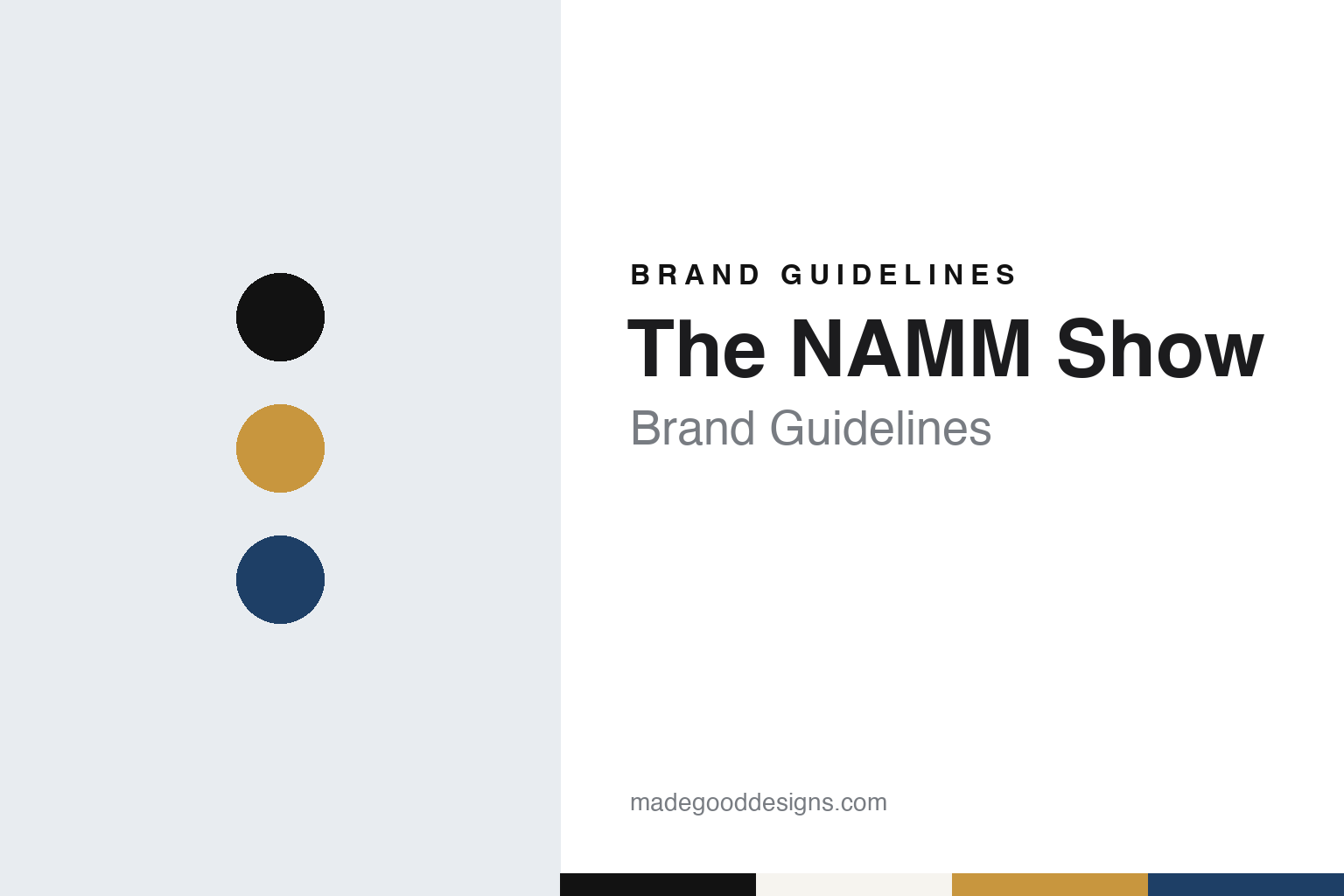
Two constants: a stage black, cable blue and brass gold palette and a condensed sans register. Abstract homage — not a NAMM asset; no logo, instrument or key visual is reproduced.
NAPDA
A piano dealers’ association and a roving convention.
The NAMM Show is run by the National Association of Music Merchants, a trade association that began as a group of piano sellers. English Wikipedia says that in 1901 52 members of the National Piano Manufacturers Association of America formed the National Association of Piano Dealers of America (NAPDA) in New York City, to promote legitimate makers and sellers at a time when cheap imitations were being sold under better-known names. NAMM’s own show history, compiled by its music historian Dan Del Fiorentino, dates the formation to 16 May 1901 in New York.
The trade show followed a year later. NAMM’s list gives the opening NAPDA Convention, which it calls the first trade show, as held in Baltimore, Maryland, on 12 May 1902, and English Wikipedia gives the same city and year. Guitar.com, in a January 2019 history of the show, also places the 1902 convention in Baltimore, while saying that the association’s first trade show was held in New York in 1901, so the sources differ on where the show itself began. In its early years the convention moved around the eastern half of the United States: NAMM’s list shows Buffalo in 1903, Atlantic City in 1904, Washington in 1906 and Chicago in 1907.
The name changed twice in two decades. In 1912 the association became the National Association of Piano Merchants of America, and the show the NAPMA Convention. By 1919, English Wikipedia and Guitar.com both say, the popularity of early jazz and of marching-band music had led many piano merchants to sell full lines of band instruments, and the association took the name National Association of Music Merchants, or NAMM. NAMM’s list shows the opening NAMM Convention in New York on 3 February 1920. For roughly half a century after that the convention was held mainly in New York and Chicago, the latter being its most frequent home between 1925 and 1969, according to Guitar.com.
Colour
From Western Market to The NAMM Show.
The move to California came in stages. NAMM’s list shows a Western Seminar & Exhibits in Los Angeles in April 1970, alongside the main summer convention, and a Western Market held each March in Los Angeles or San Francisco in the following years. The Western Market moved to Anaheim, California, from 23 to 25 January 1976, and stayed there in January. Guitar.com describes the 1970 event as the start of NAMM shows in California, when the trade show became twice-yearly, and gives 1976 as the year it settled in Anaheim.
The two shows then took separate names. The summer show became the NAMM International Music Expo in 1976 and, from 1979, the NAMM International Music & Sound Expo, moving between cities including Chicago, Atlanta and New Orleans; the January show in Anaheim was called the Winter Music & Sound Market from 1979 and the NAMM International Music Market from 1988, NAMM’s list shows. Musicians came to call them Winter NAMM and Summer NAMM, Guitar.com says. From 1993 the summer event, by then called NAMM Summer Session, was held mostly in Nashville. In 1998, 1999 and 2000 the January market moved to Los Angeles while the Anaheim Convention Center was renovated, according to English Wikipedia and NAMM’s list.
In 2003 the January event took its present name, The NAMM Show, opening under that name from 16 to 19 January 2003 in Anaheim. English Wikipedia says the show expanded into the convention centre’s new North building in 2018, the year the Audio Engineering Society joined it under the title “AES at NAMM”. The 2021 show did not take place; in January 2021 NAMM held an online programme called Believe in Music Week instead. The show returned to Anaheim from 3 to 5 June 2022, was held from 13 to 15 April 2023, and went back to January with the edition of 25 to 28 January 2024, NAMM’s list shows.
The show is a trade event. English Wikipedia says entry is restricted to owners, suppliers, distributors, journalists, employees, endorsed artists and guests of NAMM member companies, and Guitar.com stressed in 2019 that it is “resolutely a trade show”, where visitors cannot simply buy a ticket at the door. Makers bring new products to sell to the dealers and distributors who plan their year’s buying there, the same article says, and it records two moments on the show floor: Marshall marking its 25th anniversary with its Silver Jubilee amplifier line at the 1987 show, and Line 6 drawing crowds to its digital amp-emulation units at Winter NAMM in 1999.
Typography
How toy, music and sporting-goods fairs present themselves.
Trade fairs for toys, musical instruments and sporting goods tend to name themselves plainly. Most pair the product field with a city or with a single word such as fair, show or expo, so that the name alone tells a buyer what is on offer and where to go. Some keep a word in the language of their home city even when most visitors come from abroad; others have shortened longer official titles to the form people already used.
Many of these events are built for the trade rather than the public. Trade days are usually reserved for retailers, buyers, distributors, manufacturers and press, and some fairs check credentials or set a minimum age at the door. Others are open to the public, either throughout or on particular days, and present themselves more like festivals for players, musicians or riders.
Behind the fairs stand different kinds of organiser: trade associations representing an industry, cooperatives owned by the exhibitors themselves, and exhibition companies that run the halls and sell the space. Dates matter as much as names. A fair tied to the buying calendar may move between seasons when the industry’s order cycle changes, and the month becomes part of how the event is known.
Inside, the halls are usually arranged by product group, so that a visitor can walk from one category to the next. Demonstration areas, play areas, sound booths and test tracks let products be tried rather than only seen. The visual identity often follows a simple pattern: a wordmark or emblem kept from year to year, set beside a key visual, edition number and dates that change with each edition. This guide describes those identities from dated sources and uses colours and type of our own choosing.
Aa
A condensed sans for an acronym in capitals. (Specimen set in Oswald, a sans STAND-IN; NOT the NAMM logo.)
The NAMM Show
Anaheim, every January.
The association behind the show has moved as well. English Wikipedia says NAMM moved its headquarters from Chicago, where it had been based since 1946, to Carlsbad, California, in 1984, and that it represented about 15,000 member companies and individual professionals in 2023. It names John Mlynczak as president and chief executive, a role in which the trade magazines Music Inc. and MMR also quoted him in January 2026. Besides the January show, NAMM holds the smaller NAMM Summer Session, usually in June or July in Nashville, and runs the Museum of Making Music in Carlsbad, which English Wikipedia says opened to the public in March 2000.
The most recent edition marked the association’s 125th anniversary. Music Inc. reported on 28 January 2026 that The 2026 NAMM Show had ended on 24 January after five days of education sessions, concerts and events, with three days of exhibits. NAMM reported more than 60,000 attendees, including more than 8,760 from 122 countries, regions and territories, and more than 1,650 exhibitors representing over 5,400 brands, the magazine said; MMR, the music-products trade magazine, reported the same exhibitor and brand figures and the same closing date.
The name itself has a fixed shape. Since 2003 the association has used the definite article, its acronym in capitals and the word Show, and its announcements place the year inside the name, as in “The 2026 NAMM Show”. Behind the acronym sit more than a century of earlier titles — NAPDA Convention, NAPMA Convention, NAMM Convention, Western Market and NAMM International Music Market — each recorded in NAMM’s own list of dates and places.
For a design guide, The NAMM Show shows how a trade association can carry its acronym across a century of renamings and settle a show in one city and one month. Compare Musikmesse, the Frankfurt fair for musical instruments, and Superbooth, the Berlin event for electronic instruments. For this guide we use stage black, cable blue and a brass gold with a condensed sans, an unofficial interpretation; no product or logo is reproduced.
Explore & save
Keep The NAMM Show’s identity on hand — save it to a board in the Made Good inspiration library.
The NAMM Show identity set
Pin The NAMM Show stage black, cable blue and brass gold palette and the condensed sans register to your own board.
Source & notes
Frequently Asked Questions
What font can I use to match the The NAMM Show look?
This guide describes The NAMM Show’s type as “A condensed sans for an acronym in capitals”. Its type specimen is set in Oswald from Google Fonts as a stand-in; Oswald is not The NAMM Show’s own lettering.
What colours are in the The NAMM Show palette?
This guide’s The NAMM Show palette is Stage black #121212, Amp grey #4A4D52, Cable blue #1E3F66, Brass gold #C8963E and Paper #F6F4EF. The tones are the guide’s own unofficial interpretation, not official The NAMM Show hex codes.