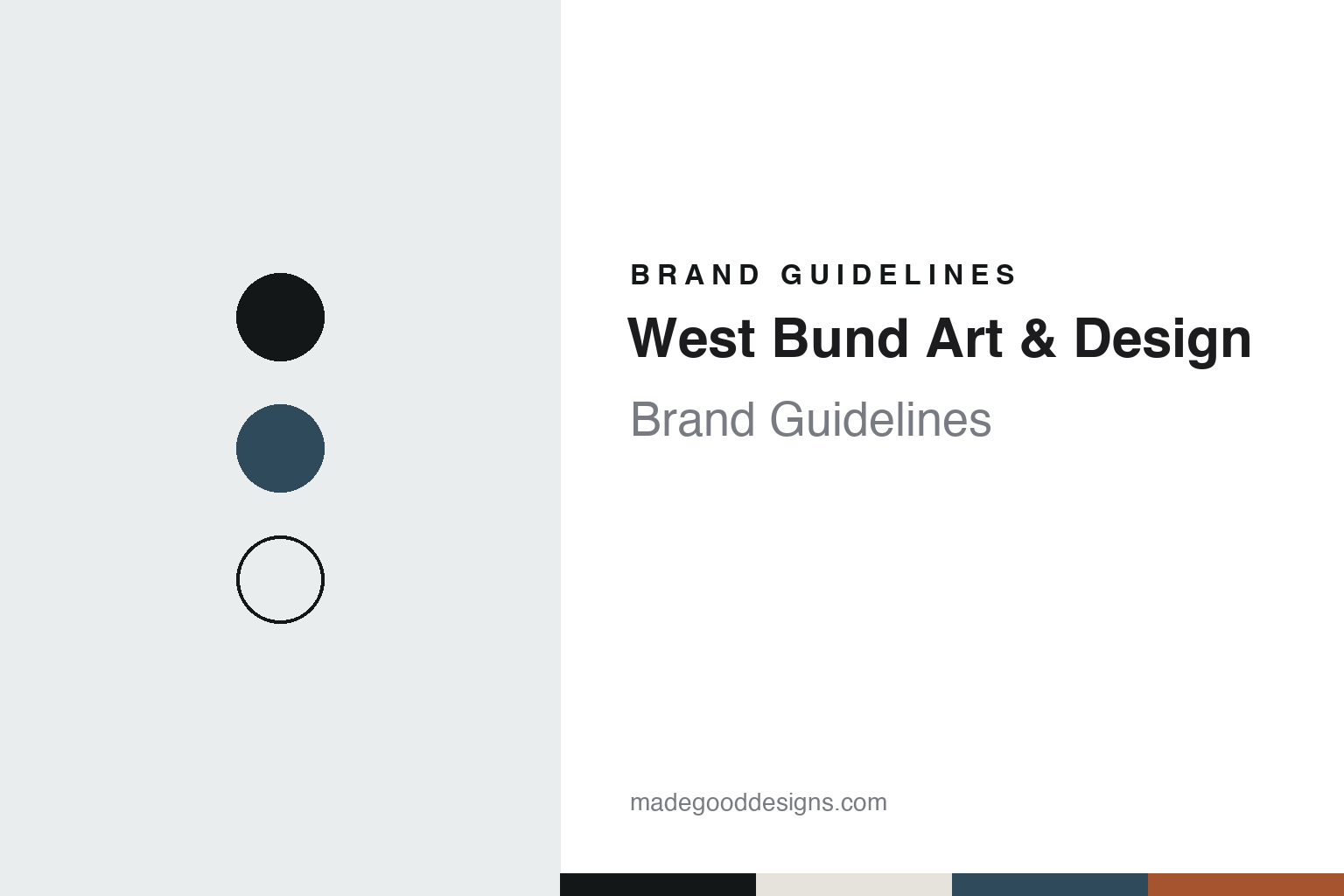
West Bund Art & Design Brand Guidelines
Shanghai’s riverside art and design fair since 2014.
Aa
Two constants: a river slate, concrete and rust palette and a condensed sans register. Abstract homage — not a West Bund Art & Design asset; no logo, poster or artwork is reproduced.
A fair in a hangar
Art and design on the Huangpu.
West Bund Art & Design is an art and design fair held each year on the West Bund, the riverside district of Shanghai’s Xuhui district on the western side of the Huangpu River. It was first held in the autumn of 2014, the year after a one-off West Bund Biennale, The Art Newspaper reported in November 2017. Its English Wikipedia entry gives its Chinese name as the West Bund Art and Design Fair, and the fair’s own website says it was founded in Shanghai in 2014.
The fair is directed by the Shanghai-based artist Zhou Tiehai, a former director of the city’s Minsheng Art Museum. The Art Newspaper described it in May 2016 as backed by the district government and run by Zhou, and in 2017 noted that the fair is “directed by an artist,” which it called unusual for a commercial event. Until 2025 its main home was the West Bund Art Center, which the paper described as a converted aeroplane hangar.
The early editions did not use the November slot it now keeps. The 2015 fair ran in September and closed on 13 September, The Art Newspaper reported, timed to coincide with a photography fair and a festival of emerging artists so that the three formed a Shanghai Art Week. In 2016 the fair moved to 9–13 November, and Zhou told the paper that the organisers reconsidered the dates every year and that holding the fair alongside the Shanghai Biennale made the city a destination in the art calendar.
Colour
Galleries, design and Xiàn Chǎng.
The name carries the fair’s two strands. In 2016 the founder of ART021, Bao Yifeng, told The Art Newspaper that one difference between the two Shanghai contemporary fairs was West Bund’s design strand, and Zhou said the exhibition space in the hangar set it apart. In 2017 the paper counted 70 galleries, among them Hauser & Wirth and White Cube, and described a new section called Talent with sixteen young galleries.
Since 2016 the fair has worked with the magazine ArtReview on Xiàn Chǎng, a programme of artist projects in the fair and around the district, according to English Wikipedia; The Art Newspaper reported that the section, curated by ArtReview Asia, returned for its second year in 2017. The fair’s website now lists its sections as galleries, design /delight, xiàn chăng, moving image, perspective and a forum of talks.
The twelfth edition opened on 13 November 2025. A Shanghai municipal government notice of October 2025 listed it as part of the 7th Shanghai International Artwork Trade Week, spread across five venues in the West Bund with some 26,000 square metres of space, six sections, nearly 200 galleries from 48 cities, about 40 invited artists and collectives with large installations and performances, and nearly 20 talks. The venues named were the new West Bund International Convention and Exhibition Center, Hall A of the West Bund Art Center, the West Bund Dome Art Center, a studio at the West Bund Dream Center and Orbit. ArtAsiaPacific reported that the main galleries sector had moved into the new convention centre that year, freeing the West Bund Art Center for the Xianchang sector of large installations and thematic projects, and that the fair coincided with the 15th Shanghai Biennale.
Typography
How fairs present themselves.
Art, antiques and collectible-design fairs tend to present themselves through a short name: an acronym built from a longer title, such as FIAC or BRAFA, or a city-based name that ties the event to the place where it is held. These names are usually set in capitals and kept from one year to the next, while each edition adds its own dates, poster or key visual.
The organisers behind them vary. Some fairs are run by dealer associations or non-profit bodies set up by dealers; others by exhibition companies that also stage trade shows; others by charities, chambers of commerce or cultural bodies acting in an institutional role. A committee of dealers or a selection panel usually decides which galleries take part.
Most fairs last only a few days a year, in a landmark hall, a pavilion in a park, an armory or a modern exhibition centre, and many open with a preview or vernissage for invited guests before the public days. Stands are arranged by gallery and often grouped by period or field, from antiquities and Old Masters to modern and contemporary art and twentieth-century design, with talks, guided tours and a curated or younger-galleries section alongside the main aisles. Some fairs add outdoor works or partner venues elsewhere in the city.
For a design guide, these fairs show how an identity can rest on a few constants — a wordmark, a month and a building — while venues, organisers and sections change around them. The guides in this series describe those constants as dated sources record them, with our own colours and type as an unofficial interpretation, and with no rankings, no prices and no claims about the quality or importance of any fair, gallery or work.
Aa
A tall condensed sans for a long, two-part name. (Specimen set in Barlow Condensed, a sans STAND-IN; NOT the West Bund Art & Design logo.)
West Bund Art & Design
One fair, several halls by the river.
The thirteenth edition ran from 10 to 15 November 2026. SmartShanghai reported on 10 November 2026 that it brought together more than 150 galleries and exhibitors from 45 cities and regions across four venues along the Huangpu, with public days from 12 to 15 November; The Art Newspaper counted 85 galleries on 13 November 2026. According to SmartShanghai, most galleries were in the West Bund International Convention and Exhibition Center; the West Bund Art Center held collectible design, large installations and the Perspective section; the Dream Factory at GATE M showed moving-image work; and West Bund ORBIT, about three kilometres away, hosted a public art installation by the river.
The fair now describes itself on its website as having grown over thirteen years from a single-venue event into a multi-venue programme stretching some five kilometres along the river, held each November. That spread shapes how it presents itself: a long, two-part name, a set of venue names along the riverside, and section titles written in lower case on its website, from design /delight to xiàn chăng.
Visitors and dealers have commented on the spaces. In 2015 dealers praised the large booth sizes and the balance of Chinese and international galleries, The Art Newspaper reported, and in 2025 galleries told ArtAsiaPacific that the new convention centre felt larger and more open than the hangar, which the magazine said had given the fair a raw, industrial character. Our palette follows that setting rather than any fair material: a river slate as the accent, a near-black ink for text, a pale concrete ground and a rust used sparingly for highlights. A tall condensed sans fits a long, two-part name across a narrow banner or a section sign.
For a design guide, West Bund Art & Design shows how a fair can tie its identity to a district and a river rather than to a single hall, and how a two-part name keeps art and design side by side. Compare ART021, the fair that shares its Shanghai week, and Design Miami, another fair built around collectible design. For this guide we use a river slate, a concrete grey and a rust with a sans, an unofficial interpretation; no product or logo is reproduced.
Explore & save
Keep West Bund Art & Design’s identity on hand — save it to a board in the Made Good inspiration library.
West Bund Art & Design identity set
Pin the West Bund Art & Design river slate, concrete and rust palette and the condensed sans register to your own board.
Source & notes
Frequently Asked Questions
What font can I use to match the West Bund Art & Design look?
This guide describes West Bund Art & Design’s type as “A tall condensed sans for a long, two-part name”. Its type specimen is set in Barlow Condensed from Google Fonts as a stand-in; Barlow Condensed is not West Bund Art & Design’s own lettering.
What colours are in the West Bund Art & Design palette?
This guide’s West Bund Art & Design palette is River slate #2F4A5A, Hangar ink #141718, Concrete #E6E3DD, Rust #A4552F and Paper #F7F6F3. The tones are the guide’s own unofficial interpretation, not official West Bund Art & Design hex codes.