ARTBO Brand Guidelines
The Bogotá chamber of commerce art fair, from Corferias to Ágora.
Aa
Two constants: a brick, green and ochre palette and a grotesque sans register. Abstract homage — not an ARTBO mark or poster; no artwork, logo or campaign image is reproduced.
Corferias
A chamber of commerce’s art fair, counted from 2005.
ARTBO, the Feria Internacional de Arte de Bogotá (Bogotá International Art Fair), is organised by the Cámara de Comercio de Bogotá, the city’s chamber of commerce. The Art Newspaper described the fair in September 2025 as created and led by the chamber, and an organiser announcement from 2023 calls ARTBO the chamber’s arts programme. The fair counts its editions from 2005: Bogotá’s city government described the 2019 fair as the fifteenth, and the 2024 and 2025 fairs were billed as the twentieth anniversary and the 21st edition. La Nación of Buenos Aires, reporting from the 2024 fair, and Colombia’s official tourism site both give 2004 as the year ARTBO was created.
For most of its history the fair was held at Corferias, the Bogotá exhibition centre. Colombia’s tourism site says it took place traditionally in a large pavilion there, and Portafolio placed the 2017 fair at Corferias. The city government reported that the fifteenth edition ran from 19 to 22 September 2019 in the Gran Salón of Corferias, with 67 galleries, 17 of them from abroad, from countries including Spain, Brazil, Mexico, Cuba and Venezuela. María Paz Gaviria, then the chamber’s manager of commercial platforms, spoke for the fair in that report.
The fair then changed buildings. Its 19th edition was held in November 2023 at Ágora Bogotá, a convention centre, ending on Sunday 26 November. The organiser called the vertical building a new space and described the result as a “boutique” fair; it said the edition brought together 113 spaces, among them 45 galleries from 14 cities in seven countries, and added new sections named Diseño, for design, and Encuentros. ARTBO returned to September at Ágora in 2024, from 26 to 29 September, and in 2025 ran from 25 to 28 September, after a preview and vernissage on 24 September.
Colour
Galleries, curated sections and a publishing floor.
ARTBO is laid out by section rather than as a single gallery aisle. Colombia’s tourism site and the city government’s 2019 report both describe eight modules: a main gallery section; Proyectos, for artworks backed by a gallery and chosen by an invited curator; Referentes, for artists who became points of reference for younger ones; Sitio, for installations, video and other non-traditional formats; a forum for talks; Artecámara, a showcase for young Colombian artists; Libro de Artista, for artists’ books and publications; and Articularte, a space for collective making. In 2019, the city government reported, invited curators from Berlin and London led Referentes and Proyectos.
The sections have shifted from edition to edition. For the twentieth-anniversary fair in 2024 the organiser counted 118 exhibitors, among them galleries, independent publishers and cultural institutions, and said its Referentes section that year reviewed the history of Colombia’s galleries through more than 90 works. Arte al Día reported on 26 September 2025 that the 21st edition had opened at the Ágora Convention Center with 46 galleries from 18 cities, including Paris, Rome, Madrid, Buenos Aires, São Paulo, New York and Bogotá, alongside 33 cultural institutions and four curatorial sections. Artecámara that year showed 21 emerging artists, a section called Trayectoria gave a solo presentation to the Colombian artist Beatriz González, and Editoriales gathered 110 publishers, bookshops, distributors and associations. La Nación wrote in 2024 that the fair spread over five floors, with more than 40 galleries and 80 independent publishers.
Leadership has changed too. The Art Newspaper reported in September 2025 that after a decade under María Paz Gaviria, the fair was now led by Jaime A. Martínez, an art historian and former gallerist who had lived and worked in Berlin. The same report noted that São Paulo’s Galeria Vermelho had taken part in ARTBO since 2007, and that the 2025 fair followed the opening of the first Bogotá Biennial the weekend before.
Typography
Fairs, halls and the few days a year.
Art, antiques and collectible-design fairs tend to present themselves through a short name: an acronym built from a longer title, such as FIAC or BRAFA, or a city-based name that ties the event to the place where it is held. These names are usually set in capitals and kept from one year to the next, while each edition adds its own dates, poster or key visual.
The organisers behind them vary. Some fairs are run by dealer associations or non-profit bodies set up by dealers; others by exhibition companies that also stage trade shows; others by charities, chambers of commerce or cultural bodies acting in an institutional role. A committee of dealers or a selection panel usually decides which galleries take part.
Most fairs last only a few days a year, in a landmark hall, a pavilion in a park, an armory or a modern exhibition centre, and many open with a preview or vernissage for invited guests before the public days. Stands are arranged by gallery and often grouped by period or field, from antiquities and Old Masters to modern and contemporary art and twentieth-century design, with talks, guided tours and a curated or younger-galleries section alongside the main aisles. Some fairs add outdoor works or partner venues elsewhere in the city.
For a design guide, these fairs show how an identity can rest on a few constants — a wordmark, a month and a building — while venues, organisers and sections change around them. The guides in this series describe those constants as dated sources record them, with our own colours and type as an unofficial interpretation, and with no rankings, no prices and no claims about the quality or importance of any fair, gallery or work.
Aa
A grotesque sans for a capitalised acronym. (Specimen set in Archivo, a sans STAND-IN; NOT the ARTBO logo.)
ARTBO
A capitalised acronym with a slash.
The organiser writes the name in capitals, ARTBO, and uses it as an umbrella joined by a slash: “ARTBO / Fair” for the autumn fair and “ARTBO / Fin de Semana” for a gallery weekend, with the fair’s long form given as “ARTBO / International Art Fair of Bogota” in its English announcements. The Art Newspaper and La Nación set the name as Artbo in their reports.
ARTBO / Fin de Semana is the spring counterpart. The organiser announced it for 11 to 14 April 2024 and for 25 to 27 April 2025, when it said more than 70 cultural spaces, including galleries, museums, institutions, independent exhibitions and design venues, would keep extended hours across Bogotá for a weekend. The autumn fair keeps a preview before its public days: in 2025 the VIP opening on Wednesday 24 September came before the public opening the next day, The Art Newspaper and Arte al Día reported. The organiser put attendance at around 26,500 visitors in 2023 and more than 29,500 in 2024.
Colombia’s tourism site notes that other art events gather in the city on the same dates, naming the galleries of the San Felipe neighbourhood, Barcú in La Candelaria, the Feria del Millón and the Odeón fair.
For a design guide, ARTBO shows how an institutional organiser can run a fair under a short capitalised acronym, extend that name with a slash into related events, and move to a new building without changing the name. Compare Zona Maco in Mexico City and ARCOmadrid, two other Spanish-language art fairs. For this guide we use brick, green and ochre tones with a grotesque sans, an unofficial interpretation; no product or logo is reproduced.
Explore & save
Keep ARTBO’s identity on hand — save it to a board in the Made Good inspiration library.
ARTBO identity set
Pin the ARTBO brick, green and ochre palette and the grotesque sans register to your own board.
Source & notes
Frequently Asked Questions
What font can I use to match the ARTBO look?
This guide describes ARTBO’s type as “A grotesque sans for a capitalised acronym”. Its type specimen is set in Archivo from Google Fonts as a stand-in; Archivo is not ARTBO’s own lettering.
What colours are in the ARTBO palette?
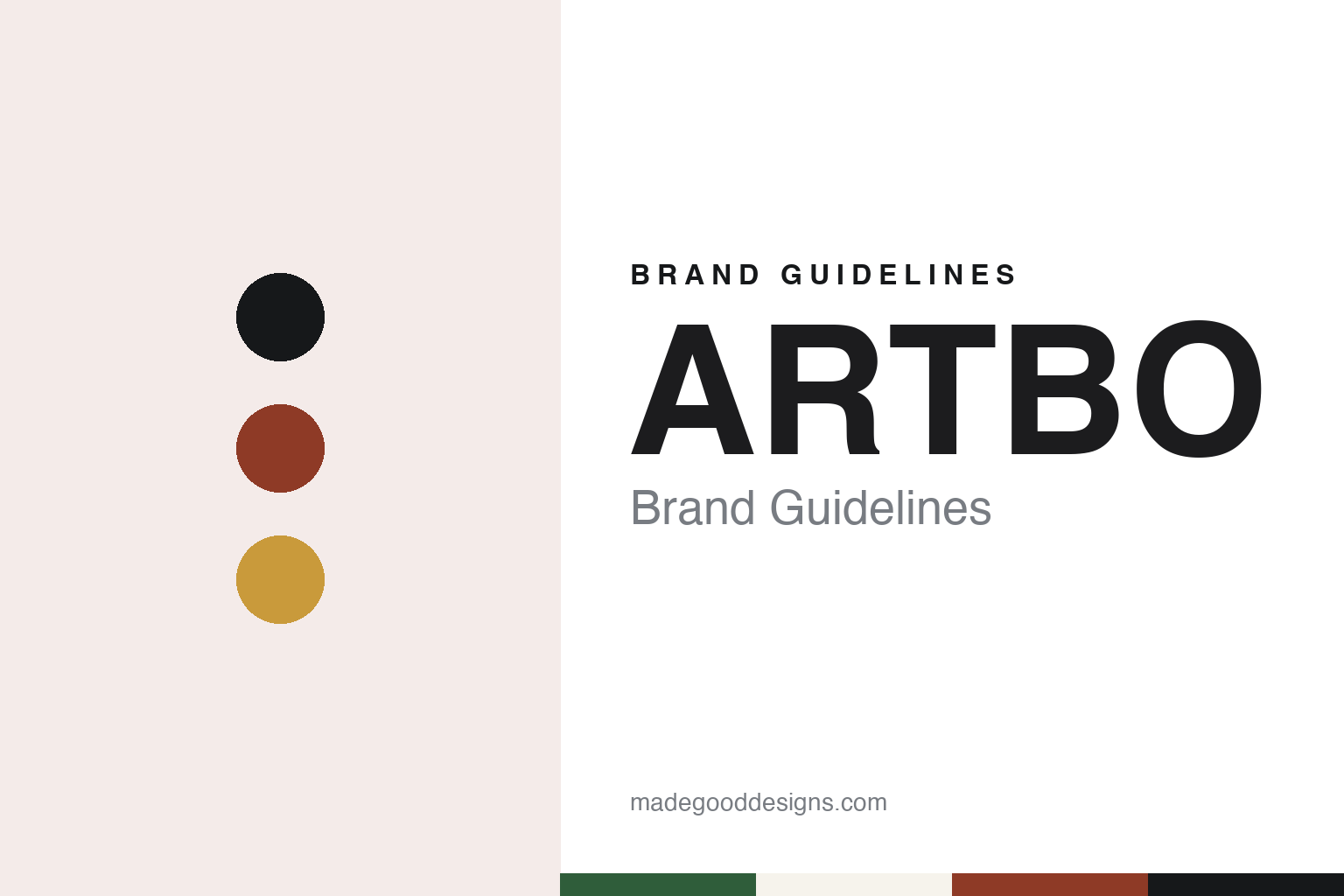
This guide’s ARTBO palette is Brick #8E3A26, Ink #16181A, Andean green #2F5D3A, Ochre #C99A3B and Paper #F6F3EC. The tones are the guide’s own unofficial interpretation, not official ARTBO hex codes.