Abu Dhabi Art Brand Guidelines
The Saadiyat fair that became Frieze Abu Dhabi.
Aa
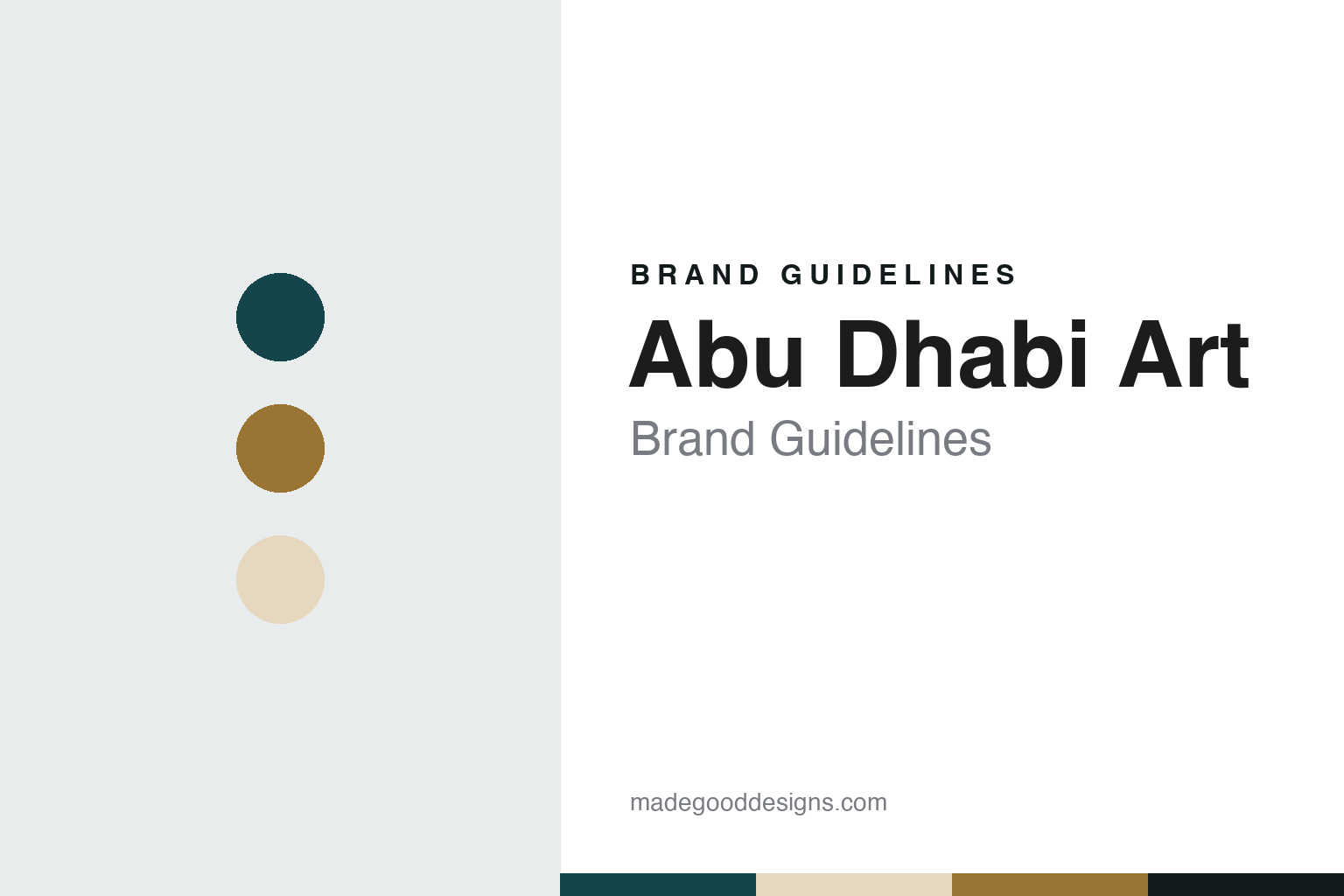
Two constants: a sand, deep teal and brass palette and a geometric sans register. Abstract homage — not an Abu Dhabi Art mark or campaign image; no artwork, logo or poster is reproduced.
Art Paris–Abu Dhabi
A Paris fair’s Gulf edition at the Emirates Palace.
Abu Dhabi Art grew out of a Gulf edition of a Paris fair. On 25 November 2007 Arab News announced Artparis-Abu Dhabi, a modern and contemporary art fair to be held at the Emirates Palace hotel from 27 to 29 November 2007. It was organised in partnership with the Abu Dhabi Authority for Culture and Heritage (ADACH) and the Tourism Development and Investment Company (TDIC), and the newspaper counted more than 40 galleries from France and from several Middle Eastern countries, among them the UAE, Lebanon, Bahrain, Oman and Tunisia.
The Paris side of the arrangement was Art Paris, which The Art Newspaper called “the French modern and contemporary art fair.” In 2008 Gulf News interviewed the fair director, whom it described as the founder of ArtParis in France, ahead of a second Abu Dhabi edition held with the support of ADACH. The Art Newspaper reported on 1 December 2008 that the second edition took place at the Emirates Palace from 18 to 21 November that year, with 59 galleries, mostly from Europe and the Middle East but also from the United States, Korea, Japan and Indonesia.
In 2009 the event took the name Abu Dhabi Art. The fair’s own site says it was launched that year at the Emirates Palace with 42 galleries, organised by what is now the Department of Culture and Tourism – Abu Dhabi (DCT Abu Dhabi). The National dated the first Abu Dhabi Art to 2009 in a September 2025 report; in October 2025 the same paper, like Artforum, counted the fair’s history from 2007, folding in the two Art Paris years. Both dates appear in print, and the difference is the Art Paris prelude.
From 2011 the fair was held at Manarat Al Saadiyat, a cultural centre on Saadiyat Island. The organiser translates the name as “place of enlightenment” and says the building opened in 2009, with three galleries for temporary exhibitions, an art studio, a photography studio and a 250-seat auditorium. It also describes Manarat Al Saadiyat as a visitor centre for the Saadiyat Cultural District, which it says is home to Louvre Abu Dhabi, Zayed National Museum and Guggenheim Abu Dhabi.
Colour
A year-round programme ending in November.
Abu Dhabi Art was built as more than a sales hall. The organiser says its annual programme of installations, exhibitions, talks and events ran across various locations in the emirate through the year and culminated each November in the fair itself. International modern and contemporary galleries showed works for sale, while guest curators were invited each year to shape a programme of exhibitions, talks and performances.
Exhibitors were chosen, the fair says, by an internal committee at DCT Abu Dhabi from proposals submitted through its website, while some were invited directly by guest curators into curated sectors. Its programme pages list strands named Beyond: Emerging Artists and Gateway, community projects, a performance programme, a talks programme and an educational programme with an Art + Tech strand.
The fair kept to November. The 2025 edition ran from Wednesday 19 to Sunday 23 November 2025, open from 2pm to 9pm each day, at Manarat Al Saadiyat. The National reported on 11 September 2025 that more than 140 galleries from 37 countries would take part, with galleries from Algeria, Senegal, the Netherlands, Peru and Tanzania making their debut and a focus on the art scenes of Nigeria, Turkey and the Gulf. Dyala Nusseibeh was named in that report as the fair’s director. The organiser’s own summary says the fair grew from 42 galleries in its first year to 142 in its final edition.
Typography
Fairs, halls and the few days a year.
Art, antiques and collectible-design fairs tend to present themselves through a short name: an acronym built from a longer title, such as FIAC or BRAFA, or a city-based name that ties the event to the place where it is held. These names are usually set in capitals and kept from one year to the next, while each edition adds its own dates, poster or key visual.
The organisers behind them vary. Some fairs are run by dealer associations or non-profit bodies set up by dealers; others by exhibition companies that also stage trade shows; others by charities, chambers of commerce or cultural bodies acting in an institutional role. A committee of dealers or a selection panel usually decides which galleries take part.
Most fairs last only a few days a year, in a landmark hall, a pavilion in a park, an armory or a modern exhibition centre, and many open with a preview or vernissage for invited guests before the public days. Stands are arranged by gallery and often grouped by period or field, from antiquities and Old Masters to modern and contemporary art and twentieth-century design, with talks, guided tours and a curated or younger-galleries section alongside the main aisles. Some fairs add outdoor works or partner venues elsewhere in the city.
For a design guide, these fairs show how an identity can rest on a few constants — a wordmark, a month and a building — while venues, organisers and sections change around them. The guides in this series describe those constants as dated sources record them, with our own colours and type as an unofficial interpretation, and with no rankings, no prices and no claims about the quality or importance of any fair, gallery or work.
Aa
A geometric sans for a plain two-word name. (Specimen set in Outfit, a sans STAND-IN; NOT the Abu Dhabi Art logo.)
Abu Dhabi Art
An artist’s work as the face of each edition.
Rather than keep one fixed poster style, Abu Dhabi Art handed its look to a different artist each year. The fair says it collaborated with artists to create each edition’s visual campaign, and its archive lists them by year from 2017. That year the campaign used photographs by Tarek Al-Ghoussein of the developing Saadiyat Cultural District, which the fair says ran across its print and digital promotion. The 2021 campaign used works by three young UAE artists who had come through the 2019 Beyond: Emerging Artists programme.
For 2025, the final edition, the campaign drew on the sculpture of Shaikha Al Mazrou. The National reported in September 2025 that she was tasked with creating the fair’s “visual identity” and that her 2023 work Beyond All Measures, made in oxidised brass, would be shown; the fair describes the campaign imagery as built from her folded and structured forms.
The fair then changed hands. On 10 October 2025 DCT Abu Dhabi and the London-based fair organiser Frieze announced that it would become Frieze Abu Dhabi. The Art Newspaper reported that day that Frieze would take over the existing fair, that the new event would stay at Manarat Al Saadiyat, that Dyala Nusseibeh would remain director, and that the 19–23 November 2025 edition would be the last Abu Dhabi Art. The fair’s site says that, after its 17th edition in 2025, it continues as Frieze Abu Dhabi, organised by Frieze in partnership with DCT Abu Dhabi. Abu Dhabi Art is no longer held under its own name.
For a design guide, Abu Dhabi Art shows how a fair can keep a plain two-word name and one venue for more than a decade while a commissioned artist supplies the image of each year, and how a state cultural body can run a fair as the end point of a year-round public programme. Compare Frieze, which took the fair over from 2026, and Art Paris, whose Gulf edition came before it. For this guide we use sand, deep teal and brass tones with a geometric sans, an unofficial interpretation; no product or logo is reproduced.
Explore & save
Keep Abu Dhabi Art’s identity on hand — save it to a board in the Made Good inspiration library.
Abu Dhabi Art identity set
Pin the Abu Dhabi Art sand, deep teal and brass palette and the geometric sans register to your own board.
Source & notes
Frequently Asked Questions
What font can I use to match the Abu Dhabi Art look?
This guide describes Abu Dhabi Art’s type as “A geometric sans for a plain two-word name”. Its type specimen is set in Outfit from Google Fonts as a stand-in; Outfit is not Abu Dhabi Art’s own lettering.
What colours are in the Abu Dhabi Art palette?
This guide’s Abu Dhabi Art palette is Deep teal #14454A, Night ink #121A1C, Saadiyat sand #E6D8BF, Oxidised brass #9A7432 and Gallery white #F7F4EE. The tones are the guide’s own unofficial interpretation, not official Abu Dhabi Art hex codes.