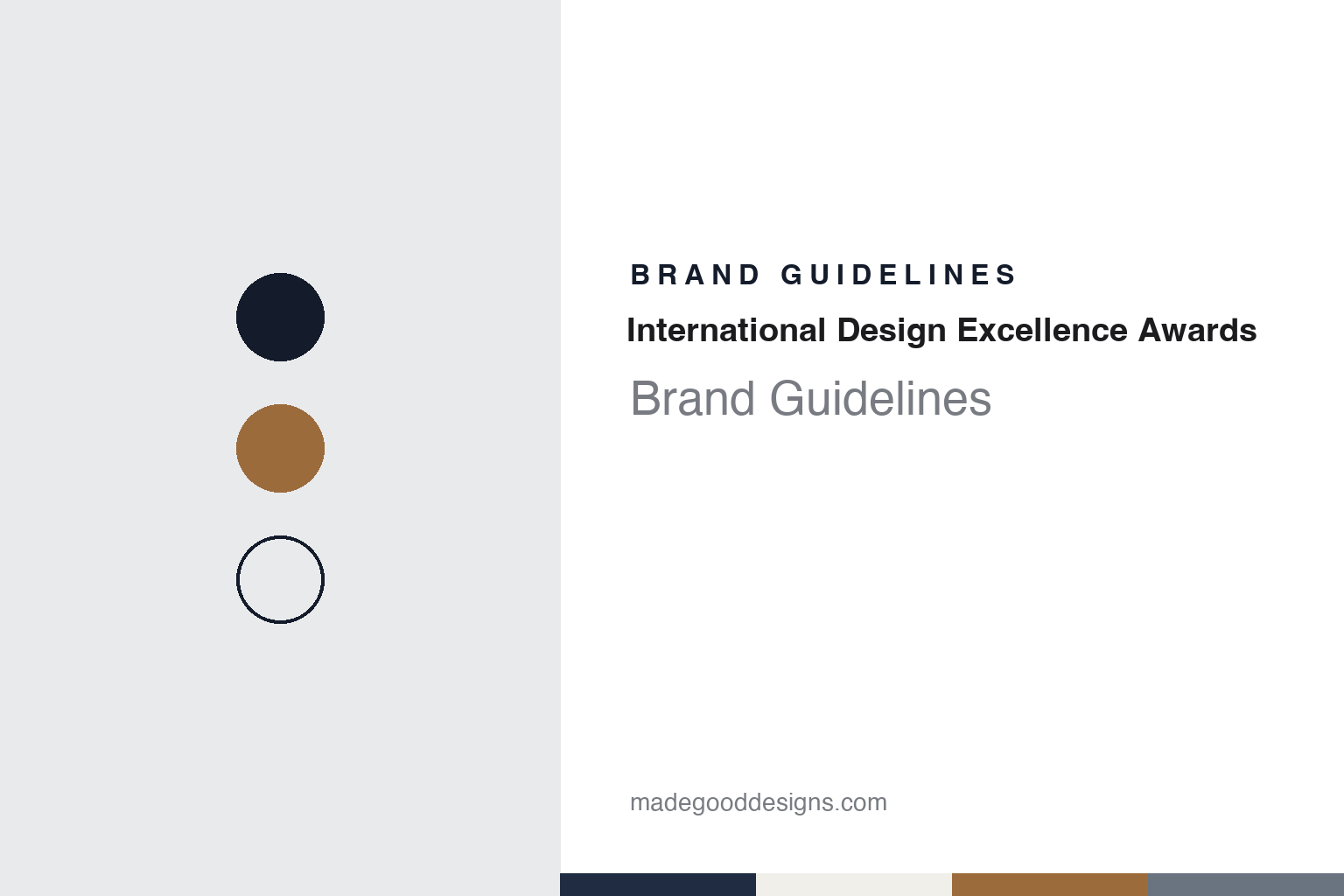
International Design Excellence Awards Brand Guidelines
The American industrial-design awards judged on five criteria since 1980.
Aa
Two constants: a navy, studio white and bronze palette and an Industrial sans register. Abstract homage — not an IDEA trophy, logo or mark; no award or product is reproduced.
From industrial to international
A society’s awards, renamed once.
The International Design Excellence Awards, shortened to IDEA, are the awards programme of the Industrial Designers Society of America (IDSA), the professional body for industrial designers in the United States, which says it was founded in 1965. English Wikipedia gives 1980 as the year the programme was established, and IDSA’s own magazine, Innovation, marked 35 years of the awards in its winter 2015 issue with a selection of Gold awards dating back to 1980.
The programme began under a different name. Innovation called it “originally the Industrial Design Excellence Awards,” and English Wikipedia says the name changed to International Design Excellence Awards in 2007; the four-letter short form, IDEA, survived the change. English Wikipedia also says the programme was for years co-sponsored by the business magazine BusinessWeek, and in 2010 by Fast Company, together with IDSA. Today IDSA presents it on its own website as an IDSA programme, with its own gallery of past winning entries, a published jury list for each year and a set of rules and regulations for entrants.
The organiser behind it is a membership society rather than a design council or a trade-fair company. IDSA describes itself as the voice of the industrial design profession in the United States, led largely by volunteers through a board of directors, committees and councils, with a professional staff. The awards sit beside its conferences and its magazine, Innovation, in the society’s yearly calendar.
IDSA’s press release for the 2026 edition, dated August 2026, described the programme as being in its 46th year, which matches the 1980 start. The same release said the 2026 competition drew more than 2,000 entries across 20 categories from more than 23 countries, and that more than 40 designers, consultants, academics and industry figures served on the jury. Core77 reported that the 2015 edition had drawn 1,700 student and professional entries in 17 general categories, plus design research, digital design and design strategy, from the United States and almost three dozen other countries.
Colour
Five criteria, two rounds, three medals.
IDSA judges every entry on five criteria, which it says have stayed largely unchanged since the programme began: Design Innovation, Benefit to the User, Benefit to the Client or Brand, Benefit to Society and Appropriate Aesthetics. Its own wording turns each into questions — how new a product or service is, how it improves the user’s life, what its business effect is, whether it considers social and cultural factors and sustainable materials, and whether its form, colours and finishes suit its use.
The categories cover far more than objects. IDSA’s current list runs from Automotive & Transportation and Consumer Technology to Furniture & Lighting, Medical & Health and Packaging, and also includes Branding, Digital Interaction, Environments, Service Design, Social Impact Design, Concepts & Speculative Design and a Student Design category for coursework. For 2026 IDSA added the Impact Award, an add-on judged separately, which looks at the outcomes of a design rather than the design itself. IDSA said the 2026 Impact Awards were given in areas including accessibility and inclusion, health and well-being, sustainability, technological innovation, communities, cultural continuity and basic human needs, and that the jury considers only the answer to the award’s own question when scoring.
Judging takes place in two rounds. For the 2026 edition IDSA set an opening entry period from January to March, a second round from April to May for invited entries, and notification of results in June. Entries that reach the second round and do not win are listed as Finalists. Winning designs receive Gold, Silver or Bronze, and IDSA says one trophy is given for each winning design; English Wikipedia says the trophy is a statue made by the New York firm Society Awards. Above the medals sits a single overall prize, which IDSA calls the programme’s highest distinction, chosen by the jurors from the year’s winners during the in-person evaluation.
Typography
Design and documentation.
Design awards and competitions usually present themselves through a short name and a single sign. Some reduce the name to an acronym or a pair of letters; others rely on a colour or a simple shape. That sign is often carried by a label that winners may print on products, packaging and their own marketing, and sometimes by a named trophy or sculpture handed over at a ceremony.
The organisations behind them vary. Some programmes are run by design councils or design centres, some by foundations or the companies they own, and some grew out of trade fairs, where a special exhibition of well-made goods turned into a yearly selection. Others are run by professional societies of designers or by design publications, and a single organiser may keep several sister programmes for students, concepts or particular disciplines next to its main award.
Most follow a yearly cycle. Entries open for a set period, juries of designers, teachers and specialist writers meet to judge them, often in several rounds and at more than one level of award, and the results are presented at a ceremony or festival. The awarded work then lives on in exhibitions, yearbooks, museums or online archives, which become a record of what each year’s juries selected.
Their disciplines range from product and industrial design to packaging, communication design, interiors, architecture, digital interfaces and unbuilt concepts. This guide describes each programme on its own terms — who founded it, who runs it, how the cycle works and how its name and mark are shown — without ranking the programmes or naming the work they have recognised.
Aa
An industrial sans — for a programme built around product, service and system design. (Specimen set in Archivo, a sans STAND-IN; NOT the IDEA logo.)
International Design Excellence Awards
A jury at The Henry Ford.
The second round of judging is held in person at The Henry Ford, the museum of American innovation in Dearborn, Michigan. Core77 reported in 2015 that two and a half days of IDEA judging had just ended at the museum in June, with about two dozen jurors deciding the Gold, Silver and Bronze awards, and that nearly 700 entries had reached that second round. IDSA said in August 2026 that The Henry Ford had hosted the jury’s in-person evaluation for more than 15 years, and it says Gold, Silver and Bronze products may be taken into the museum’s permanent collection.
The results are announced at a ceremony tied to IDSA’s own conference. Core77 reported that in 2015, unlike earlier years, the winners would not be revealed until the awards ceremony on 22 August at IDSA’s International Conference in Seattle, with a black-tie gala. For the 2026 edition IDSA said the ceremony and gala took place in person in Pasadena, California, alongside its International Design Conference, and its results release was dated from Pasadena on 27 August 2026.
People are named in their roles. Core77 quoted IDSA’s executive director in 2015, Daniel Martinage, praising the work of that year’s jury chair. In 2026 the jury was chaired by the designer Phnam Bagley, IDSA said.
For a design guide, the International Design Excellence Awards show how a professional society can keep a short acronym, a fixed set of judging criteria and a medal system steady across decades and one change of name. Compare Fast Company, a former co-sponsor, and the Core77 Design Awards, another American programme. For this guide we use navy, a studio white and a bronze with a sans, an unofficial interpretation; no product or logo is reproduced.
Explore & save
Keep International Design Excellence Awards’s identity on hand — save it to a board in the Made Good inspiration library.
International Design Excellence Awards identity set
Pin the IDEA navy, studio white and bronze palette and the Industrial sans register to your own board.
Source & notes
Frequently Asked Questions
What font can I use to match the International Design Excellence Awards look?
This guide describes International Design Excellence Awards’ type as “An industrial sans — for a programme built around product, service and system design”. Its type specimen is set in Archivo from Google Fonts as a stand-in; Archivo is not International Design Excellence Awards’ own lettering.
What colours are in the International Design Excellence Awards palette?
This guide’s International Design Excellence Awards palette is Jury navy #1F2C42, Steel #6A7380, Studio white #F1EFEA, Bronze #9C6B3C and Paper #FAF9F6. The tones are the guide’s own unofficial interpretation, not official International Design Excellence Awards hex codes.