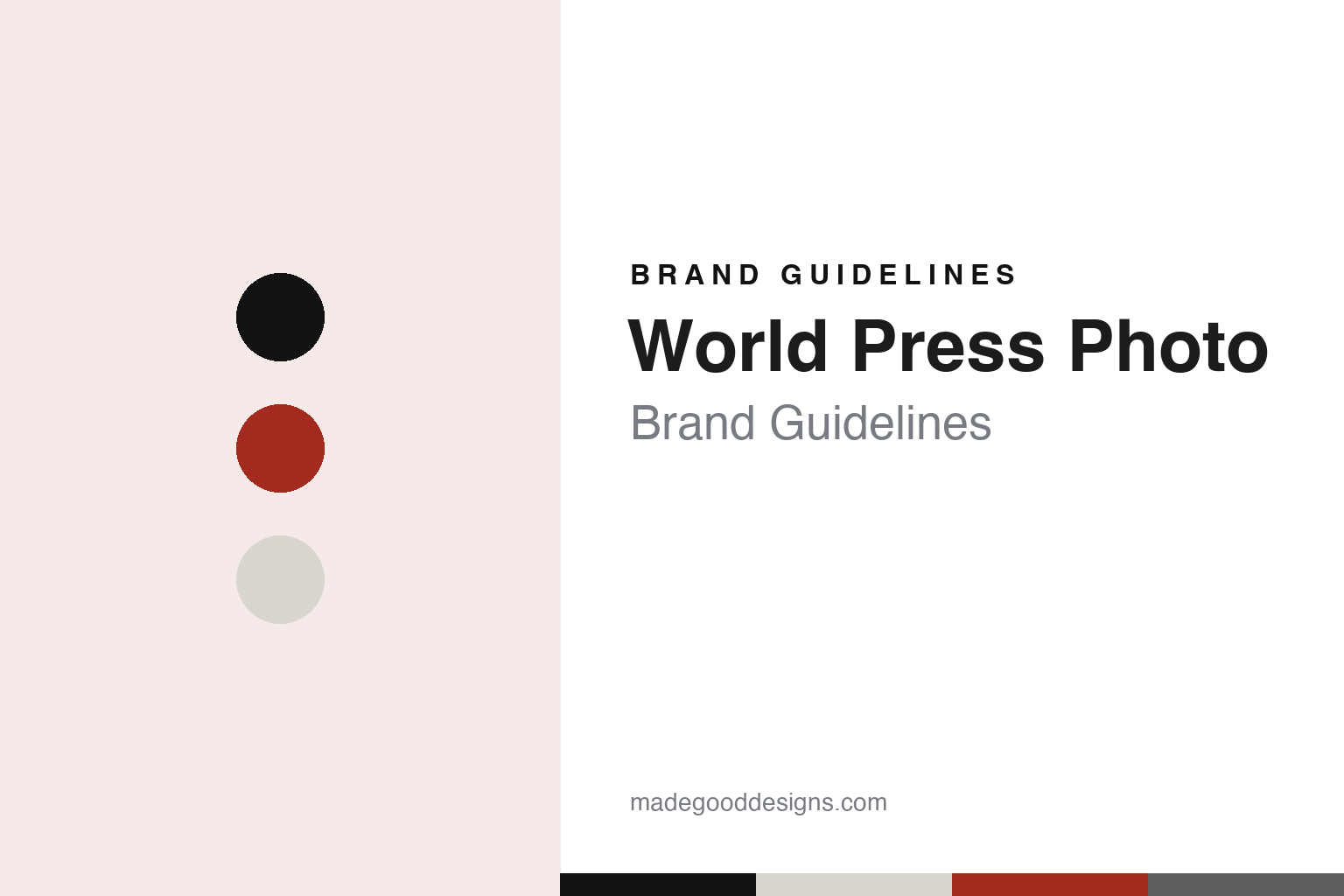
World Press Photo Brand Guidelines
Amsterdam’s photojournalism contest since 1955.
Aa
Two constants: a black, red and newsprint palette and a grotesque sans register. Abstract homage — not a World Press Photo asset; no photograph, logo or award is reproduced.
From the Zilveren Camera
A Dutch association opens its contest to the world.
World Press Photo began in 1955 in the Netherlands. Members of the Dutch photojournalists’ association, the Nederlandse Vereniging van Fotojournalisten (NVF), had the idea of turning their national competition, the Zilveren Camera, into an international one, the organisation’s history page says; the new contest marked the association’s 25th anniversary, with a public exhibition in December 1955. That first year, it says, 42 photographers from 11 countries sent in just over 300 photographs. Dutch Wikipedia also names the NVF as the founder.
What began as a one-off event became annual almost at once. English Wikipedia says the World Press Photo Foundation was formally set up as a non-profit organisation in Amsterdam in 1960. Dutch Wikipedia notes that the contest did not take place in three years, 1959, 1961 and 1970, while it was still part of the association. In 2019, Dutch Wikipedia adds, the foundation moved into the World Press Photo House, the former engineer’s house on the Westergasfabriek site in Amsterdam.
The categories grew with the press. The organisation says the first contests had only a few divisions, news and sport for single pictures and features and picture stories for series; a separate section for colour photography followed in 1965, features split into news and general features in the 1970s, and ten named categories were set in 1975. The first jury had five members, from the United Kingdom, West Germany, France, Belgium and the Netherlands; specialised juries were introduced in 2010, and a separate children’s jury awarded its own prize from 1984 to 2003, the organisation says.
Colour
Six regions, three formats, one Photo of the Year.
The contest was rebuilt for 2022. In a 2021 article the organisation said that in that year’s contest only 7% of entrants came from South America, 5% from Southeast Asia and Oceania and 3% from Africa, and announced a regional system of six world regions based on the United Nations M49 classification. Entries are judged in the region where they were shot. Thematic categories gave way to format-based ones: Singles, Stories, Long-Term Projects and, at first, Open Format. The Dutch photography magazine Focus reported on 24 March 2022 that the contest had been divided into six regions, with 24 regional winners from which four global winners would be named on 7 April. Australian Photography reported on 25 March 2022 that the 65th contest had drawn 64,823 entries from 4,066 photographers in 130 countries.
The model was adjusted for 2025. The organisation said in 2024 that winners would rise from 30 to 42, honourable mentions would end, and separate global awards for stories and long-term projects would be replaced by a single World Press Photo of the Year with two runners-up. Its current pages list three categories, Singles, Stories and Long-Term Projects, across six regions: Africa; Asia Pacific and Oceania; Europe; North and Central America; South America; and West, Central and South Asia. For the 2027 contest the organisation lists three Nature and three Sports awards, chosen from Singles and Stories entries rather than entered separately.
Judging runs in two stages, as the organisation describes it. In each region a jury of five professionals from or working in that region makes a selection; a global jury, made up of the six regional chairs and a global chair, then decides the winners and chooses the Photo of the Year. The photographer’s name is not shown to the jury at any stage, the organisation says.
Typography
Design and documentation.
Architecture, art and photography prizes tend to present themselves through the institution behind the name. A family foundation, a professional institute, a museum, a gallery or a company usually sets the rules, chooses the jury and publishes the result, and its own name often sits in the title or in a line such as “sponsored by” at the foot of the page.
The object handed over is rarely a statuette. Many of these programmes give a medal, a bronze, a certificate or a written citation, and some give an exhibition instead of, or as well as, an object. A medal can carry an inscription or ornament borrowed from architectural history, and a citation puts the jury’s reasoning on paper, so the identity leans on lettering and text as much as on a symbol. Organisers also tend to publish the names of the jury and the criteria it applies, which adds another layer of text to the identity.
Selection follows a recognisable rhythm. Nominations or entries close on a fixed date, a jury or panel deliberates, and in many cases a shortlist is published months before the result; some prizes publish no shortlist at all and keep their deliberations confidential. The cycle can be yearly, or longer, and the announcement or ceremony is often staged in a different building or city each time.
What carries the identity between ceremonies is the record. Touring exhibitions, catalogues and books, websites with archives of past citations, and photographs of buildings, artworks and images keep the programme visible, and for a designer they set the tone: neutral grounds, careful type and plenty of room for the work being shown.
Aa
A grotesque sans for a contest built around the news page. (Specimen set in Archivo, a sans STAND-IN; NOT the World Press Photo logo.)
World Press Photo
An exhibition that opens in Amsterdam and travels.
The exhibition has been part of World Press Photo since the start: the organisation says the winning photographs have been put together into a show every year since the first contest. Its flagship exhibition opens in De Nieuwe Kerk on Dam Square in Amsterdam. A media release dated 1 February 2021 said the foundation and De Nieuwe Kerk had signed a new five-year agreement on 29 January 2021, that the exhibition had been shown there since 2014 and had also been shown there every year from 1982 to 1999, and that the Amsterdam showing always starts the year’s worldwide tour.
The 2025 edition shows how the calendar works. De Nieuwe Kerk’s page says the exhibition of the 68th contest ran from 18 April to 21 September 2025, after six regional juries and an international jury had judged 59,320 entries from 3,778 photographers in 141 countries and chosen 42 winners. The Dutch Royal House’s agenda records that the 2025 award ceremony took place in De Nieuwe Kerk on 16 May 2025, alongside a presentation marking the contest’s 70th anniversary. The organisation says its exhibitions now reach more than 80 locations a year.
Print remains a second carrier of the name. The foundation publishes a yearbook of each contest’s winners in six languages, according to Dutch Wikipedia and the organisation’s contest pages, and keeps an online archive of the contest from 1955 to the present. Every winner receives a physical award, the organisation says. Its education work includes the Joop Swart Masterclass for early-career photographers, which English Wikipedia dates to 1994.
The organisation uses the one name for the foundation, the contest, the exhibition and the yearbook alike.
For a design guide, World Press Photo shows how one name can carry a contest, a yearbook and a touring exhibition at once. Compare Wildlife Photographer of the Year and the Sony World Photography Awards, two other photography competitions with exhibitions. For this guide we use black, a deep red and newsprint grey with a sans, an unofficial interpretation; no product or logo is reproduced.
Explore & save
Keep World Press Photo’s identity on hand — save it to a board in the Made Good inspiration library.
World Press Photo identity set
Pin the World Press Photo black, red and newsprint palette and the grotesque sans register to your own board.
Source & notes
Frequently Asked Questions
What font can I use to match the World Press Photo look?
This guide describes World Press Photo’s type as “A grotesque sans for a contest built around the news page”. Its type specimen is set in Archivo from Google Fonts as a stand-in; Archivo is not World Press Photo’s own lettering.
What colours are in the World Press Photo palette?
This guide’s World Press Photo palette is Press black #121212, Darkroom red #A32A1E, Contact-sheet grey #5C5E60, Newsprint #D9D6CF and Paper #F5F4F1. The tones are the guide’s own unofficial interpretation, not official World Press Photo hex codes.
When was World Press Photo founded?
World Press Photo was founded in 1955 (first contest), in Amsterdam, Netherlands.