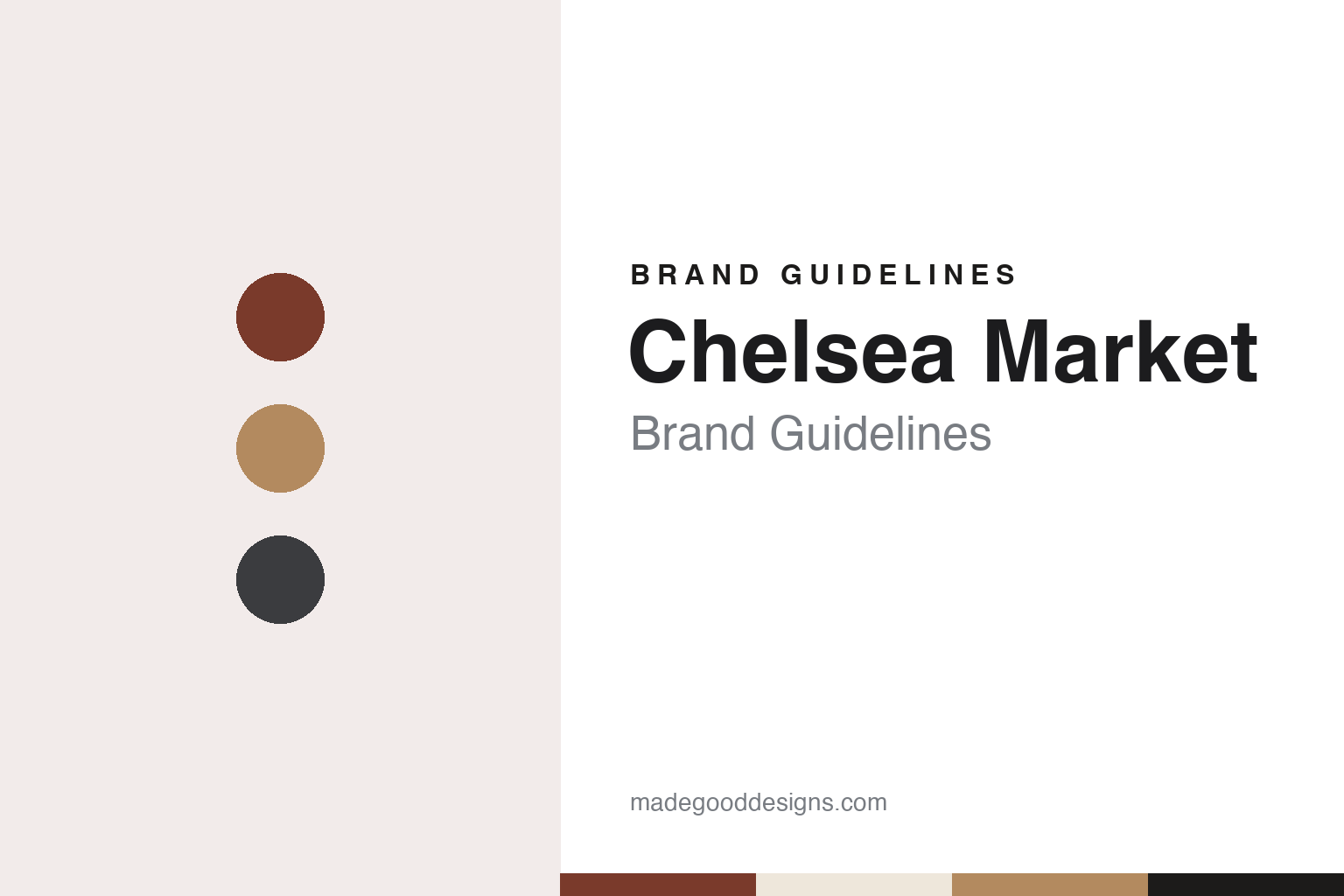
Chelsea Market Brand Guidelines
A biscuit factory’s brick, timber and monograms, turned into a food hall.
Aa
Two constants: a factory brick, iron grey and timber tan palette and a slab serif register. Abstract homage — not a Chelsea Market sign or mark; no logo, mosaic or mural is reproduced.
The biscuit block
Nineteen buildings, one company and a cookie.
Chelsea Market fills a whole Manhattan block between Ninth and Tenth Avenues and 15th and 16th Streets, in the former factory complex of the National Biscuit Company, later Nabisco. English Wikipedia says local bakeries began building on the site in the 1890s and that a merger of several companies created the National Biscuit Company, often known then as NBC, in 1898. Nabisco kept expanding the works until it left for the suburbs in 1958. Wikipedia counts 19 separate structures in the final complex, from production floors to offices; 6sqft counted 17 in 2017. Most of the original buildings, Wikipedia says, are heavy timber construction with brick facades, designed by the firm Romeyn & Stever, and 6sqft dates the main 11-storey building to 1913, built on landfill.
The Tenth Avenue building is a later structure of the 1930s by Nabisco’s architect Louis Wirsching Jr., which replaced the original bakeries on that side. Wikipedia says it was built at the same time as the elevated freight railway now known as the High Line, so that a freight siding could run directly into the building. Bridges were added to link the complex with its neighbours, including an aluminium-clad walkway across Tenth Avenue.
The complex is where the Oreo began. Untapped New York reported in 2015, and 6sqft in 2017, that Nabisco developed the Oreo Biscuit there in 1912; both say it was first sold to a grocer in Hoboken, New Jersey, on 6 March 1912 and trademarked a week later. After Nabisco left, Wikipedia says, the buildings passed through several decades of varying occupancy and light industrial use.
Commercial Observer reported in May 2018 that the developer Irwin Cohen bought the former factory in 1993. With the architect Jeff Vandeberg, Cohen turned it into offices above a retail concourse at ground level: Wikipedia says the back lots of the individual buildings were joined into one central concourse with entrances on Ninth and Tenth Avenues, completed in April 1997. 6sqft reported that the first office tenants included Food Network and several advertising companies.
Colour
A food hall below, offices above.
Chelsea Market changed hands in 2018. The Associated Press reported on 20 March 2018 that Google had finalised its purchase of the building, which stands across Ninth Avenue from its New York headquarters; the property company Jamestown announced the sale and continued to manage the food hall. English Wikipedia names the owner as Google’s parent company, Alphabet Inc. Office tenants named by the AP at the time included Major League Baseball and Food Network, and Wikipedia says Google and YouTube took space on several of the upper floors.
The market describes itself as a neighbourhood market in the Meatpacking District. Along the concourse it lists a fishmonger, a whole-animal butcher, artisanal cheeses, fresh produce and imported Italian dry goods, alongside places to eat; its website also lists shops, art exhibitions and events, and says retail leasing is handled by Jamestown. The market says it attracts about six million visitors a year, and the AP described the food hall in 2018 as drawing millions of visitors annually.
The building sits where two parts of the city meet. The High Line, the former elevated freight line that opened as a park in the spring of 2009, passes through the Tenth Avenue side of the building, and a bridge across Tenth Avenue connects the complex with a neighbouring building that was once part of the Nabisco works and is now separately owned. Wikipedia says Chelsea Market lies within the Gansevoort Market Historic District listed on the New York State and National Registers of Historic Places; the city’s own historic district, designated by the Landmarks Preservation Commission in 2003, stops short of 15th Street.
Typography
Public markets and food halls.
Public markets and food halls in North America and Australia usually introduce themselves through who stands behind the name and when the market began. Some are run by a city council or a public development authority set up by a city charter, some by a non-profit corporation and some by a private property company. A founding date tends to sit close to the name, and a market’s documented origins and its present building often carry different dates.
The buildings do much of the work of an identity. Several markets occupy structures built for something else: space under a former railway train shed, a ferry terminal on a waterfront, or the brick and timber blocks of a former biscuit factory. Others grew as rows of covered arcades and open-sided sheds added stall by stall over decades, with halls for meat and fish and long tables for farmers who rent space by the day.
Lettering is often attached to the architecture rather than drawn for a page. A rooftop sign, a clock above an entrance, painted lettering on a wall or old company monograms set into an entryway can become the image that a market protects as a trademark, and in a historic district a commission may need to approve any change to that signage.
Inside, most of these markets describe their mix in general terms: fresh produce, fish, butchers, bakers and delis alongside food counters with seating, craft stalls and shops. Some are not buildings at all but weekly open-air markets that set up in a park or on a waterfront lot. Each guide in this series describes one market from dated sources and pairs it with a palette and typeface of our own.
Aa
A slab serif for brick and timber. (Specimen set in Bitter, a slab-serif STAND-IN; NOT the Chelsea Market logo.)
Monograms and drill bits
The factory as the identity.
Chelsea Market takes its look from the factory. The market itself credits the long history of the site and “the stripped-down brick architecture of the building” with giving it its character, and Wikipedia describes the complex as distinguished by light-hearted touches and the re-use of historic urban artifacts. 6sqft reported in 2017 that the conversion kept the old factory floors, some old signs and disused ducts, and added old cast-iron light poles, banks of television sets and portholes in the lobby. The same report singled out an artificial waterfall made from discarded drill bits and an exposed pipe.
Nabisco’s own lettering survives as part of the setting. 6sqft reported monogram mosaics with the letters NBC, for National Biscuit Company, in the small entryways along 15th Street, and two painted Nabisco murals inside the market: one showing the Uneeda biscuit boy in a raincoat and one advertising Oreos. It also described two bridges that tie the block to its neighbours: a classical pedestrian bridge to the former American Can Company building on 14th Street, and the aluminium-covered Art Deco bridge across Tenth Avenue designed by Wirsching.
The name is geographic. Chelsea Market is named after Chelsea, the Manhattan neighbourhood in which Wikipedia places it, while the market’s own website places it in the Meatpacking District next door. The guide below works from the building: brick, timber, iron and the old company monograms. For designers that means a heavy, workmanlike register, with type that sits comfortably beside painted factory lettering rather than competing with it.
For a design guide, Chelsea Market shows how a food hall can take its whole identity from the industrial building it reuses, from brick and timber to a biscuit company’s monograms. Compare Google, which has owned the building since 2018, and MoMA, another Manhattan institution. For this guide we use a factory brick, an iron grey and a timber tan with a serif, an unofficial interpretation; no product or logo is reproduced.
Explore & save
Keep Chelsea Market’s identity on hand — save it to a board in the Made Good inspiration library.
Chelsea Market identity set
Pin the Chelsea Market factory brick, iron grey and timber tan palette and the slab serif register to your own board.
Source & notes
Frequently Asked Questions
What font can I use to match the Chelsea Market look?
This guide describes Chelsea Market’s type as “A slab serif for brick and timber”. Its type specimen is set in Bitter from Google Fonts as a stand-in; Bitter is not Chelsea Market’s own lettering.
What colours are in the Chelsea Market palette?
This guide’s Chelsea Market palette is Factory brick #7A3A2B, Iron grey #3B3C3F, Timber tan #B38A5F, Concourse cream #EEE7DB and Ink #1C1B1A. The tones are the guide’s own unofficial interpretation, not official Chelsea Market hex codes.
Who owns Chelsea Market?
Chelsea Market has been owned by Google since 2018; food hall managed by Jamestown.