Het Spoorwegmuseum Brand Guidelines
A railway museum in a restored 1874 station, with a workshop hall behind it.
Aa
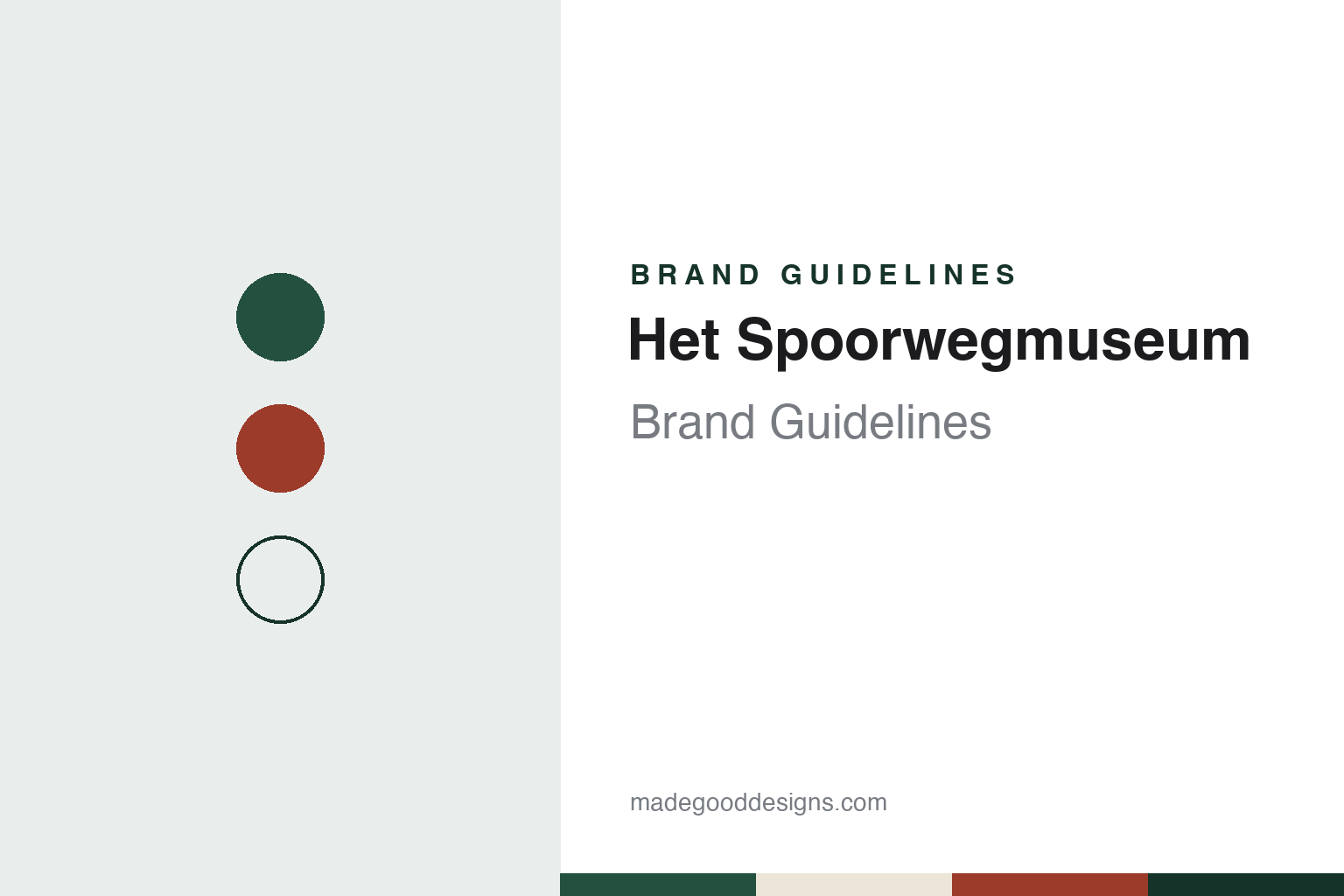
Two constants: a platform green, brick red and station stone palette and a slab serif register. Abstract homage — not a Spoorwegmuseum object or mark; no train, logo or sign is reproduced.
A foundation of 1927
From a railway office to a closed station.
Het Spoorwegmuseum, “the Railway Museum,” is the railway museum of the Netherlands in Utrecht, known until 2005 as the Nederlands Spoorwegmuseum. Dutch Wikipedia dates its start to 7 January 1927, when the Stichting Nederlandsch Spoorwegmuseum, a foundation, was set up; the museum gives the same founding date. The collection was first housed in a since-demolished building of the Nederlandse Spoorwegen (NS) in Utrecht, where the Nederlandsch Spoorwegmuseum officially opened on 1 December 1928. At first it held mainly pictures, documents and railway objects rather than trains.
In 1935 the museum moved into Hoofdgebouw I, the NS head office on the Moreelsepark in Utrecht. Dutch Wikipedia records that the first efforts to keep historic rolling stock date from the 1930s, and that part of that stock was lost in the war years. In October 1941 there was no more room for the museum at the head office; from 30 May 1942 the collection was shown in the east wing of the Rijksmuseum in Amsterdam, which closed in September 1944. After the war the collection was stored on an upper floor of Amsterdam Centraal station while a new home was sought.
That home came in 1951, when F.Q. den Hollander, then president-director of NS, designated the Maliebaan station in Utrecht, a station on the old eastern line that had closed in 1939, according to Dutch Wikipedia. The station building dates from 1874 and was designed by A.L. van Gendt; it is listed as a national monument, a rijksmonument. After conversion the museum opened there on 5 November 1954. The former station’s tracks gave it room to show historic trains, and for decades a long row of steam locomotives along the first platform was the most visible part of the display.
Colour
A restored station and a workshop hall.
The site grew in stages. Dutch Wikipedia lists a covered platform on the rear site in 1975 and a second in 1977, reached by a footbridge over working goods tracks, and a large renovation in 1988–89, finished in the year NS marked 150 years of railways in the Netherlands. In the 1990s a goods shed of 1881 from Nijverdal was re-erected on the site; the museum now uses it as Loods Nijverdal, an open store of signals, ticket machines and other objects.
The museum closed in September 2003 for its largest rebuilding and reopened in June 2005, when it dropped “Nederlands” from its name. The 1874 station was largely returned to its nineteenth-century state, with its ticket hall, restaurant room and waiting rooms by class, and with the royal waiting room from the Den Haag Staatsspoor station, demolished in 1973, rebuilt inside. Behind it a large new hall by Gert-Jan de Jong of Arc2 architecten in Almere, designed with the industrial character of a nineteenth-century railway workshop, was built to house the whole train collection. The grounds around it were laid out as a railway landscape with a turntable, a signal box from Hoogezand-Sappemeer and a water tower.
The 2005 relaunch arranged the museum as a sequence of themed “worlds,” built on the idea of the nineteenth-century station as a gateway to the world, Dutch Wikipedia says. Some are presented like theme-park attractions. De Grote Ontdekking (“The Great Discovery”) begins with a staged lift ride down a mine shaft and ends on a richly decorated platform in 1839; Stalen Monsters (“Steel Monsters”) is a dark ride about railway work and steam locomotives; and De Vuurproef (“The Trial by Fire”) is a simulator journey through two centuries of rail history. Treinen door de Tijd (“Trains Through Time”) shows rolling stock from early steam engines and wooden carriages to electric trains, with guides the museum calls EduTRAINers opening vehicles for visitors.
Dutch Wikipedia puts the rolling-stock collection at more than 120 vehicles, with those that do not fit in Utrecht kept at a carriage works in Blerick. Key objects include De Arend, a 1938 replica of the locomotive that pulled the first Dutch train between Amsterdam and Haarlem in 1839, which runs on a stretch of broad-gauge track laid in 2005 and extended in 2014; SS 13, built by Beyer, Peacock in Manchester in 1865, which Dutch Wikipedia calls the oldest surviving steam locomotive in the Netherlands; and the royal saloon carriages, presented since June 2026 in Koninklijke Klasse (“Royal Class”), a display the museum says was made with the cooperation of NS.
Typography
Transport, railway and maritime museums.
A transport, railway or maritime museum usually has an organisation behind its name: a charitable trust, a city service, a state or national agency, or a museum group that runs several sites under one umbrella. Some began as collections kept by railway companies or transport operators, which set aside old buses, locomotives or carriages as they left service, and only later passed into public hands. The founding date of a collection and the opening date of its present building are often decades apart.
The buildings are often second-hand. Former flower markets, locomotive depots, goods yards, goods stations and railway stations have been turned into galleries, and many keep the features of their first use: a turntable at the centre of an engine shed, long roofs over former platforms, rail links that still let large vehicles in and out. Other museums commission purpose-built halls, sometimes with dramatic roofs, and a few are built around a single ship that sits at the heart of the museum.
Collections are usually described in general terms: locomotives and rolling stock, buses, trams, cars, aircraft and vessels, together with signals, tickets, uniforms, models, posters, photographs and engineering drawings. Many museums keep a separate store or depot for objects not on show, open to visitors on set days, and run programmes for schools, families and researchers, from libraries and archives to guided tours.
Visual identity in this category tends to borrow from transport design itself. Museums linked to a transport operator may use that operator’s symbols, lettering and colours, and the liveries, nameplates and posters in the collection give designers a ready vocabulary of their own. Refurbishments and reopenings, each with its own dates and architects, often bring a refreshed identity with them.
Aa
A sturdy slab serif in the spirit of station lettering. (Specimen set in Bitter, a serif STAND-IN; NOT the Spoorwegmuseum logo.)
Het Spoorwegmuseum
A foundation, a station and a train hall.
The museum is run by the Stichting Nederlands Spoorwegmuseum, a foundation led by a director-manager under a supervisory board, the museum says, and it is a registered museum in the Netherlands, according to Dutch Wikipedia. It names the rail-infrastructure manager ProRail among its permanent partners. Its links with NS appear throughout its history: the first collection sat in an NS building, the NS head office housed it from 1935, and the NS president-director chose the Maliebaan station in 1951.
Visitor numbers are documented by the local press. The Utrecht news site DUIC reported in January 2024 that the museum drew 495,000 visitors in 2023, a record for the museum, ahead of the 444,000 of 2017, and that the Maliebaan station, now its entrance building, was marking 150 years in 2024.
The museum presents itself through two buildings side by side: the restored 1874 station, with its period halls and royal waiting room, and the 2005 hall built in the manner of a railway workshop. Inside the station, a projection called Droomsporen (“Dream Tracks”) brings the hall ceiling to life to tell the story of the building’s several lives, the museum says. Behind both, the turntable and signal box keep the working railway in view.
For a design guide, Het Spoorwegmuseum shows how a museum can use a restored station as its front door and a workshop-style hall as its working space. Compare NS Dutch Railways, the railway company that found the museum its station, and the Rijksmuseum, which housed the collection from 1942 to 1944. For this guide we use a deep platform green, a brick red and a pale station stone with a serif, an unofficial interpretation; no product or logo is reproduced.
Explore & save
Keep Het Spoorwegmuseum’s identity on hand — save it to a board in the Made Good inspiration library.
Het Spoorwegmuseum identity set
Pin the platform green, brick red and station stone palette and the slab serif register to your own board.
Source & notes
Frequently Asked Questions
What font can I use to match the Het Spoorwegmuseum look?
This guide describes Het Spoorwegmuseum’s type as “A sturdy slab serif in the spirit of station lettering”. Its type specimen is set in Bitter from Google Fonts as a stand-in; Bitter is not Het Spoorwegmuseum’s own lettering.
What colours are in the Het Spoorwegmuseum palette?
This guide’s Het Spoorwegmuseum palette is Platform green #24513F, Depot ink #16332A, Station stone #EDE6D8, Brick red #9C3B2A and Paper #F8F6F1. The tones are the guide’s own unofficial interpretation, not official Het Spoorwegmuseum hex codes.
When was Het Spoorwegmuseum founded?
Het Spoorwegmuseum was founded on 7 January 1927 (as a foundation), in Utrecht, Netherlands.
Where is Het Spoorwegmuseum based?
Het Spoorwegmuseum is based in Maliebaan station (1874) (since 1954).