Kennedy Space Center Visitor Complex Brand Guidelines
A spaceport’s front door, grown from Sunday drive-through tours.
Aa
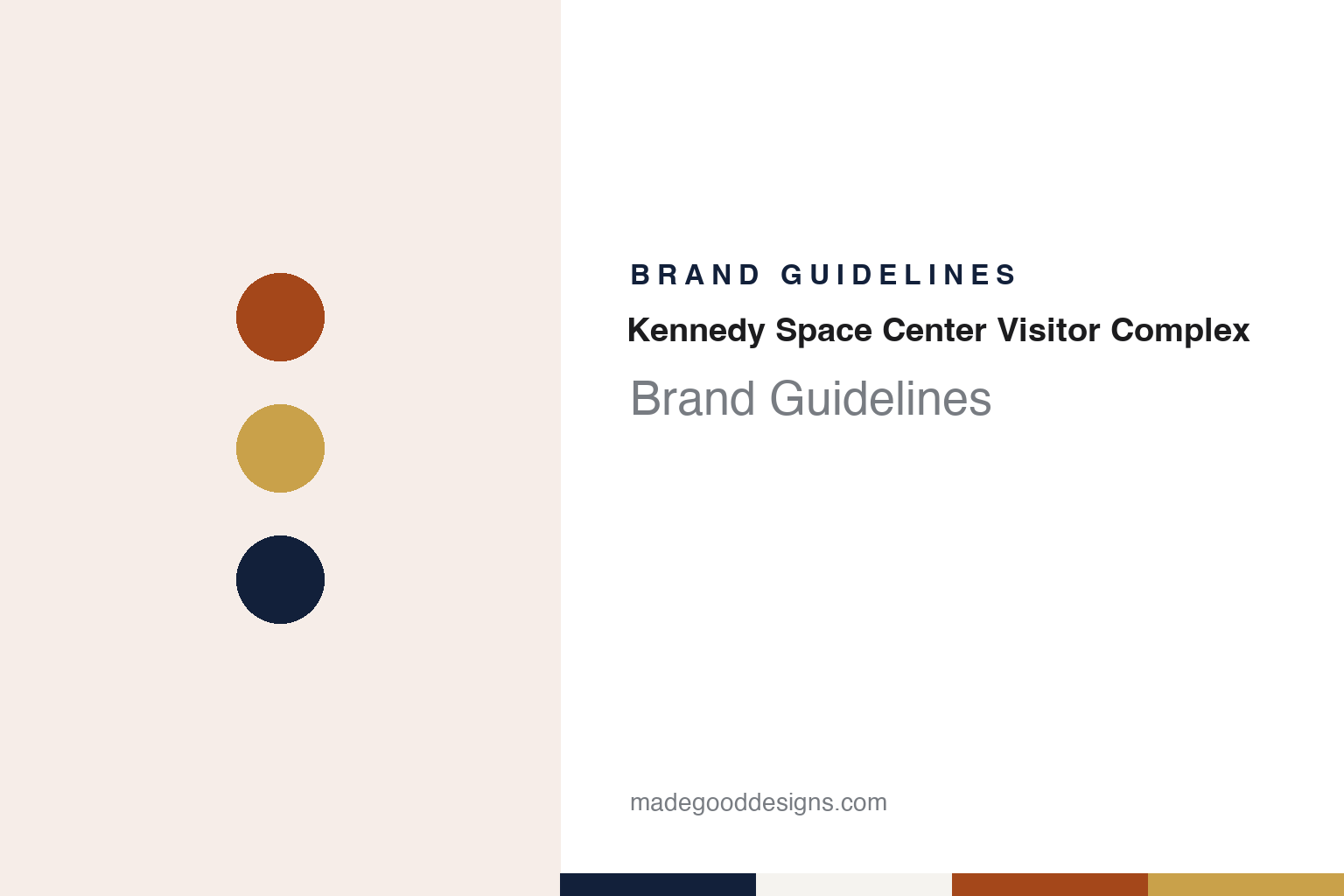
Two constants: a re-entry orange, tile gold and night-launch blue palette and a mission-control sans register. Abstract homage — not a Kennedy Space Center Visitor Complex or NASA asset or mark; no logo, insignia or spacecraft is reproduced.
From Sunday drives to a visitor centre
Tours of the Cape, a bus fleet and a site inside the space centre.
The Kennedy Space Center Visitor Complex is the visitor centre of NASA’s Kennedy Space Center on Merritt Island, on Florida’s Atlantic coast. It grew out of public curiosity about the early space programme. By 1963, the visitor complex’s own history says, visits to the area had become so popular that a congressional committee chairman asked NASA Administrator James Webb to create a visitor programme. It began as a drive-through tour: on Sunday afternoons the public could drive their own cars along a set route through what was then Cape Kennedy, now Cape Canaveral Space Force Station, for a glimpse of launch pads and facilities.
In January 1965 the tours were extended into the Kennedy Space Center itself, which had been named in 1963 after President John F. Kennedy. NASA, with help from the National Park Service, planned a visitor information centre and a guided bus tour, run by a private concessioner, and chose a site inside the space centre. While it was being built, a temporary facility at the main entrance served as the hub for public bus tours, which began on 22 July 1966, with a shorter tour of the space centre and a longer one that included the Air Force station. English Wikipedia says the first tours were operated by TWA on 40-passenger buses.
The permanent Visitor Information Center opened on 1 August 1967. It covered 42 acres and showed Mercury, Gemini and Apollo hardware, with exhibits, two theatres and concessions in two main buildings, the visitor complex says; an expansion soon added a reception area, an exhibit hall and a Hall of History with a theatre and classrooms. Through the 1970s the site added outdoor displays, among them the beginnings of the Rocket Garden, which appears in a 1975 aerial photograph published by the visitor complex. In the summer of 1976 a Saturn V Moon rocket was put on outdoor display in front of the Vehicle Assembly Building for the United States Bicentennial Exposition on Science and Technology, held at the space centre.
The centre went through several names, including Spaceport USA, before its present one. In 1995 NASA awarded the contract to operate it to a new concessioner, Delaware North, which still runs it, the visitor complex says; Space.com reported in June 2013 that Delaware North Companies Parks & Resorts had operated the property for NASA since 1995.
Colour
A rocket garden, a Saturn V hall and an orbiter in flight.
The years after 1995 rebuilt much of the site. Restaurants, shops and buses were renewed first, and between 1995 and 2000 the centre added exhibitions on nature and technology and on early space exploration, a conference facility and a renovation of the Rocket Garden, according to its own history. The Rocket Garden is an outdoor display inside the entrance. English Wikipedia lists upright Mercury-Redstone, Mercury-Atlas, Titan II, Juno I, Juno II, Thor-Delta and Atlas-Agena rockets, with a Saturn IB mounted on its side, restored in 2018, and a Delta II added in March 2021; all but the Mercury-Atlas are real articles rather than replicas.
The Apollo/Saturn V Center stands inside NASA’s gates, near Launch Complex 39, and is reached only by the centre’s bus tour. It brought the Saturn V indoors into a building of about 100,000 square feet, with two theatres about the Apollo programme. English Wikipedia dates its opening to 17 December 1996 and credits the design to BRC Imagination Arts for NASA and Delaware North; the visitor complex’s history gives January 1997. Its exhibits were updated for the 50th anniversary of the first Moon landing in 2019.
The centre’s most prominent building houses Atlantis, the last of NASA’s orbiters to fly in space. NASA announced in April 2011 that Atlantis would go to the visitor complex, which received it in April 2012; NASA kept ownership, Space.com reported. The hall opened on 29 June 2013. Inside the five-storey building the orbiter is raised 30 feet above the floor and tilted at 43.21 degrees, with its payload-bay doors open and a replica robotic arm extended, as if in orbit. Architect magazine’s project listing names the architect as PGAV Destinations and records a LEED Silver rating; PGAV says it also designed the interiors, exhibits and media. The hall includes a full-size Hubble Space Telescope model and more than 60 interactive exhibits.
Other halls followed. Heroes & Legends, opened in 2016 in place of the earlier space-exploration exhibition, houses the United States Astronaut Hall of Fame and objects including the Gemini 9A capsule; Gateway: The Deep Space Launch Complex opened in spring 2022 with spacecraft hardware and shows about travel beyond the Moon. The visitor complex also lists education programmes and camps, and in 2026 marked 60 years of its bus tour.
Typography
Design and documentation.
Aviation and space museums usually present themselves through the body behind the name. Some are national institutions, such as a museum that belongs to the Smithsonian Institution in Washington, D.C.; others are private non-profit museums, trusts, foundations or associations that grew out of a group of enthusiasts; and some visitor centres are run by a company on behalf of a space agency. The name on the door often says which: “national”, “royal”, a city or a founding society.
Their buildings tend to carry much of the identity. Many sit on or beside airfields, and several occupy structures that had another life first: a hangar, an early aircraft factory, an airport terminal or an exposition hall, and in some cases a ship that became a museum. Others are purpose-built galleries with clear spans and glass roofs large enough to hang aircraft in mid-air, or open-sided shelters that keep the weather off airliners parked in rows.
The collections are described in general terms: aircraft, spacecraft, rockets, engines, instruments, models and archives of photographs and drawings, usually with a handful of objects that the museum and the press return to again and again. Restoration workshops, libraries and observatories sit alongside the galleries, and most of these museums run school and family programmes, learning centres and summer camps.
The graphic language is often borrowed from aviation itself: stencilled lettering, registration marks and roundels, runway and taxiway markings, instrument dials and the plain sans-serif type of signage on airfields and launch sites. In this guide we look at how each museum uses its building, its objects and its name, described plainly and in our own unofficial colours and stand-in typefaces.
Aa
A geometric mission-control sans for a spaceport’s visitor centre. (Specimen set in Space Grotesk, a sans STAND-IN; NOT the Kennedy Space Center Visitor Complex or NASA logo.)
Kennedy Space Center Visitor Complex
A building that glows like re-entry.
The most fully described piece of design at the visitor complex is the Atlantis building itself. It was designed to evoke a shuttle returning from space, Space.com reported at the opening in 2013: its iridescent orange and gold tones represent the glow of re-entry, and a shimmering tile pattern recalls the underside of the orbiter. Outside, full-size replicas of the shuttle’s solid rocket boosters and external fuel tank form a gateway to the hall.
The arrival sequence was redesigned around the same time. PGAV says its master plan for Delaware North, begun in 2010, produced a new entrance plaza that it dates to December 2012, with a bold “Explore” marquee; the visitor complex’s own history places the new entry in 2013 and describes a plaza with ticket booths, guest services and a three-dimensional NASA insignia, the “meatball,” 13 feet across. A fountain beside it was replaced in 2023 by a three-dimensional monument that traces the national space programme and quotes Kennedy’s 1962 “Moon speech” at Rice University, the visitor complex says.
Much of the centre’s look comes from the objects rather than from graphics: rockets standing upright against the Florida sky in the Rocket Garden, the Saturn V lying the length of its hall, and Atlantis lit as if in orbit. The visitor complex sits within a working spaceport, and the bus tour that began in 1966 still carries visitors behind NASA’s gates to Launch Complex 39 and the Apollo/Saturn V Center.
The arrangement behind it is a NASA site and NASA hardware, presented by a private operator under contract. Since 1995 that operator has been Delaware North, and the visitor complex’s own history describes the years since as a rebuilding funded by private investment and visitors rather than new government money.
For a design guide, the Kennedy Space Center Visitor Complex shows how a building’s skin can borrow the colour and texture of the object it shelters. Compare Delaware North, which operates the visitor complex for NASA, NASA itself, and the Intrepid Museum, home of the test orbiter Enterprise. For this guide we use a re-entry orange, a tile gold and a night-launch blue with a geometric sans, an unofficial interpretation; no product or logo is reproduced.
Explore & save
Keep Kennedy Space Center Visitor Complex’s identity on hand — save it to a board in the Made Good inspiration library.
Kennedy Space Center Visitor Complex identity set
Pin the Kennedy Space Center Visitor Complex re-entry orange, tile gold and night-launch blue palette and the mission-control sans register to your own board.
Source & notes
Frequently Asked Questions
What font can I use to match the Kennedy Space Center Visitor Complex look?
This guide describes Kennedy Space Center Visitor Complex’s type as “A geometric mission-control sans for a spaceport’s visitor centre”. Its type specimen is set in Space Grotesk from Google Fonts as a stand-in; Space Grotesk is not Kennedy Space Center Visitor Complex’s own lettering.
What colours are in the Kennedy Space Center Visitor Complex palette?
This guide’s Kennedy Space Center Visitor Complex palette is Re-entry orange #A4471A, Tile gold #C9A14A, Night launch #12203A, Gantry grey #8A8D91 and Paper #F5F3EF. The tones are the guide’s own unofficial interpretation, not official Kennedy Space Center Visitor Complex hex codes.