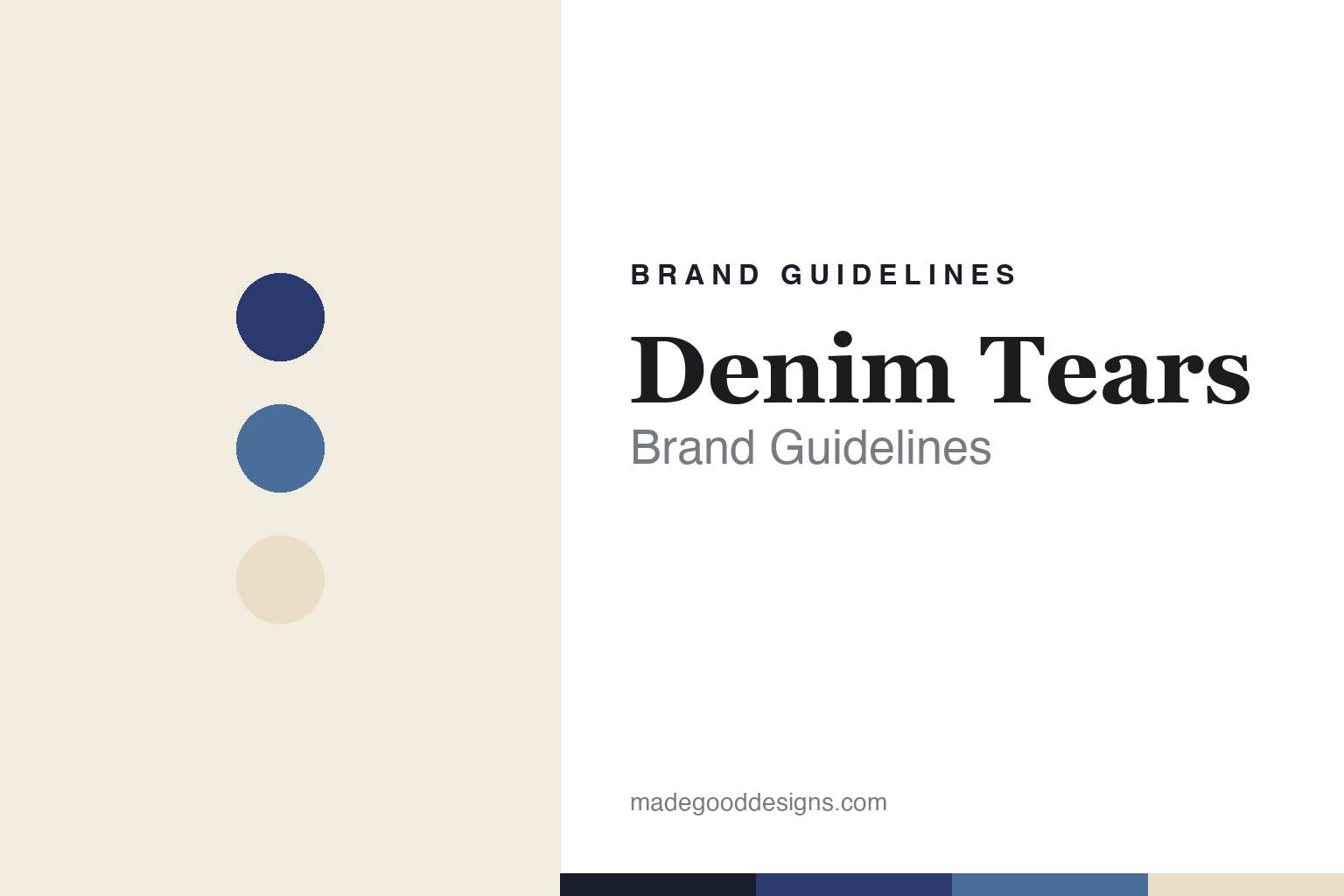
Denim Tears Brand Guidelines
Cotton & history.
Aa
Two constants: an indigo Americana palette and a narrative serif register. Abstract homage — not the Denim Tears wordmark or its cotton-wreath motif.
Cotton & history
Denim Tears tells history through denim.
Denim Tears is a lesson in clothing as storytelling. Founded in 2019 by Tremaine Emory (born in Atlanta, raised in Queens) in New York, the conceptual brand exists to illustrate the complexities of Black American history — Emory calls the work “visual storytelling as a Trojan horse.”
Its signature is the cotton-wreath motif: a wreath of cotton flowers printed on denim, a deliberate reference to the history of cotton, slavery and the Black American experience. The debut collection — a Levi’s collaboration — was tied to the 400th anniversary of 1619, when the first enslaved Africans were brought to the Virginia colony. The work is held in the permanent collections of the Met’s Costume Institute and the SCAD Museum of Art.
(Honest notes: the cotton wreath is a memorial and commentary on enslavement — not a decorative floral. The 1619 reference marks the 400th anniversary of the first enslaved Africans’ arrival (not the end of slavery, which is a different history). Emory is a widely-collaborating figure (Frank Ocean, Virgil Abloh, Tom Sachs); he was Supreme’s creative director from 2022 and resigned in 2023 amid a dispute — an account he and Supreme have framed differently. There’s no official brand hex, so the tones here are an unofficial interpretation.)
Colour
Denim Tears lives in indigo Americana. Click a swatch to copy the hex.
Denim Tears’ identity is conceptual, narrative and Americana — an indigo, a denim blue, an ecru, a cotton white, and an ink. The palette pairs indigo and denim blue with a cotton ecru — the register of American denim, recontextualised through a Black American lens. It signals history, storytelling and dignity rather than hype. The honest caveat: with no published brand hex, these tones are an original, unofficial interpretation, not first-party values.
The lesson is an indigo Americana palette carries narrative weight. Denim Tears’ world is a piece of American denim telling a story. For designers, it is a reminder that a considered palette — indigo, denim blue, cotton ecru — can carry serious historical meaning, letting a garment become a form of storytelling. The takeaways: use a considered, materially-honest palette; let the concept carry the meaning; and treat any single hex as unofficial — using ink for small text so the indigo stays considered.
Typography
The register is a narrative serif — considered and dignified.
Denim Tears’ identity carries a conceptual, narrative, dignified spirit — history told through denim. A considered narrative serif captures the mood: it is literary and dignified, the register of storytelling and memory. Set in indigo Americana, the narrative serif feels considered and dignified — exactly the personality Denim Tears carries. It is dignified rather than loud, mirroring a story told with care. (Denim Tears’ real wordmark and its cotton-wreath motif are trademarks we describe but do not reproduce, and the exact brand typeface is not ours to use.) Because the mark is not ours to use, the honest description is “a narrative serif spirit,” shown here in a stand-in. The type behaves like the brand: conceptual, narrative and dignified.
Aa
A narrative serif spirit — considered and dignified. (Specimen set in Newsreader, an editorial serif STAND-IN; NOT the Denim Tears wordmark or cotton-wreath motif, which are trademarks.)
Storytelling as identity
Denim Tears stands for design as narrative.
Denim Tears is a lesson in making narrative the whole identity. An indigo Americana palette, the cotton-wreath motif and a commitment to Black American history turn clothing into storytelling — conceptual, dignified, museum-recognised. The narrative is the differentiator. The differentiator is a conceptual, storytelling, history-rooted identity.
For designers and brand-builders, Denim Tears offers a clear takeaway: a genuine narrative can be the brand. The lessons: let a real story lead; use materially-honest, considered design; and treat the work with the seriousness of its subject. It is also a reminder to report carefully and respectfully: the cotton wreath references enslavement (not decoration), the 1619 anniversary is specific, and the palette here is an unofficial interpretation. Denim Tears made storytelling the brand — proof that narrative can be the difference.
Explore & save
Keep Denim Tears’s identity on hand — save it to a board in the Made Good inspiration library.
Denim Tears identity set
Pin the indigo Americana palette and the narrative-serif register to your own board.