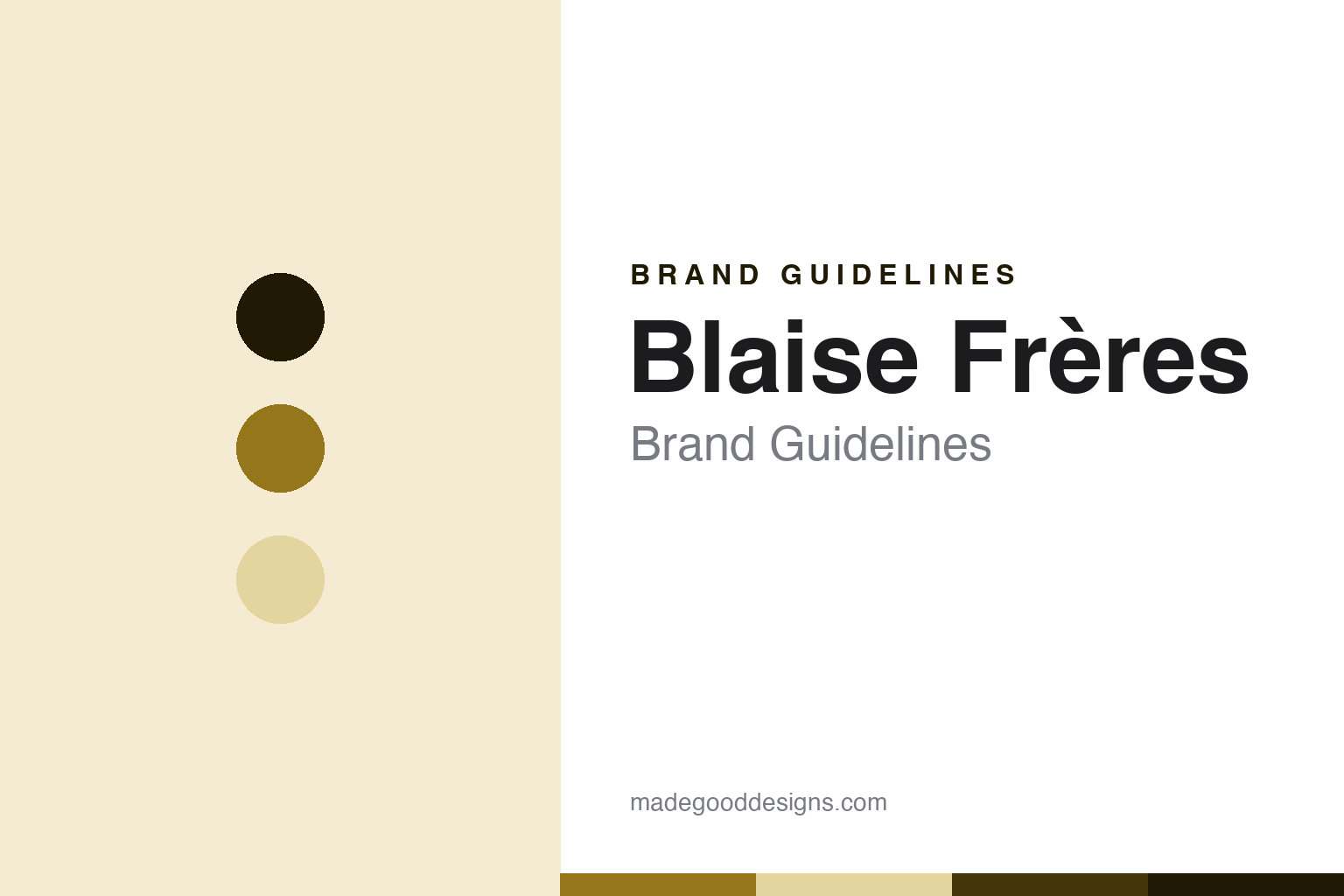
Blaise Frères Brand Guidelines
The stamp and the regulation are the same mark.
Aa
Two constants: a Blaise-gold palette and a forge-sans register. Abstract homage — not a Blaise Frères product or mark; no blade, stamp or forge mark is reproduced.
The stamp and the regulation are the same mark
Blaise Frères forges blades in the Loire — and the two letters it cold-stamps into the steel are the same two letters the international federation prints in its rulebook.
Blaise Frères is the brand the rest of this round buys from, and it owns the single most elegant identity fact in the series. Competition blades must carry the maker’s mark, cold-stamped into the steel near the guard. The federation, publishing its list of approved blades, identifies each maker by a short code. For this forge those are the same two letters. Its trademark and its regulatory identifier are one object, struck into the product at manufacture. Its answer to a round about who owns and where-makes the fencing house is a mark that is simultaneously branding and compliance: the stamp and the regulation are the same mark.
Its identity is the stamp and the regulation are the same mark. The 1885 origin, the Loire forge and a two-letter code are the story here. The blade. The stamp and the regulation are the same mark.
(Honest notes, so the founding, the ownership, the making and the limits are framed accurately. On founding: the firm dates itself to 1885, and that year is consistent across its own site, national press and reference works — but the registered company was created in 2008, so 1885 is a continuity claim about the business rather than the age of the legal entity, and an editor should not merge the two. We do not name a founder, because no source does; the last principal of the founding family named anywhere is a Marcel Blaise. On ownership, the correction: this is a family-controlled firm, but not that family’s. It was taken over in 2008, and its president today is a holding company whose own president and managing director share a different surname. So the name on the blade is one family and the name on the share register is another. On the making: it genuinely forges, which is what distinguishes it from every other brand in this round. It is one of a small number of specialist forges worldwide, its blades are made in the Loire, and they reach fencers mounted and sold under other companies’ names — which is why the same two letters turn up in the catalogues of German, Italian and British houses. On the limits: the federation’s published approved-blade list covers foil and épée only, so we say its foil and épée blades appear on that list and stop there. Reported figures for output, revenue and steel sourcing conflict between sources and we give none as settled. Its marks are IP we describe but do not reproduce; there is no official brand hex.)
Colour
Blaise Frères lives in a Blaise gold. Click a swatch to copy the hex.
Blaise Frères’s identity is French, forge-based and regulatory — a Blaise gold, an ink, a pale straw, a deep bronze, and a paper. The palette leans Blaise gold and deep bronze: a forge register that stands in for hot steel rather than a loud logo colour. It signals the stamp and the regulation being the same mark — French, forge-based and regulatory. The honest caveat: with no official brand hex, these values are an unofficial interpretation, not first-party colours.
The lesson is the strongest mark is one the rules require you to apply. Most brands fight for space on a product. This one is obliged to occupy it: the governing body’s own material rules require the maker’s identification and the date of manufacture to be cold-stamped into every blade near the entry into the guard, to a maximum depth of half a millimetre. The mark is therefore not decoration, not a sticker and not removable — it is a condition of the blade being legal to compete with, and it is struck into the steel at the point of manufacture. That does something no marketing budget can buy. Every armourer inspecting a weapon reads it. Every rival brand mounting these blades ships them with it. The identity survives being sold under someone else’s name, because the someone else cannot take it off. For anyone thinking about brand assets, this is the limit case: an identifier that regulation makes permanent, universal within its category, and impossible for a reseller to strip. Because a strong hue can fail as small text, keep type dark and let the colour live in the accents, palette and band. The takeaways: date the business to 1885 and the company to 2008; name the controlling family correctly; say it forges rather than assembles; and keep the blade-list reference to foil and épée.
Typography
The register is a forge sans — French, industrial, exact.
Blaise Frères’s identity carries a French, industrial spirit — a works in a steel valley that makes one product extremely well. A forge sans captures the mood: plain, technical and unliterary, the register of a firm whose catalogue is three weapons and nothing else. Set in a Blaise-gold palette, the forge sans feels struck rather than styled — exactly the personality the record supports. It behaves like a hot-worked, ground thing rather than a loud logo, mirroring a blade taper and a stamp edge. (Blaise Frères’s real products, its stamp and the name itself are things we describe but do not reproduce, and the exact typeface is not ours to use — the mark is a regulatory identifier as well as a trademark, which is all the more reason to describe rather than render it.) Because it is not ours to use, the honest description is “a forge-sans brand,” shown here in a stand-in. The type behaves like the brand: French, industrial and exact.
Aa
A forge-sans brand — plain and technical. (Specimen set in Manrope, a forge-sans STAND-IN; NOT the Blaise Frères logo, stamp or products.)
The forge node
Blaise Frères stands for the stamp and the regulation being the same mark.
Blaise Frères holds the round’s forge node. A Blaise-gold palette, a forge sans and an 1885 origin make one thing — the stamp and the regulation are the same mark — the whole identity: French, forge-based and regulatory. The origin is the frame, the Loire works is the substance, and the two-letter code is the signature. The point is the supplier behind the suppliers: the firm whose blades several other brands in this round sell as their own, carrying a mark the rules will not let them remove.
Put to work, the identity is the forge credited and the ownership corrected. A brand in this spirit would date the business to 1885 while noting the registered company dates from 2008, decline to name a founder because no source does, state that control passed out of the founding family in 2008 and sits today with a holding company under a different surname, say plainly that this firm forges rather than assembles, explain that its blades are sold mounted under other brands’ names, and keep the federation reference to the foil and épée list that actually exists. A reader in this spirit would keep the facts right: Blaise Frères forges fencing blades; the business dates to 1885; it is not owned by the Blaise family; and it makes in the Loire. Blaise Frères follows Negrini, before PBT. The honest editorial moves are to date both the business and the company, to correct the family, to credit the forging, and to bound the list.
For designers and brand-builders, Blaise Frères holds the forge node: a mark that regulation requires is the most durable brand asset there is. The lessons: a category can contain a supplier whose customers are its competitors, here a forge whose blades are mounted and sold by German, Italian and British houses under their own names; an origin is dated to 1885 as a continuity claim and separated from the registered company of 2008, which is the correct treatment of a heritage date; a founder is left unnamed because no source names one, and the last principal of the founding family is reported only as a surname and an initial; an ownership is corrected, because the firm is family-controlled by a family that is not the one on the product; a making is credited precisely, since forging is what separates this house from every brand that buys blades in, and it is one of only a handful of such forges worldwide; and a mark is understood as infrastructure rather than decoration, cold-stamped into the steel near the guard because the material rules require the maker’s identification and date of manufacture to be there. Three disciplines apply. The federation’s published approved-blade list covers foil and épée, so sabre homologation is not claimed here. Reported figures for annual output, revenue and the origin of its steel conflict across sources and none is given as settled. And every federation reference in this round is dated, because the international federation restructured its supplier registration during 2026, separating supplier registration from product homologation, with the framework still being implemented through that year. Federation statuses here are therefore reported as the published record at their date rather than as live certifications. The hook is that permanence: Blaise Frères is the stamp and the regulation being the same mark. Read that way, Blaise Frères is less a single blade than a mark the rules make indelible: French, industrial, exact. The lesson for a brand is that the identifier you are obliged to apply may be worth more than the one you chose. Blaise Frères made the-stamp-and-the-regulation the identity — proof that compliance can be branding.
Explore & save
Keep Blaise Frères’s identity on hand — save it to a board in the Made Good inspiration library.
Blaise Frères identity set
Pin the Blaise-gold palette and the forge-sans register to your own board.