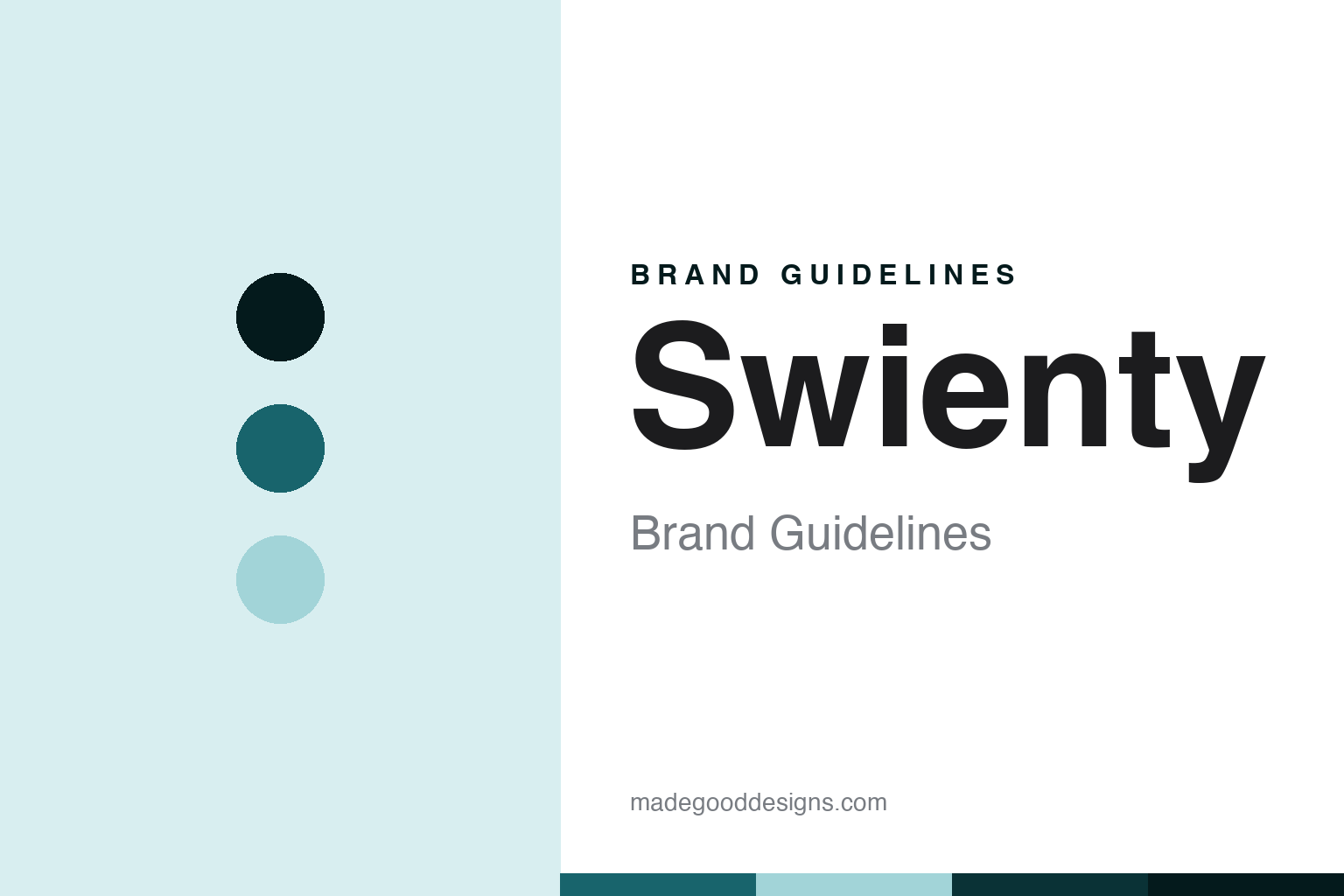
Swienty Brand Guidelines
The filling machine is the flagship.
Aa
Two constants: a Swienty-teal palette and a machinery-sans register. Abstract homage — not a Swienty product or mark; no hive, machine or livery is reproduced.
The filling machine is the flagship
Swienty began as a small hobby business in 1981 — and today it names its honey-filling machines, not its hives, as the company’s flagships.
Swienty follows Lyson as the round’s second European manufacturer, and it makes a different choice about what it is for. Most firms in this trade lead with hives, because hives are what a beekeeper buys first. Swienty leads with machinery: its own pages call its series of filling machines the company’s flagships, and describe a trajectory that runs from a hobby business to supplying filling lines worldwide. Its answer to a round about who makes and who brands the hive is a maker that quietly moved past the hive: the filling machine is the flagship.
Its identity is the filling machine is the flagship. The 1981 founding, the Sønderborg workshop and a machinery-first catalogue are the story here. The honey plant. The filling machine is the flagship.
(Honest notes, so the founding, the ownership, the making and one mistranslation are framed accurately. On founding: the company says it has supplied the beekeeping trade since 1981, and that it all started as a small hobby business that year. Its founder was Bernhard Swienty, whom it calls its grand old man and who received the Danish beekeepers’ association gold pin for his pioneering work. It does not say where the hobby business began, so we place the company at Sønderborg without claiming that as its founding town, and we say nothing about whether the founder is still involved, because nothing on the record does. On ownership: the company’s own terms name its management as Bjørn and Lotte Swienty Andresen — the founder’s surname surviving as a middle name, which is the documented evidence of family succession. We call it second-generation carefully, because the precise relationship is not stated. Its shareholding, and the date its present corporate form was registered, are not verifiable from the public registers we could reach. On the making: a single site holding production, administration, showroom and warehouse, and an unusually specific claim — its own workshop develops, produces and services filling machines, automatic filling lines, thawing units, queen-rearing equipment and tools, and it counts more than a hundred self-produced products across four groups. But it is candid that this sits inside a much larger bought-in catalogue: it says it regularly supplements its range with the best products from around the world, and it carries other companies’ brands openly. So it is part maker, part distributor, and does not pretend otherwise. On one translation trap: it calls a Danish hive measure our own, meaning the national Danish measure, not a format it invented — rendering that as a proprietary Swienty standard would be a real error. Its marks are IP we describe but do not reproduce; there is no official brand hex.)
Colour
Swienty lives in a Swienty teal. Click a swatch to copy the hex.
Swienty’s identity is Danish, family-run and machinery-led — a Swienty teal, an ink, a pale aqua, a deep marine, and a paper. The palette leans Swienty teal and deep marine: a workshop register that stands in for a Danish machine shop rather than a loud logo colour. It signals that the filling machine is the flagship — Danish, family-run and machinery-led. The honest caveat is unusually strict here: we could not verify this company’s colour conventions, logo form or packaging treatment from its own text at all, so nothing on this page should be read as describing them, and the tones are an unofficial interpretation chosen for this series.
The lesson is a naming system can show you where a company thinks its value is. Swienty runs two prefix families, and they are not interchangeable. Its machinery carries one prefix; its apiary equipment carries another; its own-label soft goods simply take the company name as an adjective. That structure is a map of the business. The machines get the distinctive, memorable naming because the machines are where the engineering — and the margin — sits; the hives get a plain systematic code because a hive built to a public standard cannot be differentiated by its name. And the firm’s own words confirm the reading: it describes its workshop as developing, producing and servicing, with service named explicitly alongside manufacture. For a maker of capital equipment sold to commercial honey producers, being able to fix what you built is part of the product, and it is telling that the company says so in the same sentence. Because a strong hue can fail as small text, keep type dark and let the colour live in the accents, palette and band. The takeaways: date the founding to 1981; keep the second-generation claim careful; say part maker, part distributor; and never render the Danish measure as a Swienty format.
Typography
The register is a machinery sans — Danish, engineered, serviceable.
Swienty’s identity carries a Danish, engineering spirit — a firm that builds machines and then keeps them running. A machinery sans captures the mood: plain, technical and bilingual, the register of a trilingual catalogue sold across a border. Set in a Swienty-teal palette, the machinery sans feels built and maintained rather than styled — exactly the personality the record supports. It behaves like a welded, serviced thing rather than a loud logo, mirroring a smoke curl and a frame line. (Swienty’s real products, its prefix families and the name itself are things we describe but do not reproduce, and the exact typeface is not ours to use; we could not verify its colours or logo form and therefore describe neither.) Because it is not ours to use, the honest description is “a machinery-sans brand,” shown here in a stand-in. The type behaves like the brand: Danish, engineered and serviceable.
Aa
A machinery-sans brand — plain and technical. (Specimen set in Manrope, a machinery-sans STAND-IN; NOT the Swienty logo or products.)
The machinery node
Swienty stands for the filling machine being the flagship.
Swienty holds the round’s machinery node. A Swienty-teal palette, a machinery sans and a 1981 founding make one thing — the filling machine is the flagship — the whole identity: Danish, family-run and machinery-led. The founding is the frame, the Sønderborg workshop is the substance, and the choice of flagship is the signature. The point is a beekeeping supplier whose real engineering is downstream of the hive entirely, in the plant that handles what the bees produce.
Put to work, the identity is the flagship taken at its word. A brand in this spirit would date the founding to 1981 and name Bernhard Swienty while noting the company does not say where the hobby business began, describe the management as the company states it and treat the second generation carefully because the relationship is unstated, say plainly that the firm is part maker and part distributor because it says so itself, count its own-made lines as it counts them, and keep the Danish hive measure as a national standard rather than a company format. A reader in this spirit would keep the facts right: Swienty makes filling machines, thawing plant, poly hives and queen-rearing equipment; it dates to 1981; it is family-run; and much of its catalogue is bought in. Swienty follows Lyson, before Abelo. The honest editorial moves are to date the founding, to hedge the succession, to admit the distribution, and to translate carefully.
For designers and brand-builders, Swienty holds the machinery node: what a company calls its flagship tells you what it actually sells. The lessons: a category can contain a firm that leads with the machine rather than the hive, and says so in its own words; a founding is dated to 1981 as a hobby business and attributed to a named founder honoured by his national association, with the founding town left unstated because the company leaves it unstated; an ownership is read from a management line in which the founder’s surname survives as a middle name, which is documented succession evidence, while the share register and the company’s incorporation date remain unverified; a making is described as the company describes it, a single site with its own workshop that develops, produces and services, and more than a hundred self-produced lines across four groups — sitting candidly inside a much larger bought-in catalogue that carries other firms’ brands by name; and a naming system is read as a map, because the machines carry distinctive prefixes while the standardised hives take plain systematic codes, which is exactly what you would expect when one product can be differentiated and the other cannot. Three cautions close it. Its award record needs reading carefully rather than aggregating: two are product awards decades apart, and the most recent is for exhibition stand design, not a product — though that is itself revealing, since both European manufacturers in this round have won large-stand golds, and in a trade sold at fairs the stand genuinely is the brand. Its environmental measures are its own account with no third-party certification named beyond timber sourcing. And one identifier circulating against this company belongs to a government food authority rather than to the firm, which is the kind of error that propagates quietly. The hook is that focus: Swienty is the filling machine is the flagship, the Danish house whose best engineering happens after the honey leaves the hive. Read that way, Swienty is less a hive maker than a honey-plant builder with a hive range: Danish, engineered, serviceable. The lesson for a brand is that the product you name your flagship is the promise you are actually making. Swienty made the-filling-machine the identity — proof that a maker can define itself by what it does best rather than what it sells most.
Explore & save
Keep Swienty’s identity on hand — save it to a board in the Made Good inspiration library.
Swienty identity set
Pin the Swienty-teal palette and the machinery-sans register to your own board.