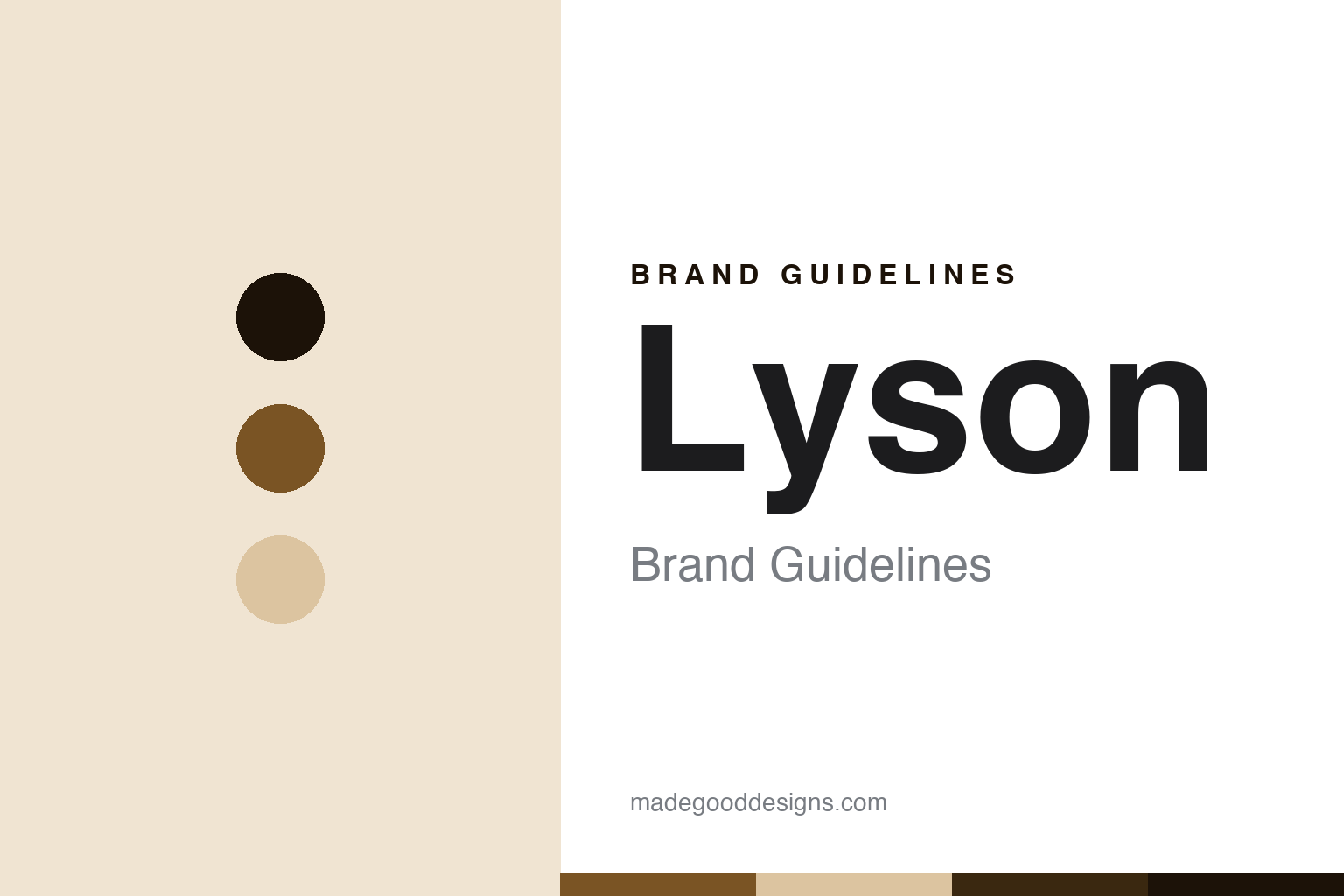
Lyson Brand Guidelines
The factory behind other people’s labels.
Aa
Two constants: a Lyson-wax-brown palette and a manufacturer-sans register. Abstract homage — not a Lyson product or mark; no hive, extractor or bear device is reproduced.
The factory behind other people’s labels
Lyson moulds hives in southern Poland that reach British beekeepers under a British name — and both companies say so in print.
Lyson is the round’s manufacturer node, and the rare case where a supply relationship is documented from both ends. A British supplier sells polystyrene hives under its own name and credits the manufacture and the design to Lyson on the same page. Lyson, in turn, lists that supplier on its own distributor map. Neither side is hiding anything, which is what makes the pair worth writing about. Its answer to a round about who makes and who brands the hive is the half that does the making: the factory behind other people’s labels.
Its identity is the factory behind other people’s labels. The 1995 founding, the Klecza Dolna works and a documented export relationship are the story here. The moulded hive. The factory behind other people’s labels.
(Honest notes, so the founding, the ownership, the making and one overreach are framed accurately. On founding: the firm dates itself to 1995, when Tomasz Łysoń began at Sułkowice under what the company calls its characteristic bear logo, making polystyrene hives. But the family’s manufacturing is older — his grandfather, a locksmith and metal modeller, and his father founded an earlier venture in 1988 making styrofoam hives for a regional cooperative, and Tomasz says he took over the family operation at nineteen. So 1995 is the firm, 1988 is the craft. The grandfather is never named on the company’s pages and we do not name him. A caution on the paperwork: the present limited company was registered only in December 2023, which is a corporate form rather than a founding, and we do not present it as one. On ownership: family-run across three generations, with the founder as president and named family members running the clothing department, the apiary farm and its visitor centre. The shareholding itself is not published, so we call it undisclosed rather than assuming the family holds it all. On the making: a single works of some twelve thousand square metres, moulding expanded polystyrene hives in six national systems and fabricating stainless honey-processing plant — the company dates its metal capability to buying an automatic welding line for tanks and extractors at its previous site. One correction to a natural assumption: this is not a woodenware house. There is no wooden-hive category in its catalogue at all. It is a moulder and a metal fabricator. On scale: it describes itself as one of the largest companies in its sector in Europe, which we attribute rather than assert, particularly as external rankings place it in a fifty-to-two-hundred-and-fifty headcount band. Its marks are IP we describe but do not reproduce; there is no official brand hex.)
Colour
Lyson lives in a Lyson wax brown. Click a swatch to copy the hex.
Lyson’s identity is Polish, family-run and industrial — a Lyson wax brown, an ink, a pale wax, a deep umber, and a paper. The palette leans Lyson wax brown and deep umber: a workshop register that stands in for a moulding plant rather than a loud logo colour. It signals the factory behind other people’s labels — Polish, family-run and industrial. The honest caveat: with no official brand hex, these values are an unofficial interpretation, and this company has no single house hive colour to interpret in any case, because colour is something it sells as a variable.
The lesson is a manufacturer that offers customisation is advertising its own invisibility. Lyson runs a catalogue category for hives with custom colour and print — choose your own, in its own words. Read commercially, that line is the mechanism by which a Polish moulding becomes a British product with a British name on it, and it explains why the arrangement in this round exists at all. It is also why this company has no fixed livery: a house colour would be a liability for a business whose customers want their own. Set that against the two brands earlier in this round — one selling cedar left bare, the other selling colour at a premium — and you can see three positions on the same question. The firm that owns the timber sells the material. The firm that owns nothing sells the finish. And the firm that owns the tooling sells the ability to be whatever the customer’s market wants. Because a strong hue can fail as small text, keep type dark and let the colour live in the accents, palette and band. The takeaways: date the firm to 1995 and the family’s manufacturing to 1988; call the shareholding undisclosed; do not describe it as a woodenware maker; and attribute the size claim.
Typography
The register is a manufacturer sans — Polish, industrial, systematic.
Lyson’s identity carries a Polish, industrial spirit — a plant that moulds, welds and ships to more than forty countries. A manufacturer sans captures the mood: plain, technical and catalogue-driven, the register of a company whose pages are full of diameters, capacities and system names. Set in a Lyson-wax-brown palette, the manufacturer sans feels produced rather than styled — exactly the personality the record supports. It behaves like a moulded, welded thing rather than a loud logo, mirroring a mould line and a wax cell. (Lyson’s real products, its bear device, its line names and the name itself are things we describe but do not reproduce, and the exact typeface is not ours to use.) Because it is not ours to use, the honest description is “a manufacturer-sans brand,” shown here in a stand-in. The type behaves like the brand: Polish, industrial and systematic.
Aa
A manufacturer-sans brand — plain and technical. (Specimen set in Manrope, a manufacturer-sans STAND-IN; NOT the Lyson logo or products.)
The manufacturer node
Lyson stands for the factory behind other people’s labels.
Lyson holds the round’s manufacturer node. A Lyson-wax-brown palette, a manufacturer sans and a 1995 founding make one thing — the factory behind other people’s labels — the whole identity: Polish, family-run and industrial. The founding is the frame, the Klecza Dolna works is the substance, and the custom-colour service is the mechanism. The point is the supplier half of a relationship this round documents from both sides, and a reminder that the name on a hive and the hands that moulded it are separate facts.
Put to work, the identity is the making credited and the claims sized. A brand in this spirit would date the firm to 1995 at Sułkowice while noting the family was moulding hives from 1988, decline to name a grandfather the company never names, treat the 2023 company registration as a corporate form rather than a founding, describe the ownership as family-run with the shareholding undisclosed, place the works at Klecza Dolna and describe what it actually does there, correct the assumption that it makes woodenware, and attribute rather than assert its claim to be among Europe’s largest. A reader in this spirit would keep the facts right: Lyson moulds polystyrene hives and fabricates honey-processing plant; it dates to 1995; it is family-run; and it exports through distributors in more than forty countries. Lyson follows Betterbee, before Swienty. The honest editorial moves are to date both beginnings, to call the shareholding undisclosed, to correct the material, and to size the claim.
For designers and brand-builders, Lyson holds the manufacturer node: the ability to be anonymous is itself a product. The lessons: a category can include a firm whose commercial strength is that its work can carry someone else’s name, here a moulder listing a custom colour and print service in its own catalogue and a British distributor on its own map; a founding is dated twice and honestly, the firm to 1995 and the family’s manufacturing to 1988, with the founder’s own account that he took over at nineteen sitting slightly against the word founder — an internal softness worth noting rather than smoothing; an ownership is described as three generations with named family members in named roles, while the share register itself stays undisclosed; a making is described precisely, a single large works moulding hives in six national systems and fabricating stainless extraction plant, with its metalworking traced to the purchase of an automatic welding line; and a premise is corrected, because this is not a woodenware business and has no wooden-hive category at all. Two disciplines apply. Its size claim is its own and sits against external rankings that place it in a mid-sized headcount band, so it is attributed. And the temptation to generalise the badging arrangement must be resisted: only one own-brand customer is documented, while its named exclusive importer in the United States and a Canadian distributor on the same map both sell the goods under the Lyson name instead — so badging is one documented case against two that keep the maker’s name, and it is not an industry pattern. The hook is that reach: Lyson is the factory behind other people’s labels, the Polish plant whose mouldings arrive wearing other names. Read that way, Lyson is less a single hive than the tooling behind several markets: Polish, industrial, systematic. The lesson for a brand is that making the product and owning the customer are different businesses, and some firms choose the first. Lyson made the-factory-behind-the-label the identity — proof that a manufacturer can hold a round.
Explore & save
Keep Lyson’s identity on hand — save it to a board in the Made Good inspiration library.
Lyson identity set
Pin the Lyson-wax-brown palette and the manufacturer-sans register to your own board.