Hailun Brand Guidelines
The factory behind other names.
Aa
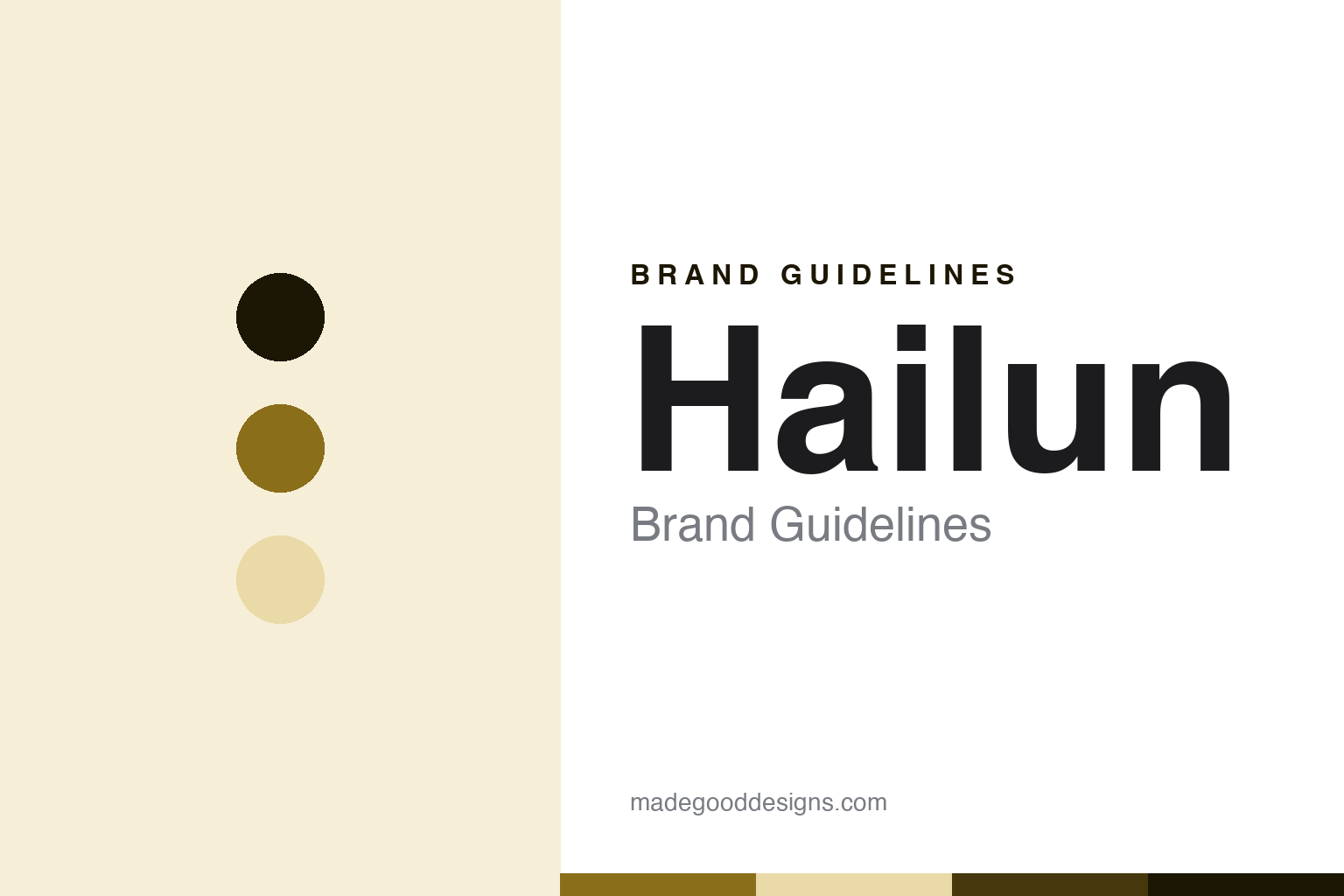
Two constants: a Ningbo-ochre palette and a workshop-grotesque register. Abstract homage — not a Hailun product or mark; no piano or logo is reproduced.
A hardware workshop and a family name
Hailun is named after its founder. In 2025 his family sold control.
Hailun’s own listing documents tell its origin precisely. In June 2001, the sponsor’s report for its stock-market listing says, the family of Chen Hailun separated a piano-parts business from his sole proprietorship — a Beilun district “decoration hardware” factory in Ningbo — into a new company formed as a Sino-foreign joint venture with AXL Musical Instruments, a firm based in the United States. The listing documents name the American partner’s principal as Alan Xiangde Liu; what the partnership contributed beyond capital, they do not say, and neither do we. It became a joint-stock company in October 2008, took the name Hailun Piano Co., Ltd. in April 2009, and listed on the ChiNext board in Shenzhen on 19 June 2012, selling 16.77 million new shares at RMB 21 and raising RMB 352 million before costs. Buyer’s guides date the parts business back to 1986; that date does not appear in the listing documents we read, so we give it as theirs.
For two decades the company carried its founder’s name and his family ran it. That ended in 2025. On 24 July 2025 the family agreed to sell 23.83 percent of the company — 60,260,600 shares at RMB 9.09 each, about RMB 548 million — to a Shanghai investment partnership, and to waive voting rights on another 6 percent. The transfer completed in December 2025. Hailun’s 2025 annual report names a new actual controller, Cui Yongqing; Chen Hailun and two family members left the board, and a new board was elected on 16 January 2026. The family’s holding company keeps 20.56 percent of the shares but 14.56 percent of the votes.
So the most literal nameplate in this round — a company named after the man who founded it — is now controlled by someone else.
Colour
Hailun’s own annual report names the European brands it builds for. Few factories say so.
Hailun’s 2025 annual report describes two core brands of its own — Hailun and 文德隆, Wendl & Lung — and says it works with well-known foreign brands to develop and produce ODM pianos: instruments designed with, and branded for, someone else. It then names them: Hailun is “德国贝希斯坦、捷克佩卓夫等国际知名钢琴企业的ODM合作伙伴” — the ODM partner of internationally known piano companies including Germany’s Bechstein and the Czech Republic’s Petrof.
Other documents fill in the detail. China Daily reported in February 2014 that Bechstein had “moved the production of its brand of Zimmermann pianos to China… the Chinese partner, Hailun Pianos, provides materials, staff and facilities. Two German technicians from C. Bechstein are based at Hailun.” Bechstein’s own Zimmermann page, as our Bechstein guide notes, names no country. Hailun’s 2012 annual report also lists cooperation with Petrof’s Rösler line and with Feurich, and its listing documents record that from October 2010 the Vienna company Wendl & Lung licensed and commissioned Hailun to make Feurich-brand pianos.
Here is the twist. Hailun bought the Chinese rights to the trademark “WENDL&LUNG WIEN” and ended a rival Chinese licence for it in 2011. The Vienna company that once traded under that name has since renamed itself Feurich Pianoforte. So the Chinese rights to a Viennese name belong to a Ningbo maker that counts it as one of its two core brands, while the Viennese company carries a Leipzig name — and that Leipzig name, the Feurich family itself has said, has been made in China by Hailun since 2012. The factory knows whose piano is whose. The nameplates are arranged for the customer.
Typography
From about 22,800 pianos in 2012 to 4,605 in 2025.
Hailun publishes its output, and the series is stark. Its listing documents give 17,871 uprights in 2010, against a capacity of 18,500. Its 2012 annual report gives 20,994 uprights and 1,801 grands. Its 2025 annual report gives 4,047 uprights and 558 grands — 4,605 pianos, down 46.71 percent in a year. It also reports making 4,515 strung backs — the iron frame, soundboard and strings that are the heart of a piano — for other companies. In 2025 Hailun built very nearly as many piano cores for others as it built finished pianos under any name.
The money follows the units. Revenue fell from RMB 297.5 million in 2023 to 159.2 million in 2024 and 122.8 million in 2025; the company lost money in each of those years. That is the same collapse visible at Pearl River, in a market the China Musical Instrument Association’s chairman described in 2024 as having fallen from 390,000 pianos in 2019 to an expected 160,000 in 2023. That is the climate in which the founding family sold control.
Hailun’s address is in Ningbo’s Beilun district, and it has a subsidiary in Yingkou, Liaoning — a city a 1999 American government report already listed among China’s piano-making centres.
Aa
A sturdy workshop grotesque — practical, heavy-shouldered, made for a factory floor. (Specimen set in Archivo, a sans STAND-IN; NOT the Hailun logo or products.)
Chinese piano, Chinese heart
The slogan is national. The order book is international.
Hailun’s slogans are among the most direct in this series. It calls itself “闪耀世界钢琴行业的中国民族品牌” — a Chinese national brand shining in the world piano industry — and its motto runs “中国琴,中国心,创国际品牌,立百年海伦”: Chinese piano, Chinese heart; build an international brand; establish a century-old Hailun. The company also says its pianos were played at Vienna’s Musikverein in 2005 and served as an official piano of the 2008 Beijing Olympics; we report both as its claims.
Set the motto beside the annual report and the identity becomes clear. Hailun wants its own name to become the century-old house. Meanwhile it is, by its own filings, one of the factories that keep several century-old European houses in production. For a buyer, that is a reason to take the Hailun nameplate seriously on its own terms — the same factory, after all, is trusted by the European names it builds for.
It is also a reminder of what “ODM” means in practice. An original-design manufacturer does not simply assemble a kit; it builds to a design developed with the client, and sometimes contributes to it. When a European house sends technicians to live at the factory, as China Daily reported Bechstein did, the line between “their piano” and “our piano” is drawn by contract, not by geography.
For this guide we use a Ningbo ochre and a pale straw with a sturdy workshop grotesque. These are an unofficial interpretation, not Hailun’s own colour values, and nothing of its mark is reproduced.
Explore & save
Keep Hailun’s identity on hand — save it to a board in the Made Good inspiration library.
Hailun identity set
Pin the Ningbo-ochre palette and the workshop-grotesque register to your own board.