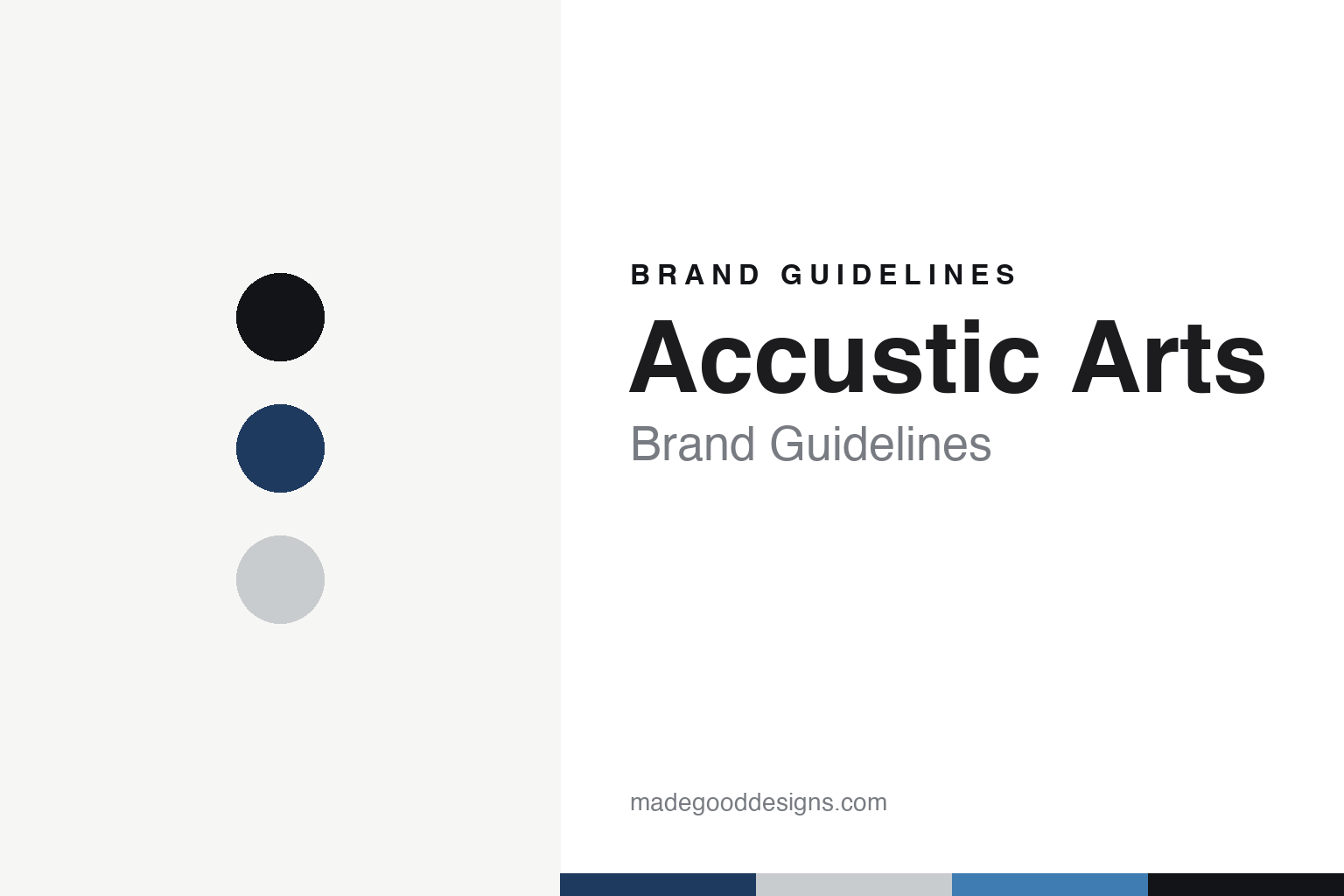
Accustic Arts Brand Guidelines
The Lauffen amplifier maker born in a family recording studio.
Aa
Two constants: an Accustic Arts navy, blue and silver palette and a Wide sans register. Abstract homage — not an Accustic Arts product or mark; no component, logo or nameplate is reproduced.
Schunk Audio Engineering
A recording family in Lauffen.
Accustic Arts comes from Lauffen am Neckar, a wine town on the Neckar south of Heilbronn, in Baden-Württemberg. The name is often misspelled “Acoustic Arts”; the company spells it with a double c and says it is short for “ACCUrate acouSTIC ARTS” — accurate acoustic art. Its own pages say the first Accustic Arts components were presented in 1997, after five years of development with outside developers and audio specialists.
The brand began as the hi-fi line of a family firm. A 2012 version of the company website, preserved by the Internet Archive, says that more than eight years of experience in professional music production were brought together in 1996 with the founding of SAE – Schunk Audio Engineering GmbH & Co. KG, which first worked in professional recording and built its own studio near-field monitors before turning to home equipment. In 2019 Stereophile named the founder as Fritz Schunk and gave 1997 as the year Accustic Arts was founded; the American webzine Dagogo, reviewing the CD Player I in December 2004, gave 1996, the year SAE was formed. The two dates describe the parent company and the brand.
Dagogo reported that Fritz Schunk set up SAE with his sons, Martin and Steffen, Martin running hardware manufacturing and Steffen the recording studio. It also reported that before SAE he had owned “Fritz Schunk GmbH,” an industrial robot and handling-technology business with about 1,000 employees supplying carmakers. Lauffen is also home to the gripper and clamping maker SCHUNK, whose published history names Friedrich Schunk as its founder in 1945; we could not match the two accounts in the sources we checked, so we leave the family connection open.
Colour
A building, a studio and a record label.
In autumn 1998, the company says, it moved into a new building in Lauffen that held sales, a development laboratory, production of all its electronics and, at the time, loudspeakers, a separate test and measurement room, and its own recording studio. The current website gives the address as Hoher Steg 7 and says the building still houses development, production, testing and the studio. In 2009 the firm started a record label, Accustic Arts Audiophile Recordings (AAAR), releasing CDs and vinyl; the company names the sound engineer Milan Sajé and the A&R manager Rasmus Muttscheller as the people who choose its titles, and in 2019 it told The Absolute Sound it was recording the trombonist Joe Gallardo.
The products are amplifiers and digital sources in heavy, plain casework, sold in a Top series and a Reference series — integrated and power amplifiers such as the AMP and MONO models, PREAMP and TUBE PREAMP units, CD drives and players. Earlier there was an ES series and, according to Dagogo, a range of around 28 products that included loudspeakers and cables. One of the few documented design details concerns the top-loading DRIVE I and CD PLAYER I: Steffen Schunk told Dagogo that the blue-lit mirror carrying the ACCUSTIC ARTS logo, which appears to float inside the glass lid, “has only a design function.”
Reviews have come from both sides of the Atlantic. In 2012 the German magazine STEREO profiled the company in a series on the secrets of hi-fi developers under the title “Auf Schwaben Art,” the company’s website of the time shows. Stereophile’s Jason Victor Serinus reviewed the Mono II monoblocks in October 2019 — a 300-watt solid-state design priced at $24,900 a pair — and the AMP V stereo amplifier in December 2021, a dual-mono MOSFET design with 40 output transistors that succeeded the AMP III, made from 2011 to 2016. The company also says its POWER ES integrated amplifier was named a product of the year for 2010 by Hong Kong’s Hi-Fi Review, which we have not checked.
Typography
German hi-fi, documented.
Several of Germany’s best-known loudspeaker names have spent decades under American owners. German Wikipedia says the US group Recoton bought the Heco brand rights in 1996, and that Audiovox — renamed Voxx International in 2012 — bought the insolvent Recoton in 2003. Today Magnat and Heco are brands of Premium Audio Company Germany GmbH in Pulheim, near Cologne, according to their legal notices, and Voxx itself was bought by the US company Gentex in April 2025, English Wikipedia says.
At the other end of the trade are small specialist workshops, and several are in Baden-Württemberg. Two are in the district of Karlsruhe: Octave, in Karlsbad, whose owner, Andreas Hofmann, says he turned from transistors to valve amplifiers in 1977, and AVM, at Malsch, whose legal name, Audio Video Manufaktur GmbH, uses the German word for a craft workshop. Accustic Arts is based at Lauffen am Neckar, in the same state.
The trade’s main meeting place has moved. The HIGH END show, held in Munich until 2025, took place in Vienna from 4 to 7 June 2026, and Acapella was among the exhibitors there, according to its website.
The makers in this guide are spread out: AVM in Malsch, Octave in Karlsbad and Accustic Arts in Lauffen am Neckar; Lindemann at Wörthsee, west of Munich; Magnat and Heco in Pulheim; and Acapella in Duisburg, with a showroom at Isen near Munich, according to the legal notices on their websites.
This guide sets out what can be checked about each brand — who founded it, who owns it, and what it says about where its products are made — and marks clearly what rests only on the company’s own word.
Aa
A wide sans, for capitals spelled with a double c. (Specimen set in Saira, a sans STAND-IN; NOT the Accustic Arts logo.)
Accustic Arts
From the Schunk family to Jochen Voss.
In 2016, Stereophile reported, Fritz Schunk sold the company to Hans-Joachim “Jochen” Voss. Voss told The Absolute Sound in May 2019 that he met the former owner as he was preparing to retire; his two sons had no interest in the company, so he was looking for an outside successor, and after a period of negotiation Voss bought it. Voss had owned an Accustic Arts AMP II, DAC and preamp as a customer, and had spent about twenty years in consumer-goods sales and marketing, including at the Ferrero Group, Stereophile wrote. Register notices summarised by North Data show the vehicle: a company registered in February 2015 as MaKon Press GmbH, with Voss as managing director, was renamed ACCUSTIC ARTS AUDIO GmbH and moved its seat to Lauffen in December 2015.
Voss is managing director, according to the company’s legal notice, and a Stereophile show report named Sebastian Ruhland as chief engineer. The company says “all our products are manufactured in Germany” and that each unit is built by hand and tested for up to two weeks before delivery; we give these as its claims. In November 2024 the distributor On A Higher Note announced that it had taken on the brand for the United States and Canada.
For a design guide, Accustic Arts shows how a family studio business became a hi-fi brand that kept its name, its building and its plain casework after a change of owner. Compare Burmester, another German amplifier maker, and beyerdynamic, from nearby Heilbronn. For this guide we use a dark navy, a mirror blue and brushed silver with a wide sans, an unofficial interpretation; no product or logo is reproduced.
Explore & save
Keep Accustic Arts’s identity on hand — save it to a board in the Made Good inspiration library.
Accustic Arts identity set
Pin the Accustic Arts navy, blue and silver palette and the Wide sans register to your own board.