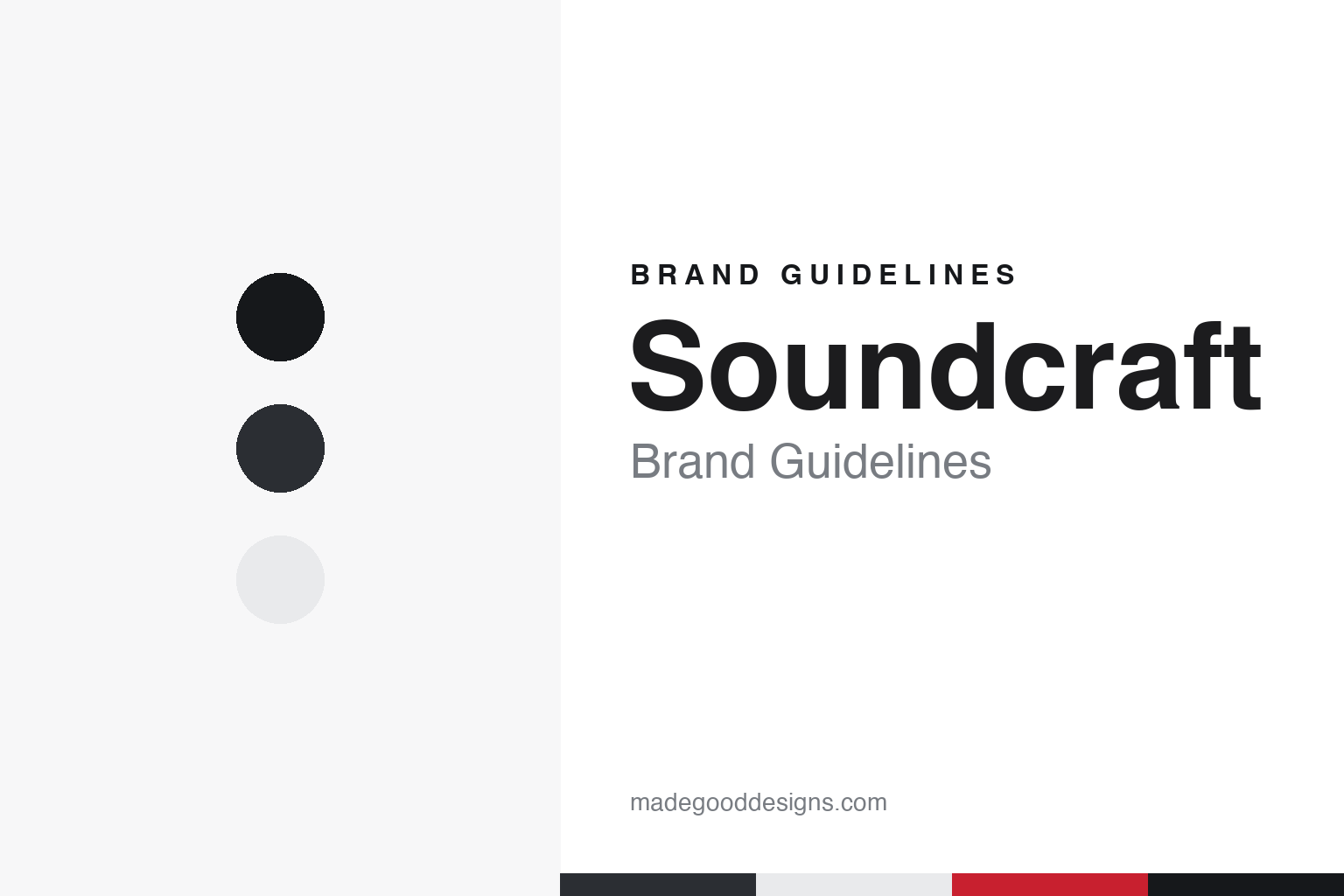
Soundcraft Brand Guidelines
The London mixer maker that put a console in a flight case.
Aa
Two constants: a Soundcraft console grey and signal red palette and an Engineered sans register. Abstract homage — not a Soundcraft product or mark; no console, logo or nameplate is reproduced.
Series 1
A sound engineer and a designer.
Soundcraft began in London in 1973. Its own history book, printed in 2001, says “young electronics designer Graham Blyth and sound engineer Phil Dudderidge” formed the company, and English Wikipedia’s article on Blyth dates the founding of Soundcraft Electronics Ltd to September 1973. The two had worked together before: with Paul Dobson they ran a company called RSD, building custom PA systems for bands including Roy Wood’s Wizzard and Steve Harley & Cockney Rebel, Wikipedia says, citing Pro Sound News. Dudderidge had been Led Zeppelin’s concert sound mixer in the spring of 1970, according to a 2008 account in Performing Musician.
Their first product set the tone. The Series 1, a 16-channel portable mixer, was, the company says, “the first mixing console built into a flight case,” made for touring bands whose equipment had to survive the road. Wikipedia adds that it came in 12- and 16-channel versions with four outputs, four-band fixed EQ and a multi-pin connector for the stage snake. The company’s history says that as the Series 1 caught on, Soundcraft set up a manufacturing facility on Great Sutton Street in London; later, in the early 1990s by the same timeline, it moved to Potters Bar in Hertfordshire, north of the city.
Blyth stayed with the firm for decades. Wikipedia says he served for years as technical director at the Soundcraft Studer design offices in Potters Bar, that he was made a Fellow of the Audio Engineering Society in 2007, and that he was also a concert organist. Dudderidge left in early 1989 and went on to form Focusrite Audio Engineering, which took over the assets of Rupert Neve’s Focusrite company.
Colour
From Series 2 to Spirit.
Through the 1970s and 1980s Soundcraft built a catalogue that ran from small live mixers to large studio desks. Its history book lists the Series 1S, with sweepable mid-range EQ; the Series 2, a combined live and recording console; the Series 3, its first dedicated recording console; the 1624 and 2400 recording desks; the Series 400 and Series 800 live consoles; the Series 4; and, in the mid-1980s, the TS24 in-line recording console and the 200B. Wikipedia dates both the Series 1S and the Series 2 to 1975, and says the Series 2 was semi-modular, with each input channel on its own module. It also lists the SAC2000, which it calls the first radio on-air desk, and the 3200, a 32-bus recording console first shown at the AES exhibition in Hamburg.
The same book is generous with names, which should be read as the company’s own account. It says the rental company Electrotec commissioned a special blue version of the Series 800B for its hire stock, that Giorgio Moroder bought two TS24 consoles for his studio in North Hollywood, that Bob Dylan bought a Series 2400 for his home studio, and that a 200B was installed at the Sydney Opera House. The book itself notes that the inclusion of artists “does not imply endorsement.”
In 1988, fifteen years after its founding, Soundcraft was sold to Harman International Industries, the American audio group, according to both its own history and Wikipedia. Under Harman it launched Spirit by Soundcraft, a line of compact mixers that, the company says, developed the design ideas of the Seck brand, which Harman had bought shortly before; its history calls the Spirit Folio “groundbreaking.” Later lines include the GB analogue consoles; the Vi series of digital live consoles; the Si series; the Signature analogue mixers; and the Ui series of compact digital mixers, which are run from remote-control apps. Soundcraft says that, “twinned with sister console company Studer,” it introduced the patented FaderGlow and Vistonics interfaces.
Typography
Live and broadcast consoles.
The mixing consoles and processors behind concerts, theatres and broadcast studios come from a small number of makers, and most of them now sit inside larger groups.
The biggest of those groups is Audiotonix, formed in 2014 by combining Allen & Heath, Calrec and DiGiCo, according to Wikipedia, citing The Wall Street Journal. It bought Solid State Logic in 2017, and the investment firm Ardian took a majority stake in 2019, the Financial Times reported. In 2024 Audiotonix announced an agreement with the investment firm PAI Partners, with Ardian and Astorg keeping minority stakes. DiGiCo gives its address as Chessington, in Surrey; Calrec’s is a mill in Hebden Bridge, West Yorkshire. Harrison, which presents itself as a Nashville brand, was bought by Solid State Logic, which announced the deal in April 2023; Harrison’s own history gives 2022.
Soundcraft, founded in Britain in 1973 by Phil Dudderidge and Graham Blyth, describes itself as part of Harman’s professional division. Samsung Electronics completed its purchase of Harman in 2017.
Midas and Klark Teknik have shared owners since Klark Teknik, of Kidderminster, bought Midas in 1987. Since December 2009 both have belonged to Music Group, now Music Tribe, the company chaired by Uli Behringer and based in Makati, in the Philippines; Midas says it opened a research centre in Manchester.
Lawo, of Rastatt in Germany, was founded in 1970 by Peter Lawo, according to Wikipedia; its website lists his son Philipp on the supervisory board. We found no outside group owner in the sources we checked.
This guide sets out what can be checked about each brand — who founded it, who owns it, and what it says about where its products are made — and marks clearly what rests only on the company’s own word.
Aa
An engineered sans — a console maker’s register. (Specimen set in Inter Tight, a sans STAND-IN; NOT the Soundcraft logo.)
Soundcraft
Soundcraft by Harman.
Ownership changed again in 2017. Samsung Electronics agreed in November 2016 to buy Harman for $8 billion in cash, and on 11 March 2017 announced that it had completed the purchase; Harman has since run as an independent subsidiary of Samsung, Wikipedia says. Soundcraft’s website, as archived in June 2026, still presents the brand as “Soundcraft by HARMAN,” part of Harman Professional Solutions, with the Vi, Si, Ui, Signature, GB and Notepad families on sale. We found no report of a sale or closure of Soundcraft in the sources we checked.
Where its consoles are made today is less clear. English Wikipedia now describes Soundcraft as a “designer and importer (formerly a manufacturer)” of mixing consoles, and its article on Studer says Harman closed the Potters Bar facility in June 2016 and moved manufacturing and customer support to Hungary. Neither statement is cited there, and we could not find a dated trade report confirming them, so we give them as Wikipedia’s account. Studer itself was sold to Evertz Microsystems in 2021, according to Evertz.
For a design guide, Soundcraft shows how a brand can be built on one practical idea — a mixer in a flight case — and outlast changes of owner. Compare Allen & Heath, another British mixer maker that Harman once owned, Wikipedia says, and Solid State Logic, the Oxfordshire studio-console firm. For this guide we use a console grey and a signal red with a sans, an unofficial interpretation; no product or logo is reproduced.
Explore & save
Keep Soundcraft’s identity on hand — save it to a board in the Made Good inspiration library.
Soundcraft identity set
Pin the Soundcraft console grey and signal red palette and the Engineered sans register to your own board.