Perugina Brand Guidelines
The Perugia chocolate maker behind Baci and its blue box.
Aa
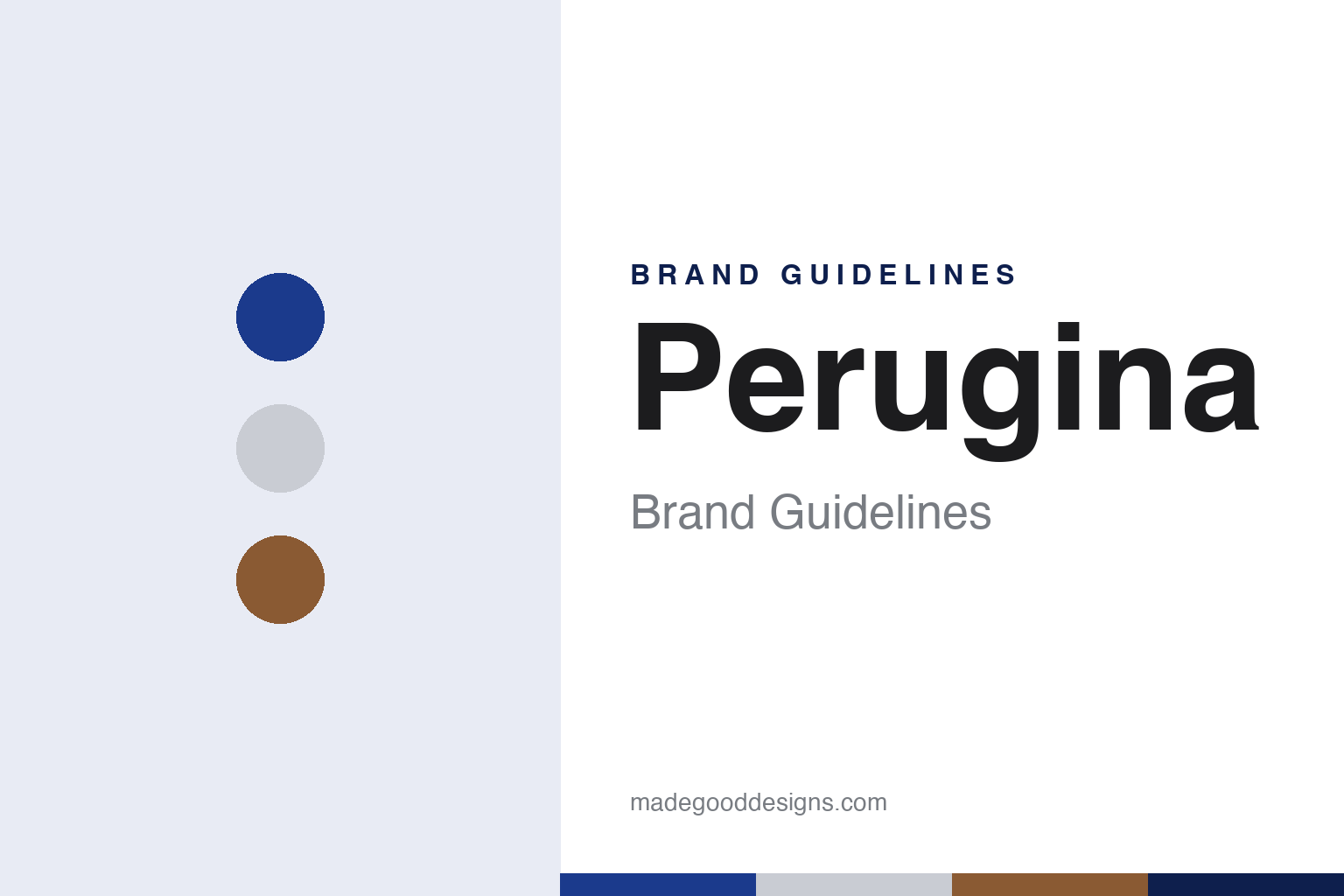
Two constants: a Baci blue, silver and hazelnut palette and a romantic serif register. Abstract homage — not a Perugina product or mark; no wrapper, box, logo or artwork is reproduced.
Perugia, 1907
A sugared-almond workshop becomes a company.
Perugina began in Perugia, the Umbrian hill city, on 30 November 1907, when an artisan workshop was enlarged into the Società Perugina per la Fabbricazione dei Confetti, a company for making sugared almonds, with a capital of 100,000 lire, according to Italian Wikipedia, citing the company’s own history page. Its partners were Francesco Buitoni, of the pasta-making family, Luisa Spagnoli and her husband Annibale, Leone Ascoli and Francesco Andreani; English Wikipedia, citing The Washington Post in 2005, gives the same five names. The Spagnolis had earlier taken over a confectionery shop in the city, the Dizionario Biografico degli Italiani says.
The young company nearly failed. At the end of 1909 it was handed to Francesco’s eighteen-year-old son, Giovanni Buitoni, who raised capital and loans and scaled back its commercial plans, according to SAN, the Italian state portal of business archives. In 1915 production moved to a new factory at Fontivegge, near Perugia’s railway station, where Luisa Spagnoli set up a nursery for workers’ children; the First World War limited raw materials but brought orders for cocoa products for the troops. Perugina became a joint-stock company in 1923, and by 1927 the Buitoni family had secured control, the historians Francesco Chiapparino and Renato Covino write.
Under Giovanni Buitoni, Perugina pushed into packaging and marketing. SAN describes it as one of the first Italian firms to wrap and box its chocolates, and the first in its sector to apply scientific management, between 1926 and 1929. Its name also went on a motor race, the Coppa della Perugina, held four times from 1924 to 1927. Luisa Spagnoli later founded an angora-wool business that grew into the Luisa Spagnoli fashion house, still based in Perugia.
Colour
The Bacio and its blue box.
The product that made Perugina famous arrived in 1922. Italian Wikipedia, citing a 2016 biography of Luisa Spagnoli by Maria Letizia Putti and Roberta Ricca, says she mixed leftover hazelnut fragments with chocolate into an irregular sweet shaped like a clenched fist, with a whole hazelnut as the knuckle, and called it the Cazzotto — the punch. Giovanni Buitoni thought that a poor name for a gift and renamed it the Bacio, the kiss; the public broadcaster’s RaiNews told the same story at its centenary in January 2022.
Its look came from Federico Seneca, the poster artist who ran Perugina’s advertising office from about 1919 until 1932. Reworking Francesco Hayez’s painting Il bacio in strong light and shadow, he drew two embracing lovers and created the blue box; the idea of wrapping each chocolate with a slip carrying a line about love, the cartiglio, is also credited to him, though Italian Wikipedia says the first slips appeared in the 1930s. The chocolate is still sold in silver foil printed in blue. When Perugina tried a cherry-and-liqueur version in 1964, in a gold wrapper with red graphics and a red box, buyers turned it down, Italian Wikipedia says. The Bologna painter Emma Bonazzi also designed posters, luxury boxes in wood, silk and card, and shop fittings for Perugina from 1925 to 1940.
Advertising stayed central. In 1934 Perugina and Buitoni sponsored the radio serial I quattro moschettieri with a collectible-card contest, the cards drawn by Angelo Bioletto; it was devised by Luisa’s son Aldo Spagnoli, then advertising director. From 1997 to 1999 an Alitalia Boeing 747 on the Rome–New York route flew in a blue Baci livery, and in 2009 the Armando Testa agency’s “Giovanni Don Giovanni” campaign won an award at Cannes, Italian Wikipedia says. The love notes now come in several languages.
Typography
Chocolate in Italy, Spain and the Netherlands.
The seven brands in this group all make or sell chocolate, and they come from three countries with distinct chocolate habits: Perugina and Baratti & Milano from Italy, Valor and Blanxart from Spain, and Droste, Verkade and Van Houten from the Netherlands. Each country is known for a different way of using cocoa, and those habits shape how the brands present themselves.
In the Netherlands the story is cocoa powder: the pressed, alkalised “Dutch” cocoa that made a drink of chocolate easy to mix, sold in tins and boxes whose graphics became part of the brand. In Italy it is gianduja, chocolate blended with hazelnut paste and associated above all with Piedmont, alongside pralines and boxed gifts. In Spain it is chocolate a la taza, a thick drinking chocolate served in cafés, often with churros, alongside bars made for melting into it. The names here range from century-old firms now owned by large groups to family companies, and some survive mainly as brands.
Each guide separates what independent sources record from what the company says about itself — who founded it, who owns it now, where its cocoa comes from and where its chocolate is made — and marks plainly what rests only on the company’s own word.
Aa
A romantic serif — for a brand built on a painted kiss. (Specimen set in Playfair Display, a serif STAND-IN; NOT the Perugina or Baci logo.)
Perugina
From the Buitoni family to Nestlé.
Perugina reached the United States in the 1930s: Italian Wikipedia dates the launch to 1935, with a Fifth Avenue shop called La Bomboniera, while English Wikipedia ties it to the 1939 New York World’s Fair. In the 1960s the factory moved from Fontivegge to San Sisto, on the edge of Perugia. In 1968 Buitoni merged with Perugina to form IBP – Industrie Buitoni Perugina, which struggled through the 1970s and was sold in 1985 to Carlo De Benedetti’s CIR group. In March 1988 CIR sold Buitoni-Perugina to Nestlé for 1,600 billion lire, La Repubblica reported. Nestlé sold Buitoni in 2008 but kept Perugina, whose registered office has been in Milan since 1988.
Nestlé has reshaped San Sisto. In July 2007 it sold the plant’s cocoa-mass and liquid-chocolate production to Barry Callebaut, with 87 employees, Wall Street Italia reported. After a dispute over job cuts that ran from 2015 to 2018, it sold the Ore Liete pastry business to Tedesco and, in June 2016, the Rossana sweets and related brands to Fida of Asti, ANSA reported. In November 2019 Il Sole 24 Ore reported that Perugia had become Nestlé’s European hub for KitKat, at the end of a three-year investment plan of €60 million; in January 2026 the local paper PerugiaToday reported that a new KitKat F1 bar would also be made at San Sisto and exported to more than 30 countries. The Baci are still made in Perugia, and a chocolate school has operated at the factory since 2007. The city also hosts Eurochocolate, an independent festival held since 1994.
For a design guide, Perugina shows how one wrapper, one box and one painted kiss can carry a brand through a century of owners. Compare Baratti & Milano, an older Italian house now inside a larger group, and Amedei, a Tuscan maker. For this guide we use Baci blue, silver and hazelnut with a serif, an unofficial interpretation; no product or logo is reproduced.
Explore & save
Keep Perugina’s identity on hand — save it to a board in the Made Good inspiration library.
Perugina identity set
Pin the Perugina blue, silver and hazelnut palette and the romantic serif register to your own board.