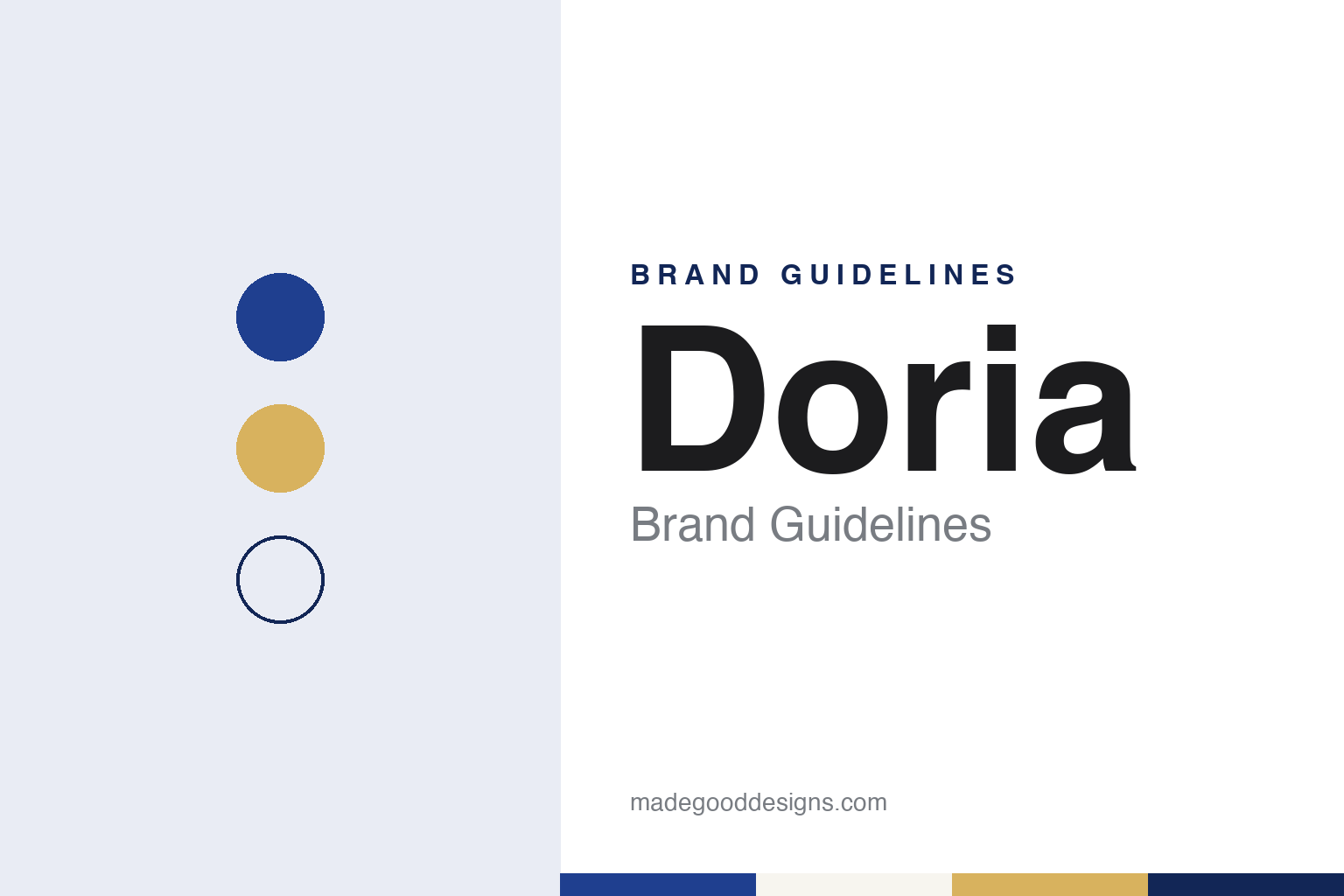
Doria Brand Guidelines
The Treviso bakery behind Bucaneve, named after a Swiss biscuit maker.
Aa
Two constants: a Doria blue, white and wheat palette and a soft old-style serif register. Abstract homage — not a Doria product or mark; no pack, logo or biscuit is reproduced.
From Sarmede to Orsago
A bakery in the Treviso hills.
Doria’s roots are in the hills of the province of Treviso, in the Veneto. Italian Wikipedia, citing Mauro Castelli’s 2006 business history Una marcia in più, traces the company to a bread bakery run by Alessandro Zanin at Sarmede at the end of the 19th century, where a pastry-maker, Antonietta Donadon, added sweet baking to the bread. The company tells the same family story on its website, and Il Sole 24 Ore wrote in 2014 that sweets were added in 1920, after the First World War.
In the 1930s sales spread to the surrounding towns, with Alessandro’s son Ugo Zanin making the deliveries. In 1950 Ugo, by then running the business with his two sons, Gastone and Giorgio, bought a plot of land at Orsago and built a small factory there with about a dozen workers, under the name Zanin Ugo & figli, Italian Wikipedia says.
The same year, according to the company, to Il Sole 24 Ore and to its present owner, Bauli, the family launched the Bucaneve — the name means “snowdrop” — a shortbread biscuit that became its best-known product. The company says the Bucaneve celebrated its 50th anniversary in 2000. Ownership stayed with the family for more than half a century: from 1979, Italian Wikipedia says, Gastone and Giorgio Zanin each held half, and the next generation joined the business.
Colour
A borrowed name and a tube of biscuits.
The Doria name came from abroad. Italian Wikipedia, citing Castelli, says that in the mid-1950s Ugo Zanin met René Italo Ricolfi Doria, a Swiss who made biscuits in Haute-Savoie under the Doria mark, at a spa town. The two became friends and signed a handwritten agreement not to enter each other’s markets, under which Zanin could use the name. Il Sole 24 Ore, writing in 2014, gave the date as 1958, credited Gastone Zanin with the meeting, and said he liked the name’s echo of the famous Genoese family. In 1958 the firm became Doria S.p.A.
Television built the brand. From 1956, Italian Wikipedia says, Doria made heavy use of TV advertising, and its sketches on Carosello, the evening advertising showcase, are still remembered, from “Tacabanda” to a jingle about grandmother’s recipe of sugar, milk and the finest flour. The Bucaneve’s classic pack is a tube with the biscuits lined up in a row; larger bags were added from the 2000s, Italian Wikipedia says.
The range broadened into savoury baking. The company dates its Doriano crackers and its Giambonetti snacks to the late 1960s, and Italian Wikipedia names the Atene biscuits and Doria crackers among its best-known products. In 2006 il Giornale listed Bucaneve, Atene, Doricrem and Doriano among its brands. The Bucaneve itself is now sold in chocolate-chip and six-cereal versions as well as the original, Italian Wikipedia says.
Typography
Design and documentation.
The seven brands in this group all make biscuits, and all of them come from Italy: Pavesi, Doria, Galbusera, Gentilini, Colussi, Misura and Saiwa. Italian biscuit brands in general sit at many different points in the trade, from family firms that still carry a founder’s surname to names that now belong to much larger food groups, and a single brand can be sold everywhere from a corner bar to a supermarket shelf.
A biscuit brand’s identity is usually carried less by a single product than by a pack, a name and the breakfast or snack it promises, because the company behind the name may have changed hands, moved its factory or grown far beyond the town where it started. That makes the questions behind each name worth asking plainly: who started it, who owns it now, and where its biscuits are actually baked and packed.
Each guide separates what independent sources record from what the company says about itself — its founding story, its owners over time, where its biscuits are made and how its packaging has changed — and marks plainly what rests only on the company’s own word.
Aa
A soft old-style serif for a family bakery’s name. (Specimen set in Fraunces, a serif STAND-IN; NOT the Doria logo.)
Doria
A Treviso brand inside the Bauli group.
In 2006 the Zanin family sold. Bauli, the Verona maker of pandoro and panettone founded by Ruggero Bauli in 1922, bought 100% of Doria in a deal dated 31 July 2006, il Giornale reported that August; Doria then had annual sales of about €37 million and a single plant, at Orsago. Bauli, based at Castel d’Azzano near Verona, went on to buy the Motta and Alemagna bakery brands from Nestlé in 2009 and Bistefani, the maker of Krumiri, in 2013, Italian Wikipedia says. In January 2014 Il Sole 24 Ore reported the death of Gastone Zanin, whom it called Doria’s founder, at the age of 88, and put the company’s workforce at about 250.
The figures show the scale of the deal. il Giornale put Doria’s share of its market at about 3.5%, against Bauli’s 28% of the Italian panettone and pandoro trade, and said the purchase would lift the Verona group’s annual sales to about €280 million, more than €120 million of it outside the Christmas cakes. Bauli kept the Doria name rather than folding the biscuits into its own brand, Il Sole 24 Ore noted in 2014, and its 2025 report lists Doria beside Motta, Bistefani, Alemagna and Olivieri 1882 as historic Italian brands whose separate identities, it says, the group preserves.
Bauli’s 2025 sustainability report still lists a production plant at Orsago, in the province of Treviso, among its eight plants in Italy and India, though it does not say which products each one makes. The report says the group’s “free-from” ranges — gluten-free, lactose-free and no-added-sugar — are sold under the Bauli and Doria brands, and it describes the Bucaneve, created in 1950, as the biscuit that made Doria’s name. Since 2017, the company says, Doria has also sold a line called Semplicissimi, made with short ingredient lists under the slogan “#tornasemplice.”
For a design guide, Doria shows how a family bakery’s borrowed name and a tube of biscuits became a national brand. Compare Matilde Vicenzi, another Veneto biscuit maker, and Lazzaroni, the Saronno amaretti house. For this guide we use a royal blue, a snowdrop white and a warm wheat with a serif, an unofficial interpretation; no product or logo is reproduced.
Explore & save
Keep Doria’s identity on hand — save it to a board in the Made Good inspiration library.
Doria identity set
Pin the Doria blue, white and wheat palette and the soft old-style serif register to your own board.