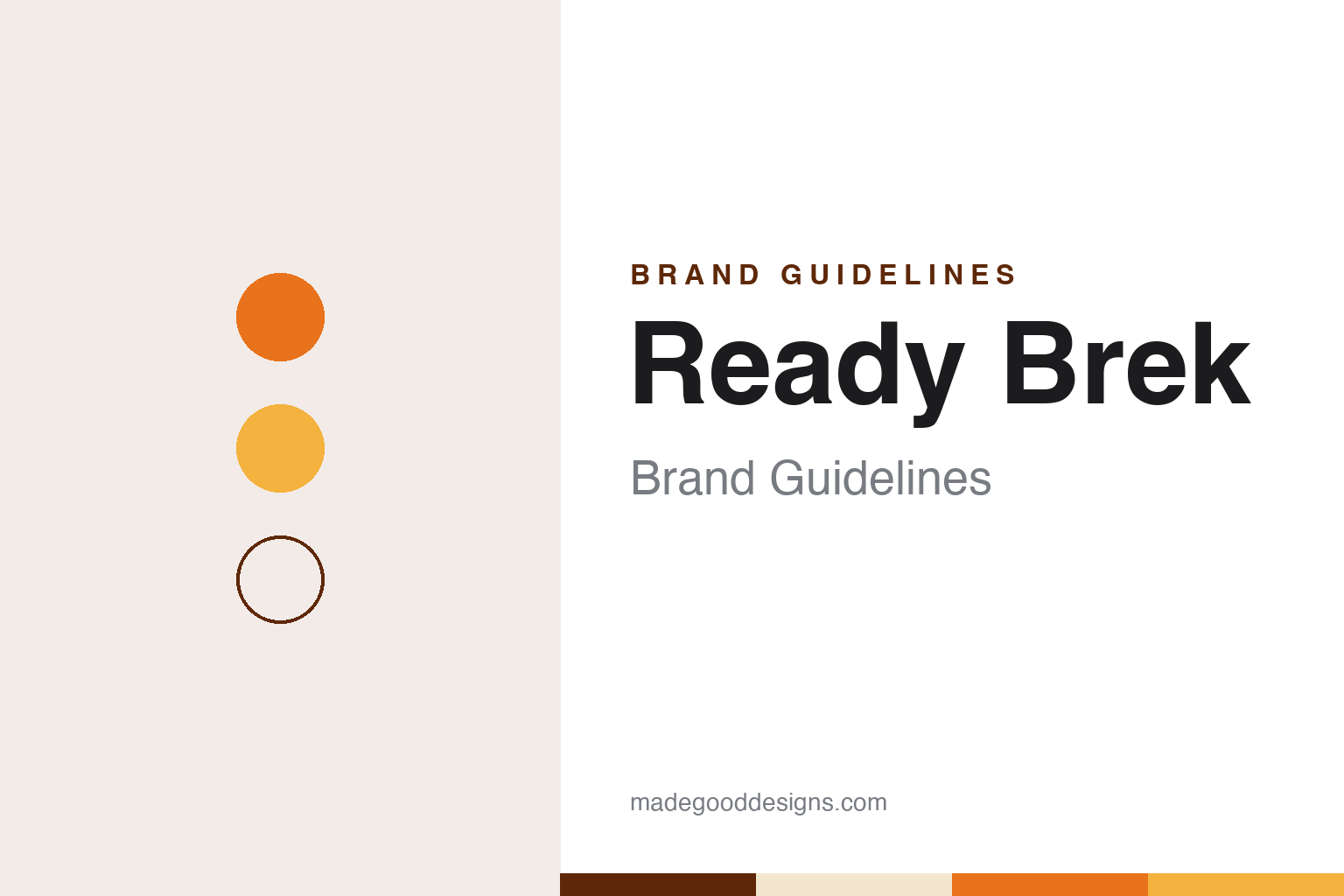
Ready Brek Brand Guidelines
The Lyons instant oat cereal sold on a glow.
Aa
Two constants: a glow orange, warm amber and oat cream palette and a rounded warm sans register. Abstract homage — not a Ready Brek product or mark; no pack, logo or bowl is reproduced.
Greenford
A tea-division manager, a canal-side factory and an instant porridge.
Ready Brek began inside J. Lyons and Co., the London food and catering company founded in 1884 by Joseph Lyons and his brothers-in-law Isidore and Montague Gluckstein. Lyons was best known for its teashops, which opened from 1894 and numbered around 200 at their peak, and for the Corner Houses of the West End; between 1951 and 1963 it also built the LEO business computers, according to English Wikipedia.
Lyons had a large factory at Greenford, in west London, which officially opened in July 1921, straddled the Grand Union Canal and covered 63 acres at its height. It made tea, coffee and grocery products, and later Lyons Maid ice cream. English Wikipedia says Ready Brek was “created from experimentation by Walter Pitts, factory manager from the Tea division” there, and that it was launched in 1957 as an instant porridge, made from rolled oat flakes and oat flour and usually served hot with milk. In 1969 it was repositioned as an “instant hot cereal.”
Lyons changed hands while Ready Brek was growing. In 1978 the company was acquired by Allied Breweries and became part of the new Allied Lyons, which later turned towards spirits as Allied Domecq and sold off the food businesses. Lyons’ cake brands went to what is now Premier Foods, its biscuits to Burton’s and its ice cream to Nestlé. The Greenford site was dismantled from 1998 and had become the Lyon Way Industrial Estate by 2002, English Wikipedia says.
Colour
Central heating for kids.
Ready Brek’s fame rests on one advertising idea. Its slogans were “Central heating for kids” and “Get up and Glow,” and in its television adverts of the 1970s and 1980s children walked to school surrounded by a superimposed radiant glow, the warmth of a hot breakfast made visible. English Wikipedia names the actor Jon Pertwee as the voice of the commercials. The History of Advertising Trust, the British advertising archive, catalogues Ready Brek commercials under the “Central heating for kids” title.
The glow faded from screens, then came back. On 3 November 2008 Weetabix returned it to television and cinema in a £2 million national campaign, Talking Retail reported that day; Campaign credited the agency WCRS. In the new spot a boy eats his Ready Brek and then makes light work of a string of imaginary obstacles, from a bucking horse made of numbers to life-size table-football players. That autumn the range had three flavours, original, chocolate and a new honey version, Talking Retail said.
Over the years Ready Brek has tried many flavours. English Wikipedia lists banana, butterscotch, strawberry, golden syrup, gingerbread, toffee and honey among those since discontinued, and gives the current range as Original and Chocolate.
The glow has kept returning in the brand’s promotions. In 2017 Ready Brek partnered with Walker Books on a campaign built around the picture book We’re Going on a Bear Hunt, encouraging families to get outdoors. In January 2021 Weetabix ran an on-pack promotion called “Central Heating for Everyone,” offering ten prizes of a year’s free home heating and asking shoppers to post photos of “glowing creations” made with the cereal on Facebook and Instagram. In that release Weetabix described Ready Brek as a £10 million brand growing faster than the hot-cereals category, and said it was putting more than £500,000 of television, in-store and social media support behind it that year.
Typography
British breakfast, documented.
The seven brands in this group all make breakfast cereals or oats, and all of them come from Britain: Weetabix, Jordans, Dorset Cereals, Alpen, Ready Brek, Shreddies and Scott’s Porage Oats. British breakfast cereal and oat brands in general sit at many different points in the trade, from names that still carry a founder’s surname to names that now belong to much larger food groups, and a single brand can be sold everywhere from a village shop to a supermarket shelf.
A cereal brand’s identity is usually carried less by a single product than by a box, a name and the breakfast it promises, because the company behind the name may have changed hands, moved its mill or grown far beyond the town where it started. That makes the questions behind each name worth asking plainly: who started it, who owns it now, and where its cereals and oats are actually milled and packed.
Each guide separates what independent sources record from what the company says about itself — its founding story, its owners over time, where its cereals are made and how its packaging has changed — and marks plainly what rests only on the company’s own word.
Aa
A rounded, warm sans for a brand sold on a glow. (Specimen set in Baloo 2, a rounded sans STAND-IN; NOT the Ready Brek logo.)
Ready Brek
From Lyons Tetley to Weetabix, and on to Post.
Ready Brek left the Lyons business in 1990. Weetabix says it acquired the brand that year from Lyons Tetley; English Wikipedia dates the purchase to June 1990. A company history published by FundingUniverse says Weetabix bought Ready Brek together with the Applefords Cluster brand, and that Ready Brek had launched, and still led, the instant hot breakfast cereal category. No price for the deal is given in those sources.
Weetabix itself was already an established Northamptonshire company. It took the name Weetabix Limited in 1932, changing it from the British & African Cereal Company, and its headquarters remain at Burton Latimer, with a further factory at Ashton-under-Lyne, according to English Wikipedia. Ready Brek sits in its portfolio alongside Weetabix and Alpen.
The company that owns Ready Brek has itself been sold several times since 2003. English Wikipedia records a purchase by the Dallas private-equity firm HM Capital for £642 million in November 2003, a transfer to Lion Capital in January 2004, the acquisition of a 60% controlling stake by China’s state-owned Bright Food in May 2012, in a deal that valued Weetabix at £1.2 billion, and the purchase of the whole company by the American cereal maker Post Holdings for £1.4 billion in July 2017. Ready Brek has been part of each of those deals as one of the Weetabix brands, which means a cereal first developed by a tea manager in west London is now owned, through Weetabix, by the American group behind Post cereals.
Weetabix’s own description of the brand, on its company history page, is of a porridge “without the lumps” for children.
For a design guide, Ready Brek shows how a single visual idea, a child wrapped in a warm glow, can outlast the company that invented it and carry a brand through several owners. Compare Weetabix, its stablemate, and Scott’s Porage Oats, the Scottish rolled-oat brand. For this guide we use a glow orange, a warm amber and an oat cream with a rounded sans, an unofficial interpretation; no product or logo is reproduced.
Explore & save
Keep Ready Brek’s identity on hand — save it to a board in the Made Good inspiration library.
Ready Brek identity set
Pin the Ready Brek glow orange, warm amber and oat cream palette and the rounded warm sans register to your own board.