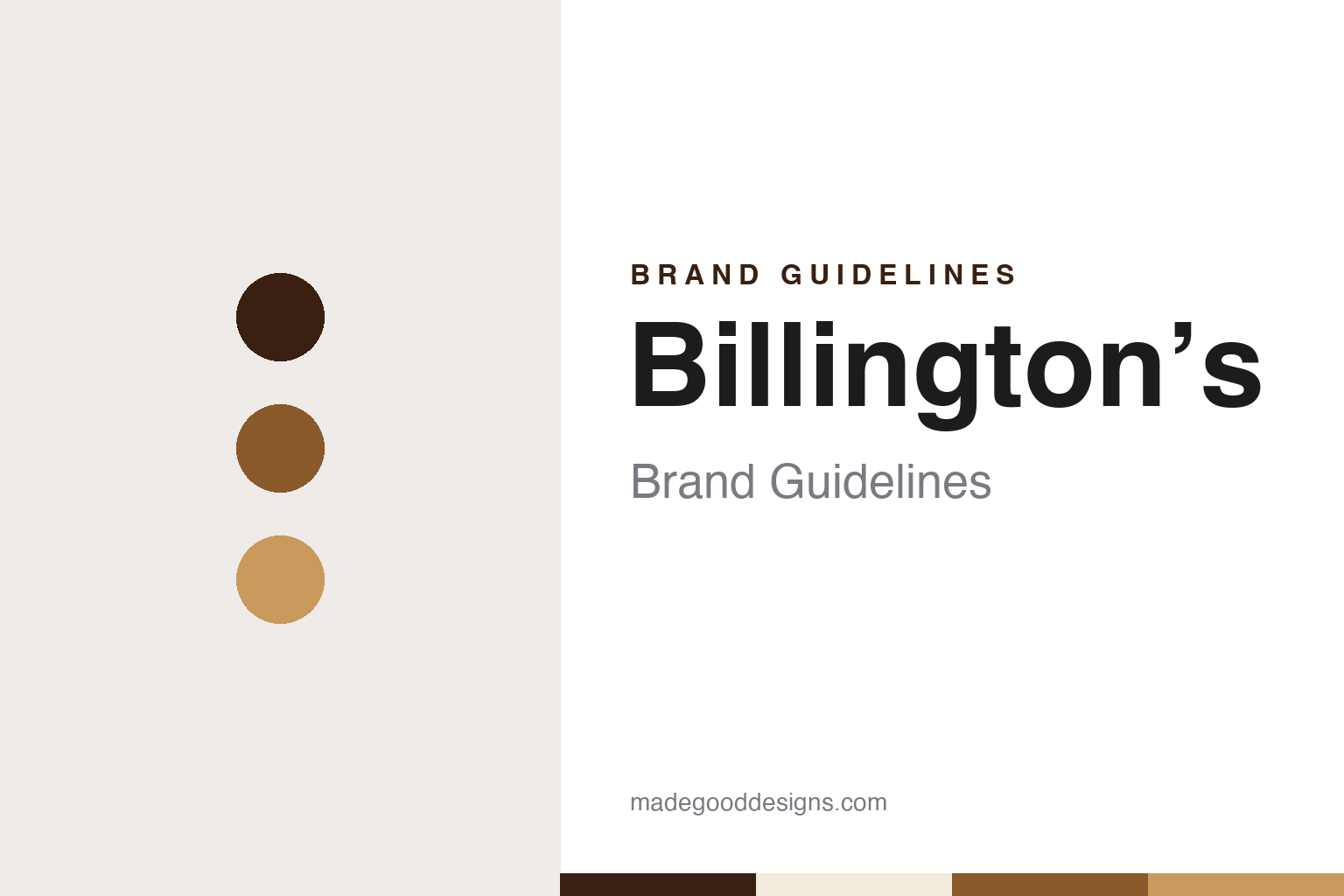
Billington’s Brand Guidelines
Liverpool merchants, Mauritian unrefined sugar.
Aa
Two constants: a molasses, muscovado and demerara palette and a merchant’s serif register. Abstract homage — not a Billington’s product or mark; no pack or logo is reproduced.
A Liverpool trading house
Tea, coffee and then sugar on the Mersey.
Billington’s began not as a sugar brand but as a merchant’s business in one of Britain’s great trading ports. The Billington family’s group says Edward Billington founded a trading company in Liverpool in 1858, dealing first in tea and coffee and adding sugar within a few years; English Wikipedia, citing the brand’s own heritage page, gives the same founding year and describes the firm as a tea and coffee trading company. The business traded for a long time as Edward Billington and Son.
For more than a century sugar was one line among several. The family’s group history says the business spread into other trades over the following century, from tin packaging in the early 1900s to cattle feed.
The turn that made the brand came in 1977, when the company began importing unrefined brown sugars from Mauritius, the magazine About Time reported in a profile of the brand. That origin became the brand’s argument. Its site today presents the range as “Naturally Unrefined” — “Natural molasses locked in. Nothing refined out.” — and says its sugars are crafted at source in partnership with Mauritian growers and producers.
Colour
From a family importer to British Sugar.
By the early 2000s Billington’s had become the leading name in its corner of the British sugar market. When British Sugar agreed to buy the business in May 2004, ABF’s finance director John Bason called Billington’s widely regarded as the leader in that sector of the UK market, Just Food reported. The Irish Examiner described the company as based in Ipswich, with sugars sourced from Mauritius, Malawi and Barbados.
The Office of Fair Trading’s decision on the deal sets out what was bought. The Billington Food Group was a subsidiary within a structure whose ultimate holding company was Edward Billington & Son; it imported unrefined cane sugars, mainly from Mauritius, and sold them under its own brand, as supermarket own-label and to food manufacturers, with turnover of about £29 million in the year to April 2003. On 26 May 2004 British Sugar agreed to buy its entire share capital, together with a minority stake in Sukpak, a hand sugar-packing business in Mauritius. The OFT cleared the purchase in August 2004 without referring it to the Competition Commission. Just Food put the net assets acquired at £7.7 million.
The decision also records how the two businesses overlapped. Both companies sold sugar to shoppers and to food manufacturers, but the parties told the OFT that Silver Spoon was not strongly branded in organic and natural sugars. British Sugar also confirmed in July 2004 that it was discontinuing its production of organic beet sugar, the OFT noted.
Bason framed the purchase as filling a gap: it added a full range of unrefined raw cane sugars to complement British Sugar’s existing Silver Spoon range of beet sugars, he said. Billington’s has been a British Sugar brand, and so part of Associated British Foods, ever since.
Typography
Design and documentation.
The seven brands in this group all sell baking, sugar, flour and spice products, and all of them are sold under their own names on British shelves: Lyle’s, Tate & Lyle, Silver Spoon, Billington’s, McDougalls, Homepride and Schwartz. British baking and store-cupboard brands in general sit at many different points in the trade, from names that still carry a founder’s surname to names that now belong to much larger food groups, and a single brand can be sold everywhere from a corner shop to a supermarket baking aisle.
A store-cupboard brand’s identity is usually carried less by a single product than by a pack, a name and the kitchen task it promises to help with, because the company behind the name may have changed hands, moved its factory or grown far beyond the town where it started. That makes the questions behind each name worth asking plainly: who started it, who owns it now, and where its products are actually made and packed.
Each guide separates what independent sources record from what the company says about itself — its founding story, its owners over time, where its products are made and how its packaging has changed — and marks plainly what rests only on the company’s own word.
Aa
A bookish serif for a brand born in a Victorian trading port. (Specimen set in Libre Baskerville, a serif STAND-IN; NOT the Billington’s logo.)
Billington’s
Two Billingtons, one sugar brand.
The sale split the name in two. The sugar brand went to British Sugar, but the family business that sold it carried on. The Billington Group still trades today across animal feed and food, and its history notes the 1997 purchase of the English Provender Company, the 1998 formation of the agricultural joint venture Carr’s Billington, and a sugar venture in the United States, Wholesome Sweeteners, in which it sold its stake in 2022. Anyone looking for the sugar brand should go to billingtons.co.uk; thebillingtongroup.com belongs to the family group, not to British Sugar.
Under British Sugar the brand has stayed with what it is known for. Its current range runs through golden granulated and golden caster, demerara, light and dark brown soft sugars, light and dark muscovado and molasses sugar, each sold as a natural unrefined cane sugar, and more recently a set of coffee syrups made with unrefined cane sugar. The brand’s site quotes the cookery writer Delia Smith calling Billington’s “the finest collection of quality sugars in the world”. It also quotes John Whaite, winner of The Great British Bake Off in 2012, on its sugars’ caramel undertones. It presents each sugar by the bakes it suits, from sponges and biscuits to sticky toffee pudding.
The brand’s story is also a sourcing story: the Mauritian connection that began with the 1977 imports remains its central claim on its site today, and the OFT’s 2004 decision shows that it extended at the time to a packing operation on the island itself.
For a design guide, Billington’s shows how a merchant’s surname and a single origin can carry a premium ingredient brand for decades. Compare Silver Spoon, the British Sugar beet brand that sits beside it, and Lyle’s, another British cane-sugar name. For this guide we use molasses brown, a demerara tan and a golden caster with a bookish serif, an unofficial interpretation; no product or logo is reproduced.
Explore & save
Keep Billington’s’s identity on hand — save it to a board in the Made Good inspiration library.
Billington’s identity set
Pin the Billington’s molasses, muscovado and demerara palette and the merchant’s serif register to your own board.


