Aldaris Brand Guidelines
The Riga brewery named “brewer” by a 1937 public poll.
Aa
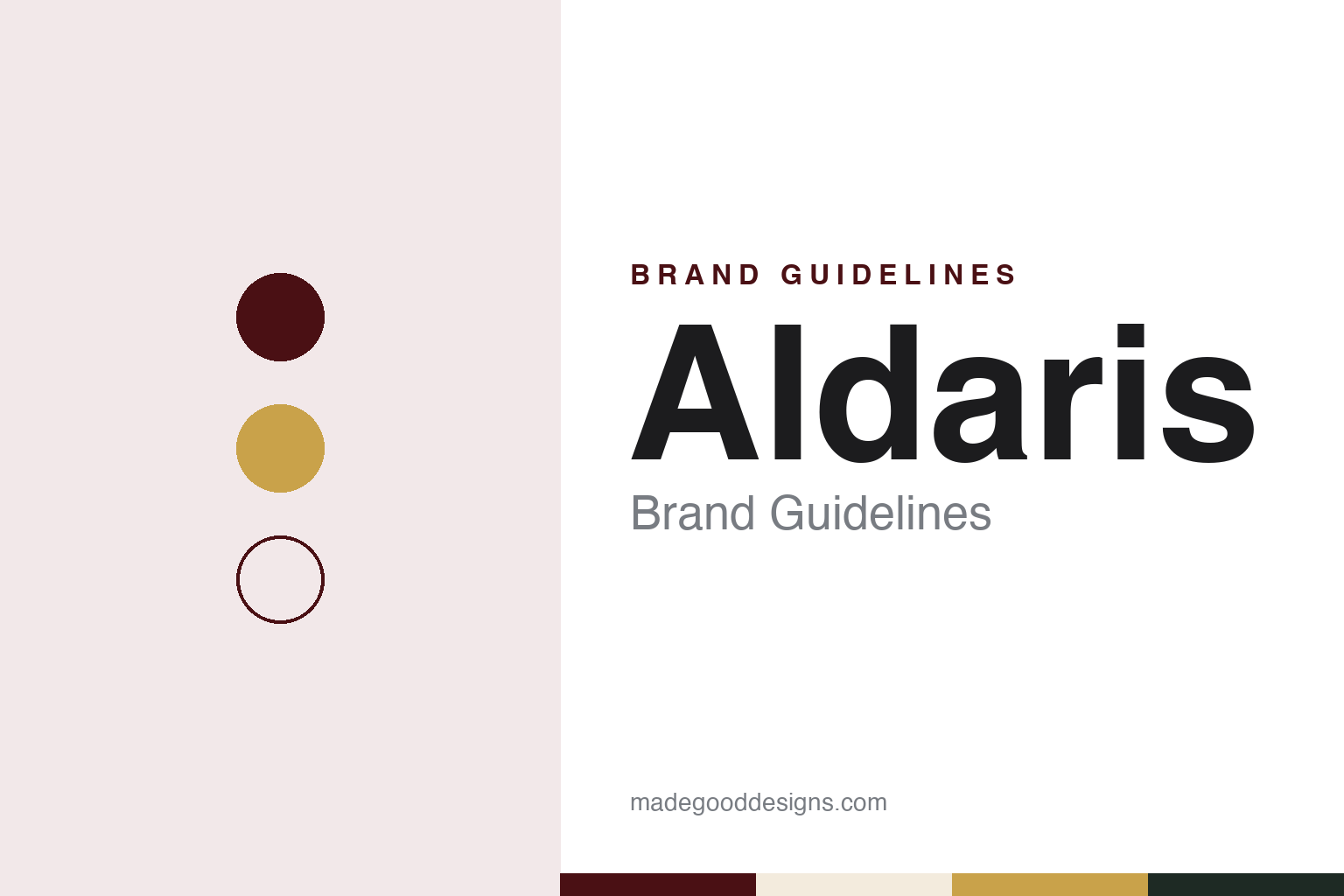
Two constants: a porter red, malt gold and label cream palette and a classic label serif register. Abstract homage — not an Aldaris product or mark; no label, logo or bottle is reproduced.
Waldschlößchen
A forest castle on the edge of Riga.
Aldaris dates its beginnings to 1865, when a brewery called Waldschlößchen — German for “little forest castle,” rendered in Latvian as Mežpils — was built on the outskirts of Riga, in the Sarkandaugava district where the company still brews. Latvian Wikipedia, citing a 2024 report by the public broadcaster LSM on the restored exhibition at the Dauderi museum, says the man behind it was Jānis Daude, the son of Latvian peasants, who had taken the German-sounding name Johann Dauder. The company’s own history gives the same account, naming him as Johann Dauder, or Jānis Daude.
Under its next owner and manager, Adolf von Bingner, the brewery was extensively modernised around 1900, Latvian Wikipedia says: water treatment, filtering and artificial cooling were brought into the brewing process, the plant was fully electrified and it was connected to the railway. In 1905 Waldschlößchen became a joint-stock company. The company says that at the start of the twentieth century it brewed six beers, of which the porter and the export beer were the most popular, and it describes the brewery of that time as one of the most modern in Europe.
The business survived the First World War and carried on into Latvia’s first period of independence. Its present name came in the 1930s. In 1937, Latvian Wikipedia says, citing the newspaper Jaunākās Ziņas of March that year, the state-owned Latvijas Kredītbanka bought all the shares of three Riga breweries — Waldschlößchen, Iļģuciems and Tannhäuser — in what amounted to a nationalisation, and a new company was formed. Its name was chosen through a public poll that drew more than 3,300 entries, and the winning entry was Aldaris, the Latvian word for “brewer.” The company says it was also in 1937 that the brewery imported new equipment from Germany, including copper vessels that are still on the site, though no longer used for brewing.
Colour
A name from a poll and symbols by an artist.
The new name came with a new look. According to the company, Aldaris’ symbols were created in 1937 by the artist Artūrs Apinis, and elements he drew are still found on its labels today.
The late 1930s were a period of growth. The company says that in 1939 Aldaris was recognised as the most modern brewery in Northern Europe, able to brew six million litres of beer a year; that it opened a juice department, selling apple juice and a sparkling fruit lemonade; and that Aldara Gaišais, a pale beer, reached the market in July 1939. Latvian Wikipedia, citing the Latvian Soviet Encyclopedia, says that by 1940 Aldaris made two beers, Aldara gaišais and Aldara tumšais — a pale and a dark — with a capacity of nine million litres a year.
The name outlasted the political upheavals that followed. After the Soviet occupation of Latvia in 1940 and through the Second World War, Latvian Wikipedia says, the brewery kept the name Aldaris. By 1964 it was the largest brewery in Latvia, producing a quarter of the beer brewed in the Latvian SSR, and in 1976 it was merged administratively with the Vārpa and Iļģuciems breweries into a single production association, also called Aldaris. The company says the main brewery on Tvaika iela in Riga was rebuilt and enlarged at that time with Czechoslovak and German equipment, and that a new bottling line in 1969 could fill 12,000 bottles an hour.
Today the brand’s best-known beers include Mežpils, the Latvian form of the name Waldschlößchen, and Porteris, English Wikipedia says. In 2014, the company says, it restarted brewing in the historic Waldschlößchen brewhouse, in the building where Aldaris began, to make limited beers.
Typography
Design and documentation.
The seven brands in this group all make food or drink, and all of them come from Latvia and Estonia: Laima, Selga, Spilva, Riga Black Balsam, Aldaris, Saku and A. Le Coq. Food and drink brands in general sit at many different points in the trade, from firms that still carry a founder’s name to names that now belong to much larger groups, and a single brand can be sold everywhere from a corner shop to a supermarket shelf.
A food or drink brand’s identity is usually carried less by a single product than by a pack, a name and the taste it promises, because the company behind the name may have changed hands, moved its factory or grown far beyond the town where it started. That makes the questions behind each name worth asking plainly: who started it, who owns it now, and where its products are actually made and packed.
Each guide separates what independent sources record from what the company says about itself — its founding story, its owners over time, where its products are made and how its packaging has changed — and marks plainly what rests only on the company’s own word.
Aa
A classic label serif for a brewery named in 1937. (Specimen set in Playfair Display, a serif STAND-IN; NOT the Aldaris logo.)
Aldaris
From state brewery to Carlsberg subsidiary.
After Latvia regained independence, Aldaris was reorganised. The current joint-stock company, AS Aldaris, was established in 1992, and that year it began working with Baltic Beverages Holding (BBH), a Nordic brewing group that English Wikipedia says was founded in 1991 by Finland’s Hartwall and Sweden’s Pripps. In the privatisation that followed, both BBH and the brewery’s employees acquired shares, and the Latvian state sold its remaining stake in 1995 under a cabinet order, Latvian Wikipedia says.
BBH then built up its holding step by step. Latvian Wikipedia, citing Delfi and Apollo reports, puts it at 75% in 2000, with employees holding the rest, and at about 85% in early 2006. BBH later became a joint venture of Carlsberg and Scottish & Newcastle, English Wikipedia says; in January 2008 the BBC reported that Carlsberg and Heineken had agreed to buy Scottish & Newcastle, and in 2008, when Carlsberg became the sole owner of BBH, Aldaris became wholly owned by the Carlsberg Group. English Wikipedia’s Carlsberg article dates Carlsberg’s acquisition of the Riga brewery to 2008, and the company describes itself as part of the Carlsberg Group since that year.
For years Aldaris was the leader of the Latvian beer market. Latvian Wikipedia, citing the newspaper Neatkarīgā Rīta Avīze, says its beers held 46.1% of the market in 2008, and that it led the market until 2013, when the company restructured, cut production and laid off 59 employees, as LSM reported. It still brews in Riga, at Tvaika iela, and the company says it is one of the few breweries in Latvia still working on its historic site.
The brand’s history has become part of its public face. In 2015, for its 150th anniversary, Aldaris opened a beer museum in the brewery complex during Riga’s Museum Night; the company calls it the first beer museum in Latvia, and it is listed by the European Route of Industrial Heritage.
For a design guide, Aldaris shows how a name chosen by public vote in 1937, and symbols drawn for it by an artist that year, can carry a brewery through occupation, merger and foreign ownership. Compare Saku, the Estonian brewery that joined the same Carlsberg group in the same year, and Rīgas Balzams, another Riga drinks maker. For this guide we use a porter red, a malt gold and a label cream with a serif, an unofficial interpretation; no product or logo is reproduced.
Explore & save
Keep Aldaris’s identity on hand — save it to a board in the Made Good inspiration library.
Aldaris identity set
Pin the Aldaris porter red, malt gold and label cream palette and the classic label serif register to your own board.