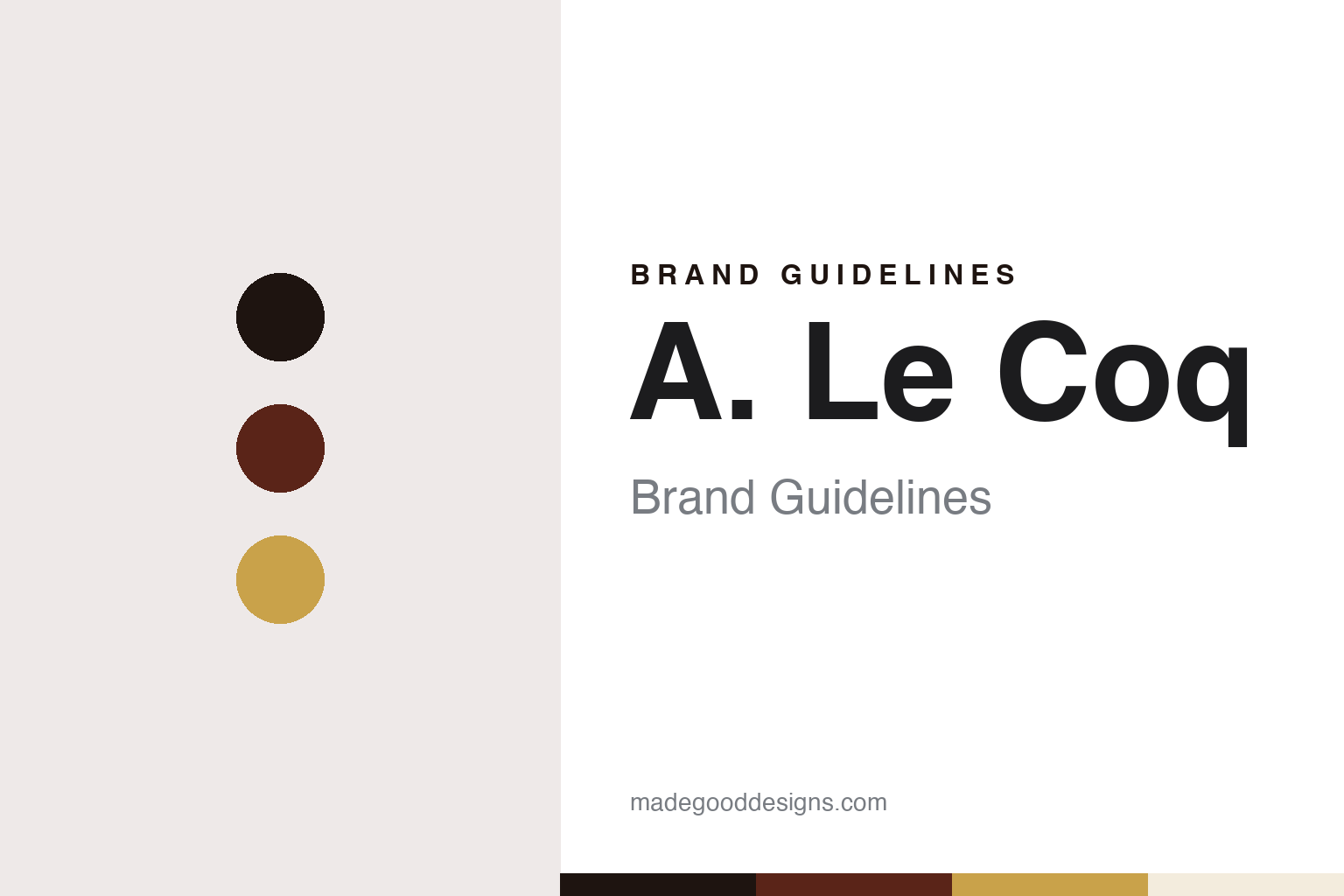
A. Le Coq Brand Guidelines
The Tartu brewery that took its name from a London stout trader.
Aa
Two constants: an A. Le Coq stout brown, brick red and barley gold palette and a Victorian display serif register. Abstract homage — not an A. Le Coq product or mark; no bottle, label or logo is reproduced.
Hesse, Schramm and Tivoli
Two Tartu breweries and a hill called Tähtvere.
A. Le Coq is a brewery and drinks maker in Tartu, Estonia’s second city, and the company calls it the oldest continuously operating brewery in the country. Its roots are two local breweries rather than the man whose name it carries. The company and Estonian Wikipedia, which draws on Andres Sepp’s company history Õllelinn Tartu. A. Le Coq 1807–2007, name its direct predecessors as the brewery of Barthold Joachim Hesse, founded in 1800, and that of Justus Reinhold Schramm, founded in 1826. The company adds that Hesse was the great-grandfather of the novelist Hermann Hesse, and that Schramm was the first in Tartu to brew quality lager.
The two lines came together under a later owner. In 1885, the company says, Julius Moritz Friedrich bought the Schramm business from its heirs; in 1893 he renamed it Tivoli and moved all production to Tähtvere, where large lager cellars had been dug in 1879–1880. Tivoli became a public limited company in 1896, and a red-brick brewery complex was built on Tähtvere Hill between 1894 and 1896, most of which still stands, the company says. In 1900 Tivoli bought the old Hesse brewery, which by then had passed to the Musso family. Tivoli sold beer in Tartu and further afield, in St Petersburg and Pskov, and began making soft drinks in 1896, according to the company.
Colour
A Prussian family, a London stout and a Russian market.
The name came from abroad. A. Le Coq & Co. was a drinks-trading firm founded in 1807 in Prussia by a family of that name, descendants of Huguenots who had left France in the 17th century, the company says, and English and Estonian Wikipedia repeat this. In the 1820s Albert Le Coq moved to London to trade in the family’s wine, and he soon began bottling and exporting Russian Imperial Stout under his own name, a strong, dark, top-fermented beer that he ordered from large London breweries for the Russian market. In the 1870s he sold the London business to the Sillem family, the company says.
High Russian customs duties and growing forgery of the trademark pushed A. Le Coq & Co. (Russia) Ltd, a private limited company from 1904, to move its headquarters, and in 1906 its bottling, from London to St Petersburg. The owners then looked for a brewery inside the Russian Empire to make the stout and chose Tivoli. In March 1912 H. O. Sillem bought all of Tivoli’s shares, and in May a public company, A. Le Coq Ltd, was set up in London with the Tartu plant as its Russian subsidiary, the company and Estonian Wikipedia say. The company says A. Le Coq was named a supplier to the Russian imperial court in 1912. In 1913 the Tartu business took the name A. Le Coq. A new stout department under an English brewer made A. Le Coq Imperial Extra Double Stout, whose labels now read “Brewed in Dorpat,” the old German name for Tartu, and which went by rail to Poland, Siberia and the Russian Far East.
The boom was short. Russia banned alcohol sales in 1914 on the outbreak of the First World War; in 1917 the Tähtvere brewery was looted by Russian soldiers, and in 1918 German forces took the remaining equipment, Estonian Wikipedia says. In independent Estonia the brewery restarted in 1921. In 1926 Estonian brewers agreed sales zones that gave A. Le Coq the south of the country and Saku the north; the company says the agreement expired in 1933, after which A. Le Coq beer was again sold nationwide, and that a Tallinn division opened in 1938.
Typography
Design and documentation.
The seven brands in this group all make food or drink, and all of them come from Latvia and Estonia: Laima, Selga, Spilva, Riga Black Balsam, Aldaris, Saku and A. Le Coq. Food and drink brands in general sit at many different points in the trade, from firms that still carry a founder’s name to names that now belong to much larger groups, and a single brand can be sold everywhere from a corner shop to a supermarket shelf.
A food or drink brand’s identity is usually carried less by a single product than by a pack, a name and the taste it promises, because the company behind the name may have changed hands, moved its factory or grown far beyond the town where it started. That makes the questions behind each name worth asking plainly: who started it, who owns it now, and where its products are actually made and packed.
Each guide separates what independent sources record from what the company says about itself — its founding story, its owners over time, where its products are made and how its packaging has changed — and marks plainly what rests only on the company’s own word.
Aa
A high-contrast Victorian serif for a brand whose name began on London stout labels. (Specimen set in Playfair Display, a serif STAND-IN; NOT the A. Le Coq logo.)
A. Le Coq
Nationalised, renamed, privatised and revived.
The brewery was nationalised in 1940, after Estonia was annexed by the Soviet Union, and renamed Tartu Õlletehas (Tartu Brewery) in 1941, Estonian Wikipedia says, citing the state gazette Riigi Teataja of July 1940. Its last pre-war director, the Englishman J. H. Sillem, left Estonia, the company says. During the German occupation of 1941–1944 it ran as the state-owned Bierbrauerei Dorpat. In the Soviet period output grew steadily, and in 1973 it was renamed Tartu Eksperimentaalõlletehas, the Tartu Experimental Brewery, which allowed it to develop its own beers and soft drinks; it began bottling Värska, which the company calls Estonia’s first mineral water, in 1968. Its soft drinks included the lemon-flavoured Kelluke, made since 1965, which English Wikipedia says was renamed in 2001 and returned under its old name in 2006, as Estonian papers reported in 2006.
Privatisation came in two steps. In 1995 the state sold Tartu Õlletehas to Magnum Konsuumer, which also bought the Saare Õlu brewery in Kuressaare in 1996; the Finnish brewer Olvi took 15% in June 1996 and bought the remaining shares on 15 September 1997, together with Saare Õlu, the company and Estonian Wikipedia say. Olvi plc, based in Iisalmi, Finland, lists itself as the 100% owner of AS A. Le Coq. After Olvi rebuilt the plant, the old name returned: in May 1999 the A. Le Coq trademark was relaunched, first on Premium, Porter and Pilsner beers and Vichy mineral water, and the company says the relaunch was named the best marketing campaign of 1999 by the Estonian Marketing Centre and Marketing Institute. In 2007, for the bicentenary of the 1807 firm, the company name was shortened back to A. Le Coq, as used from 1913 to 1940, and the company launched A. Le Coq Special.
Today A. Le Coq makes a wide range of drinks in Tartu. Estonian Wikipedia, citing the company, lists beers including A. Le Coq Premium, Porter and Imperial Extra Double Stout; Fizz and Hoggy’s ciders; Aura juices and waters, a name the company took over when it bought the juice maker Ösel Foods in 2003; and Dynami:t energy drinks, launched in 2007. The A. Le Coq Arena football stadium in Tallinn is named after the brand. In 2003 a beer museum opened in the brewery’s historic malt-drying tower in Tartu; it reopened after renovation in 2022, Estonian Wikipedia says. In September 2025 A. Le Coq signed an agreement to buy all shares in the mineral-water maker Värska Originaal, with production to stay in Värska, ERR News reported.
For a design guide, A. Le Coq shows how a brand name from a London stout label can outlast a Russian empire, a Soviet renaming and a privatisation to become a Tartu brewery’s identity again. Compare Saku, its long-time rival in the north of Estonia, and Kalev, the Estonian confectioner that also traces its roots to the early 19th century. For this guide we use stout brown, a Tähtvere brick red and a barley gold with a serif, an unofficial interpretation; no product or logo is reproduced.
Explore & save
Keep A. Le Coq’s identity on hand — save it to a board in the Made Good inspiration library.
A. Le Coq identity set
Pin the A. Le Coq stout brown, Tähtvere brick and barley gold palette and the Victorian display serif register to your own board.