Asbach Brand Guidelines
The Rüdesheim brandy house that named Weinbrand.
Aa
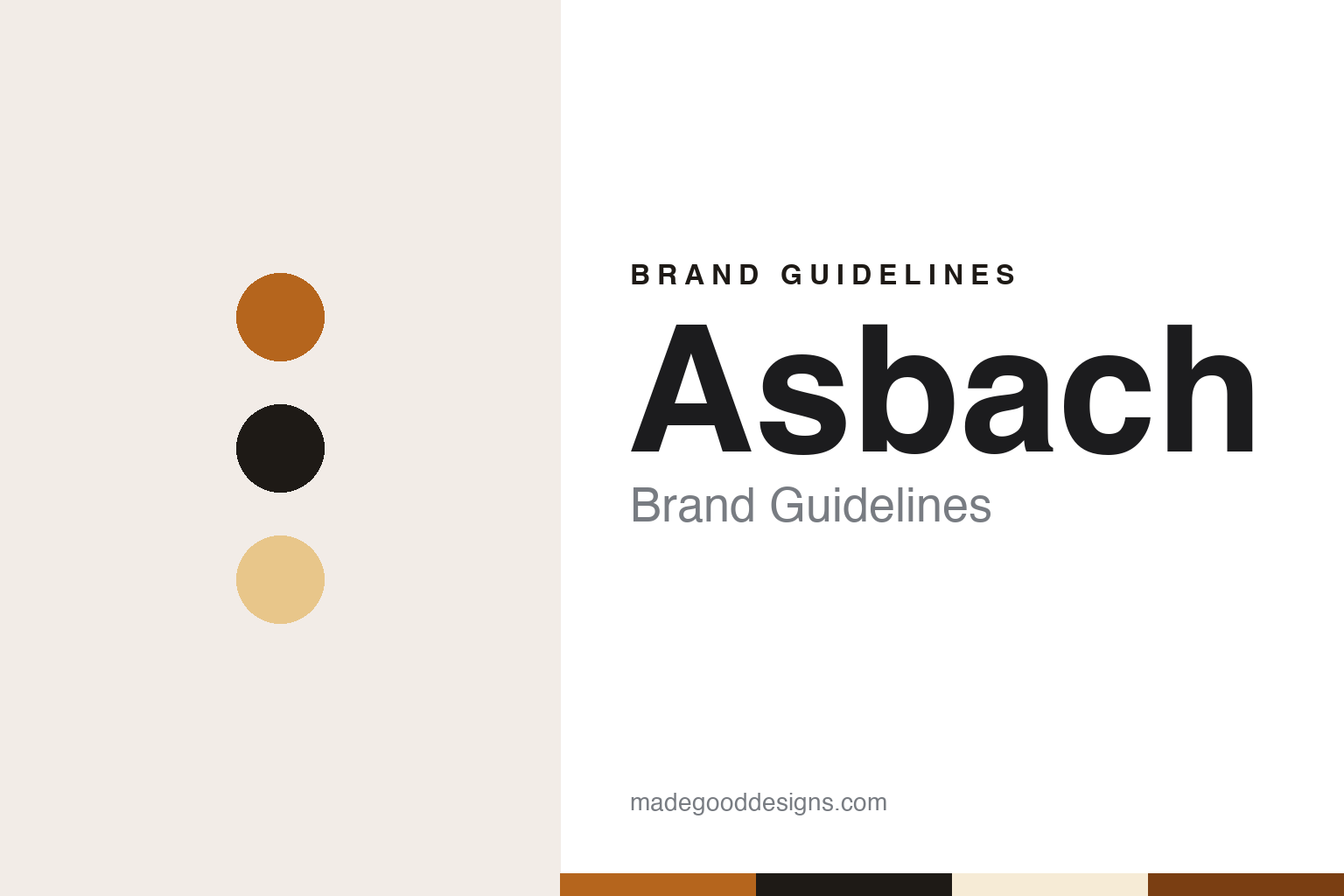
Two constants: a brandy amber, cask brown and cellar black palette and a high-contrast serif register. Abstract homage — not an Asbach product or mark; no label, logo or bottle is reproduced.
A Cologne distiller on the Rhine
From “German cognac” to a word of its own.
Asbach is a German brandy house in Rüdesheim am Rhein, the Rheingau wine town, and its best-known bottling, Asbach Uralt, is one of the oldest names in German spirits. The firm was founded in 1892 by Hugo Asbach, a distiller from Cologne. The Neue Deutsche Biographie, as summarised by German Wikipedia, says he trained in Cologne at an export company for German cognac and then spent time in France learning from brandy distillers there before returning to Germany. On 11 May 1892, according to that account, he set up Asbach & Co. in Rüdesheim together with his brother-in-law Franz Boltendahl, taking over the local business of his former employer.
The early product was sold as German cognac. The Wiesbadener Stadtlexikon says the wine merchant Albert Sturm joined as a partner in 1905, and that on 11 November 1907 Asbach registered the word “Weinbrand” — literally “wine brandy” — with the German patent office, followed in 1908 by the trademark “Asbach Uralt”, the “Uralt” (very old) pointing to long ageing. German Wikipedia says Asbach at first used the new word alongside the old one, as “Weinbrand-Cognac”, because shoppers did not yet know it.
The First World War settled the question. Under the Treaty of Versailles, Germany had to ban misleading designations of origin, and German producers lost the right to call their brandy cognac. Asbach’s coinage became the general term, and in 1923 “Weinbrand” was written into German wine law. Hugo Asbach also led the German brandy distillers’ trade association from 1917, German Wikipedia says, citing the Neue Deutsche Biographie. In 1924 the house added brandy-filled chocolates, the Asbach praline, which Die Welt described in 2011 as an Asbach invention.
From 1935 his sons Hermann and Rudolf Asbach ran the company with Franz Boltendahl, Die Welt reported. German Wikipedia says production stopped in 1943, during the Second World War, and restarted in 1950.
Colour
Slogans that entered everyday German.
Asbach’s identity has been carried as much by words as by images. The Frankfurter Rundschau, marking the brand’s 125th anniversary in 2019, dated the line “Im Asbach Uralt ist der Geist des Weines” — “in Asbach Uralt is the spirit of wine” — to 1937. A television advertisement of 1959, quoted by Die Welt in 2011, used a second line, “Wenn einem so viel Gutes widerfährt, das ist schon einen Asbach Uralt wert”, roughly “when so much good comes your way, that is worth an Asbach Uralt”, which Die Welt said passed into everyday speech.
The name travelled further than the slogans. German Wikipedia notes that “Asbach” is used colloquially as a synonym for “ancient”, and Die Welt reported in August 2011 that the company was trying to loosen the brand from that “uralt” image. The bigger change came in 2019: Spirituosen-Journal reported in January 2019 that Asbach Uralt was being relaunched in more contemporary packaging and at 36 per cent alcohol, two points lower than before. At that strength it no longer qualifies for the protected term “Deutscher Weinbrand”, which requires at least 38 per cent.
The brand also has a coffee. The town of Rüdesheim says Rüdesheimer Kaffee, coffee with Asbach Uralt, sugar and whipped cream, was created in 1957 by Karl Adam. In Berlin bars, Die Zeit reported in 2016, Asbach mixed with cola goes by the name Futschi, and the company now sells a ready-mixed Asbach and cola in cans.
The modernised communication continued with a 2023 Christmas campaign, “Prooost, ihr Fröhlichen”, which W&V covered in December 2023. In October 2023 the trade titles PR-Journal and BlachReport reported that the brand’s repositioning had won gold at the Effie Awards Germany in the Comeback category.
Typography
Design and documentation.
The seven brands in this group are all German and Polish spirits and liqueurs: Asbach, Berentzen, Underberg, Killepitsch, Mampe, Żołądkowa Gorzka and Krupnik. Spirits and liqueur brands in general sit at many different points in the trade, from family houses that still carry a founder’s name to labels that now belong to much larger drinks groups, and a single brand can be sold everywhere from a corner shop to a bar shelf.
A spirit or liqueur brand’s identity is usually carried less by a single bottle than by a label, a name and the place it promises, because the company behind the name may have changed hands, moved its production or grown far beyond the place where it started. That makes the questions behind each name worth asking plainly: who started it, who owns it now, and where its spirits are actually distilled and bottled.
Each guide separates what independent sources record from what the company says about itself — its founding story, its owners over time, where its spirits are made and how its labels have changed — and marks plainly what rests only on the company’s own word.
Aa
A high-contrast serif for an old Rhineland brandy name. (Specimen set in Playfair Display, a serif STAND-IN; NOT the Asbach logo.)
Asbach
Sold by the family, bought by Underberg.
The Asbach family sold the company in 1991 to United Distillers, the British spirits group, German Wikipedia says. In 1999 Asbach passed in equal halves to Underberg, the bitters maker from the Lower Rhine, and the Dutch firm Bols Royal, then part of Rémy Cointreau. In 2002 Underberg took full ownership by buying the remaining half, just-drinks reported at the time. Today Asbach GmbH, based in Rüdesheim, is a subsidiary of Semper idem Underberg AG, the group behind Underberg.
The brandy is still made in Rüdesheim. about-drinks.com, reporting on the 125th anniversary in May 2017, said each bottle’s spirit is distilled in Rüdesheim, as the label states, from base wines that the company sources in France, Italy and German wine regions including Rheinhessen, the Pfalz and the Nahe. The same report said the company keeps its large wooden-cask store and its own cooperage at Ottersweier, at the foot of the Black Forest, which the company describes as the largest in Germany. Visitors can tour the Asbach visitor centre in Rüdesheim, the town says.
The name needs a little care online. Asbach is also a town in the Westerwald and a common surname; the brand’s own site is asbach.de.
For a design guide, Asbach shows how a brand can own a word as well as a mark: a trademark filed in 1907 became the legal name for a whole category of German spirit, and its slogans became everyday phrases. Compare Metaxa, the Greek spirit made from brandy and Muscat wine, and Fundador, the Jerez brandy. For this guide we use brandy amber, cask brown and cellar black with a high-contrast serif, an unofficial interpretation; no product or logo is reproduced.
Explore & save
Keep Asbach’s identity on hand — save it to a board in the Made Good inspiration library.
Asbach identity set
Pin the Asbach brandy amber, cask brown and cellar black palette and the high-contrast serif register to your own board.