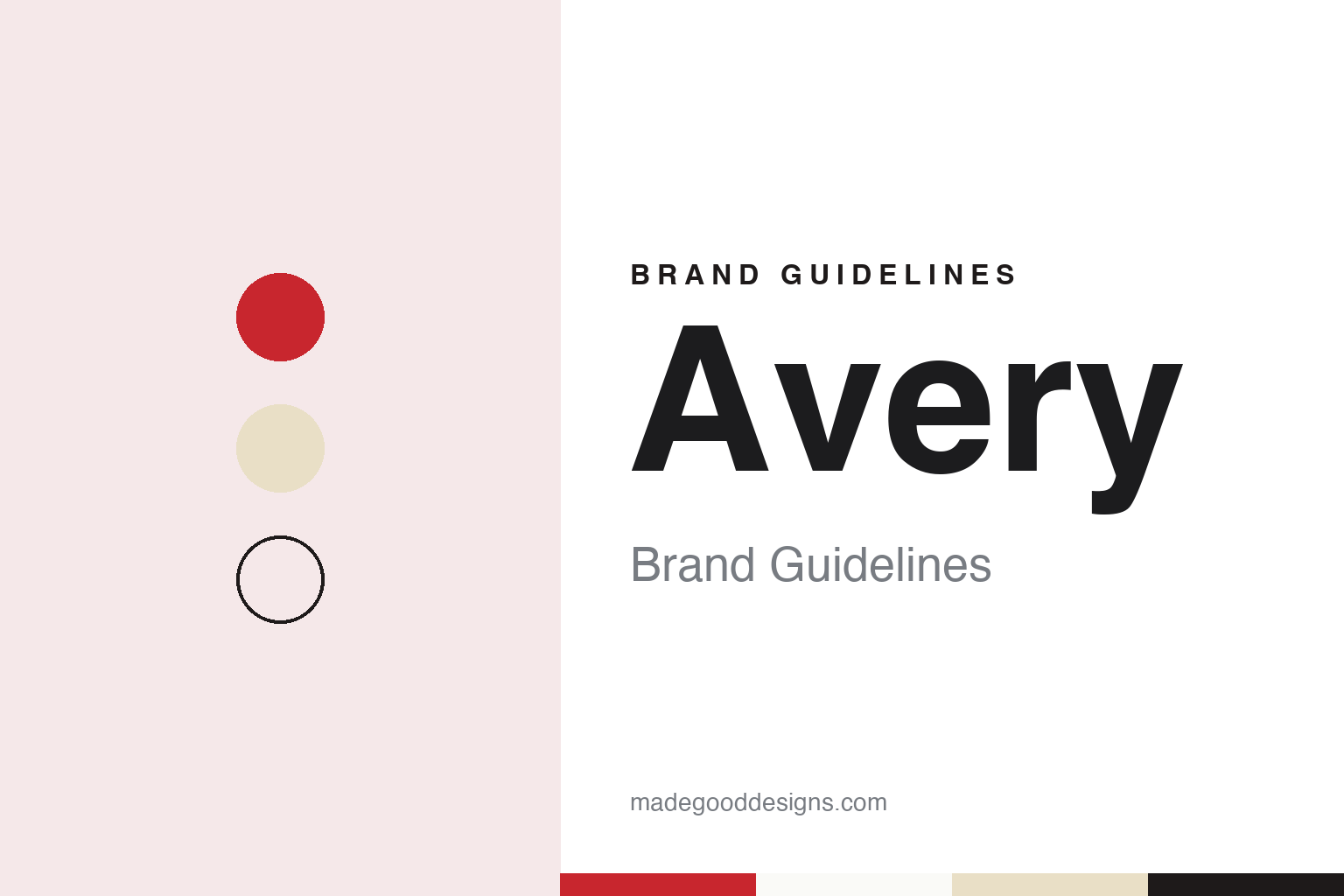
Avery Brand Guidelines
The Los Angeles label brand that left its parent in 2013.
Aa
Two constants: a label red, manila and sheet-white palette and a clean office sans register. Abstract homage — not an Avery product or mark; no label, logo or packaging is reproduced.
Los Angeles, 1935
A label partnership that became a materials company.
Avery began in Los Angeles in 1935. English Wikipedia records that the business was founded that year as Kum Kleen Products, a partnership of Ray Stanton Avery — usually known as Stan Avery — and his wife. Its product was the self-adhesive label: a label that sticks under pressure, with no need to moisten it first. Wikipedia’s article on Avery credits him with building a machine for die-cutting self-adhesive labels, which he patented.
The name changed several times as the business grew. According to English Wikipedia, Kum Kleen Products became Avery Adhesives in 1937. In 1946 the company was incorporated as Avery Adhesive Label Corp., and it later traded as Avery Adhesive Products, Inc. from 1958 and as Avery Products Corporation from 1964. In 1976 it became Avery International Corporation, the name it carried into the merger of 1990.
A partner arrived with the incorporation. Wikipedia says H. Russell Smith, a college friend of Avery’s, joined in 1946 as a part-owner and served at different times as president, chief executive and chairman. He is credited there with starting the company’s core label-materials business and with expanding its operations across the United States and into Europe. The company’s first overseas subsidiary, Wikipedia notes, was set up in the Netherlands in 1955.
Outside the business, Stan Avery’s name is attached to Avery House, a residence at the California Institute of Technology, where he chaired the board of trustees. Wikipedia also records his service as a trustee of the Huntington Library and of the Los Angeles County Museum of Art.
Colour
From adhesive materials to the office shelf.
The Avery name on a box of office labels comes from a merger as well as a founding. In 1990, English Wikipedia says, Avery International merged with the Dennison Manufacturing Company to form Avery Dennison. Dennison was an old New England business: Wikipedia records that it was founded in 1844 in Brunswick, Maine, by Andrew Dennison and his son Aaron Lufkin Dennison as a maker of jewellery and watch boxes, and that it moved to Framingham, Massachusetts, in 1898. Five years after the founding, Wikipedia says, Aaron Dennison handed the firm to his younger brother, Eliphalet Whorf Dennison, who built it into a substantial industrial business; Aaron went on to co-found the Waltham Watch Company in 1850.
The office range had already been given its own home by then. Wikipedia dates the creation of a separate office products division to 1982, selling binders, file labels and name badges under the Avery brand and logo. Unlike the larger materials business, which supplied adhesive stock to other manufacturers, the division sold finished, “converted” products, and it aimed them at households as well as offices.
That distinction shaped what the public came to know as Avery. The materials side worked behind other companies’ packaging, while the office division put the name on the shelf. Wikipedia notes that, over the following decades, personal computing created a market for printable media — sheets of labels and cards to run through home and office printers — at both home and work. It adds that the rise of email and the decline of conventional mail later weighed on the office-products market as a whole.
The merged parent kept moving away from the shelf. Wikipedia describes today’s Avery Dennison as a maker of pressure-sensitive adhesive materials, apparel labels and tags, RFID inlays and specialty medical products, with its headquarters in Mentor, Ohio. It organises that work into a Materials Group and a Solutions Group, and in 2007, Wikipedia records, it bought Paxar, a maker of identification and tracking systems for retail supply chains. Wikipedia also credits H. Russell Smith with opening the company’s research centre during his decades alongside Stan Avery.
Typography
Design and documentation.
The seven brands in this group are all office and paper names: Hamelin, Oxford, Exacompta, Atoma, Brunnen, Landré and Avery. Office and paper brands in general sit at many different points in the trade, from family companies that still carry a founder’s name to labels that now belong to much larger stationery groups, and a single brand can be sold everywhere from a school-supplies aisle to a corporate stationery cupboard.
An office or paper brand’s identity is usually carried less by a single notebook or file than by a cover, a name and the system it promises, because the company behind the name may have changed hands, moved its production or grown far beyond the town where it started. That makes the questions behind each name worth asking plainly: who started it, who owns it now, and where its paper goods are actually made.
Each guide separates what independent sources record from what the company says about itself — its founding story, its owners over time, where its products are made and how its covers and packaging have changed — and marks plainly what rests only on the company’s own word.
Aa
A clean office sans — the register of labels, files and badges. (Specimen set in Work Sans, a sans STAND-IN; NOT the Avery logo.)
Avery
An office brand with a new owner since 2013.
The office business left the company that carried its founder’s name in 2013. English Wikipedia records that on 1 July 2013 Avery Dennison completed the sale of its Office and Consumer Products business, together with a second unit, Designed and Engineered Solutions, to CCL Industries. Avery Dennison kept its own full name, history, brand and logo, Wikipedia adds, so two companies now carry the Avery name: the materials group and the office brand.
CCL Industries has owned the Avery office brand since then. Wikipedia describes CCL as an American-Canadian company founded in 1951 as Connecticut Chemicals (Canada) Limited, listed on the Toronto Stock Exchange. Its article on CCL, citing a report in The Globe and Mail from January 2013, records the purchase of Avery from Avery Dennison that year. CCL now runs Avery as one of its divisions, alongside its label, container, Checkpoint and Innovia businesses, and Wikipedia sums up the Avery division as a supplier of media for use in digital printers.
For a design guide, Avery shows how a brand born in an adhesive-materials company can be lifted out and sold on while its parent keeps the founder’s name, leaving two identities that share one surname. Compare Leitz, the German filing brand, and Esselte, the Swedish office-supplies name. For this guide we use a label red, a manila and a sheet white with a sans, an unofficial interpretation; no product or logo is reproduced.
Explore & save
Keep Avery’s identity on hand — save it to a board in the Made Good inspiration library.
Avery identity set
Pin the Avery label red, manila and sheet-white palette and the clean office sans register to your own board.