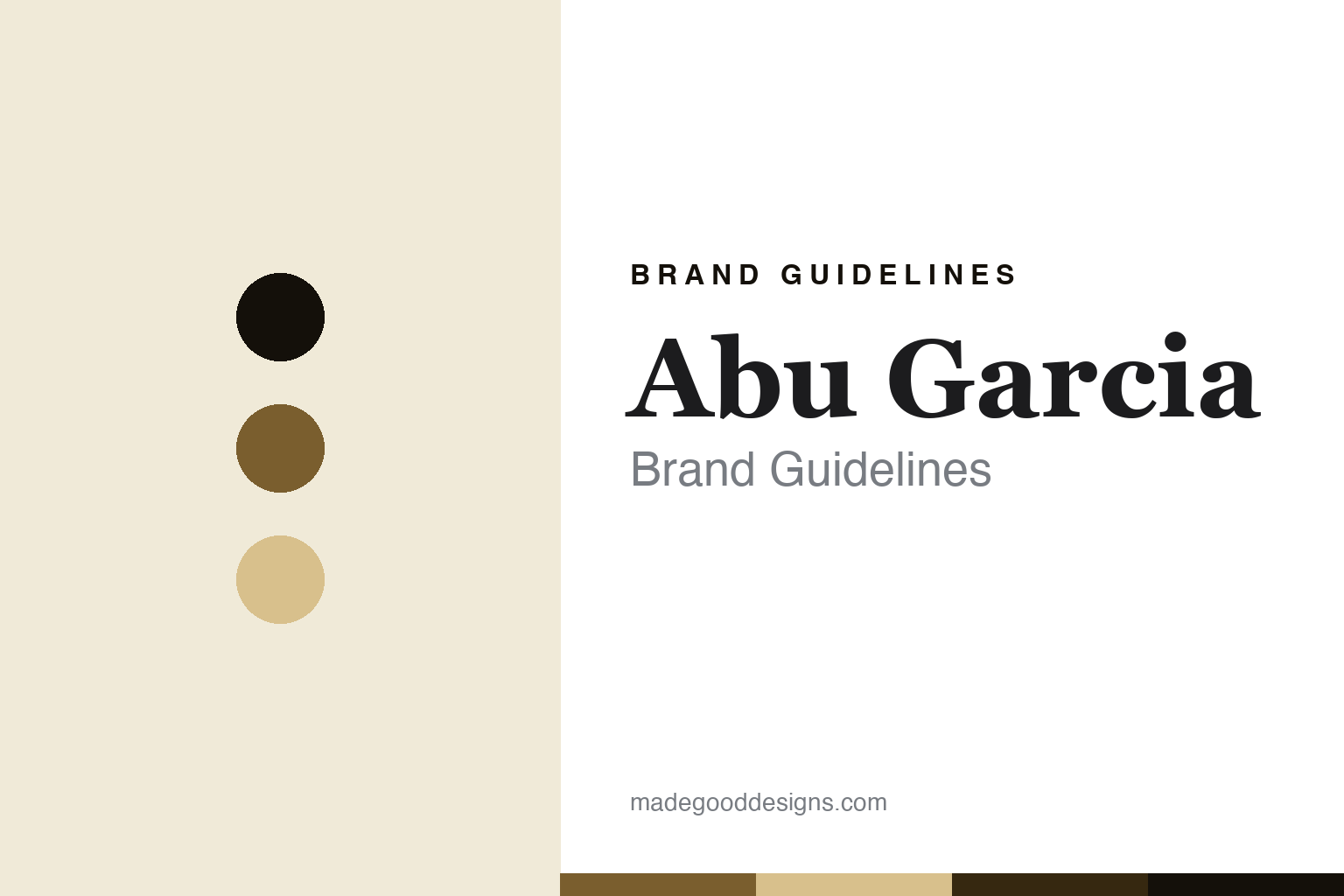
Abu Garcia Brand Guidelines
The Swedish reel, American-owned.
Aa
Two constants: a watchmaker-brass palette and a heritage-serif register. Abstract homage — not an Abu Garcia product or mark.
The Swedish reel, American-owned
Abu Garcia is the Swedish reel maker of 1921 — the round Ambassadeur baitcaster, born in a watch factory on the river Mörrum, now a Pure Fishing brand.
Abu Garcia opens the round as the heritage name with the longest reach — a Swedish reel icon that most anglers do not realise now sits inside an American portfolio. Abu Garcia makes fishing reels, above all the round Ambassadeur baitcaster, and its answer to the round’s question — who owns your tackle — is a watch factory that became a reel maker and then a line item in a private-equity stable. A reel, Swedish by birth.
Its identity is the Swedish reel, American-owned. Abu Garcia’s Ambassadeur reel, its watch-factory origin and its place under Pure Fishing are the story this round is about. A reel, born on the Mörrum. The Swedish reel, American-owned.
(Honest notes, so the story stays precise. Abu Garcia — at abugarcia.com — makes baitcasting and spinning reels, rods and tackle; the round-profile Ambassadeur is the icon, with the low-profile Revo the modern line. It was founded in 1921 in Svängsta, Sweden by Carl August Borgström as AB Urfabriken, a maker of watches and taximeters on the river Mörrum; reels came under his son Göte around the Second World War, and the Ambassadeur was introduced in the early 1950s (the famous 5000 model in 1954). On where it is made — a theme of this round — Svängsta is now heritage only, home to a museum; the current factory is not disclosed and production is largely in Asia, so we do not say “made in Sweden.” On ownership — the heart of this round — Abu Garcia is a Pure Fishing brand, alongside Penn, Berkley and Fenwick; Pure Fishing has been owned by the private-equity firm Sycamore Partners since a deal that closed in January 2019, after years under Newell and, before that, Jarden. Its marks — and the Swedish Royal Warrant — are IP we describe but do not reproduce, and there is no official brand hex; these tones are an unofficial interpretation. This is design commentary and does not promote any product.)
Colour
Abu Garcia lives in a watchmaker brass. Click a swatch to copy the hex.
Abu Garcia’s identity is Swedish, machined and owned — a brass, an ink, a gilt, a deep brass, and a paper. The palette leans brass and gilt: a warm register that nods to the 1921 watch factory as much as to a machined reel. It signals a heritage maker with a precision-instrument past. The honest caveat: with no published brand hex, these values are an original, unofficial interpretation, not first-party colours.
The lesson is a brass palette signals a heritage, precision-made identity. Abu Garcia’s world is a machined, heritage object with a corporate present. For designers, it is a reminder that a warm brass and a soft gilt can carry a reel maker — the tone of a watchmaker turned engineer. Because these tones can fail as small text, keep type dark and let the colour live in the accents, palette and band. The takeaways: honour the origin; be honest about the owner; separate heritage from where-made; and treat any single hex as unofficial.
Typography
The register is a heritage serif — precise, Swedish, owned.
Abu Garcia’s identity carries a precise, Swedish, owned spirit — a century-old name inside a modern portfolio. A heritage serif captures the mood: classic, exact and a little formal, the register of a watch factory that learned to machine reels. Set in a brass palette, the heritage serif feels precise and Swedish — exactly the personality Abu Garcia carries. It is instrument-making rather than a logo, mirroring machined metal and a watchmaker’s bench. (Abu Garcia’s real wordmark, and the Ambassadeur name, are things we describe but do not reproduce, and the exact typeface is not ours to use.) Because it is not ours to use, the honest description is “a heritage-serif spirit,” shown here in a stand-in. The type behaves like the reel: precise, Swedish and owned.
Aa
A heritage-serif spirit — precise and Swedish. (Specimen set in Playfair Display, a heritage-serif STAND-IN; NOT the Abu Garcia logo.)
Who owns your tackle
Abu Garcia stands for the Swedish reel, American-owned.
Abu Garcia opens the round as the heritage name. A brass palette, a heritage serif and a machined reel make one thing — the Swedish reel, American-owned — the whole identity: Swedish, machined and owned. The Ambassadeur is the differentiator, and the Pure Fishing parentage is the meaning. The point is a Swedish watch factory that became a reel icon and now shares a corporate roof with Penn, Berkley and Fenwick.
Put to work, the identity is a consolidation story told straight, as design. A maker in this spirit would honour a foreign origin while an American owner signs the cheques — a reel Swedish by birth, corporate by ownership. A reader in this spirit would keep the facts right: it began in 1921 in Svängsta as a watch factory under Carl August Borgström; the Ambassadeur arrived in the early 1950s; Sweden is now heritage, not the factory; and the owner is Pure Fishing, held by Sycamore Partners since January 2019. Abu Garcia opens the round’s parent thread at the Pure-Fishing end it shares with Penn, Berkley and Fenwick, and it ties across to the first fishing round through Hardy and Greys, which sit under the very same owner. The honest editorial moves are to separate the Swedish heritage from the Asian making, to name the private-equity owner plainly, and to leave the Royal Warrant undrawn. The lesson Abu Garcia teaches is that a beloved national icon and a private-equity balance sheet can be the same object — and that saying so is more useful than pretending otherwise.
For designers and brand-builders, Abu Garcia opens who owns your tackle: honour the origin — but be honest about the owner. The lessons: keep the heritage story truthful; separate where-from from where-made; name the parent; do not reproduce a warrant or a logo; and treat any single hex as unofficial. It is also a reminder to stay precise: Abu Garcia is the Swedish reel maker of 1921, the Ambassadeur baitcaster, born in a watch factory, now a Pure Fishing brand — with the palette here an unofficial interpretation. Read that way, Abu Garcia is less a reel than a lesson in how tackle is owned: a Swedish name, an American portfolio, and a private-equity firm at the top. The lesson for a brand is that provenance and ownership are two different facts, and a reader who is told both trusts the story more than one who is sold a flag. Abu Garcia made the-Swedish-reel-American-owned the identity — proof that the name on the reel and the name on the deed are rarely the same.
Explore & save
Keep Abu Garcia’s identity on hand — save it to a board in the Made Good inspiration library.
Abu Garcia identity set
Pin the watchmaker-brass palette and the heritage-serif register to your own board.