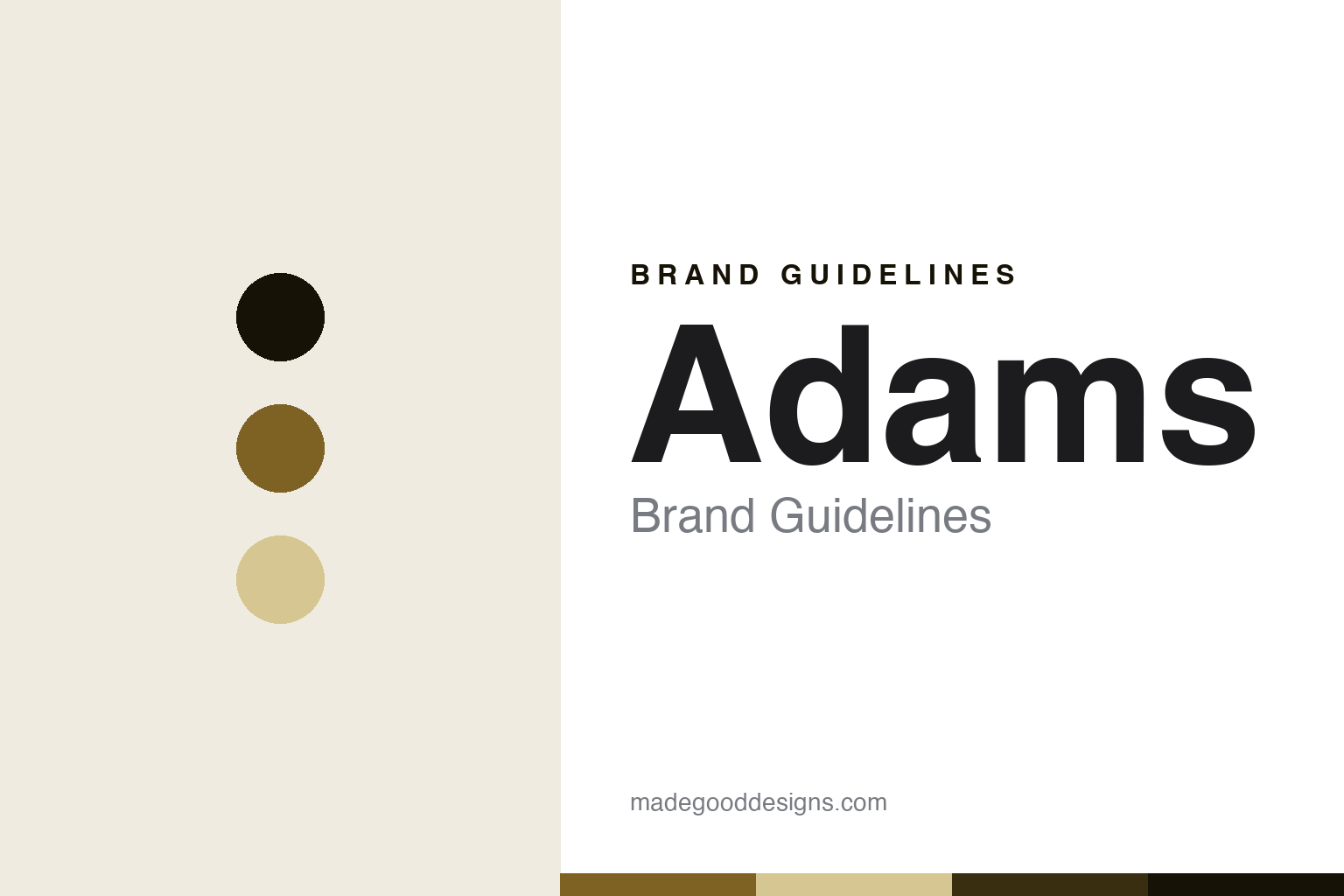
Adams Brand Guidelines
The Dutch percussion & brass house.
Aa
Two constants: a brass-gold palette and a concert-sans register. Abstract homage — not an Adams instrument, bar or mark.
The Dutch percussion & brass house
Adams is the Dutch maker of concert percussion and brass founded by André Adams in 1970, still family-owned and made in-house in Ittervoort, Netherlands.
Adams is the round’s dual-craft maker — one of the few houses that builds both concert percussion and brass. From Ittervoort, in the Netherlands, Adams makes marimbas, timpani, vibraphones and concert percussion, and also trumpets, trombones and other brass. Its answer to how a house becomes a name is range and self-reliance: master concert percussion, then add brass, and build it all in-house at home. A Dutch maker that spans two instrument families under one roof.
Its identity is the Dutch percussion & brass house. Adams’ concert marimbas and timpani, its later brass line and its in-house Dutch making are the work it is known for. A percussion house, that also makes brass. A family that builds both at home.
(Honest notes, so the story stays precise. Adams — Adams Musical Instruments — was founded in 1970 by André Adams, who began in a shed behind the family home in Thorn, in the Netherlands; we do not repeat the church-organ origin sometimes attached to the story, which its own history does not confirm. On what it makes, it is a genuine dual maker: concert percussion (timpani, marimbas, vibraphones, xylophones, concert bass drums) and brass (trumpets, cornets, flugelhorns, trombones, euphoniums, tubas) — the brass a later addition, developed from 2004 with its first in-house brass instrument in 2007. On where it is made — a theme of this round — Adams develops and produces its instruments in-house in Ittervoort (the company was founded in Thorn and consolidated in Ittervoort by the mid-2000s); we found no overseas Adams line, so we say its instruments are made in-house in the Netherlands, without asserting that literally every product is. On ownership, it is an independent, family-owned Dutch business with a third generation active, today directed by Frans Swinkels; we do not spell out a family lineage the company does not publish, and we keep its large associated retail store separate from the manufacturing brand. Its name and marks are IP, described but never reproduced, and there is no official brand hex; these tones are an unofficial interpretation. This is design commentary and does not promote any product.)
Colour
Adams lives in a brass-gold palette. Click a swatch to copy the hex.
Adams’ identity is dual-craft, Dutch and self-reliant — a brass gold, an ink, a maple, a deep brass, and a paper. The palette leans brass gold and maple: the register of a brass bell and a marimba’s wooden bars. It signals range and in-house making. The honest caveat: with no published brand hex, these values are an original, unofficial interpretation, not first-party colours.
The lesson is a brass-gold palette signals a dual-craft, made-in-house identity. Adams’ world is a dual-craft, wood-and-brass, Dutch object. For designers, it is a reminder that a warm brass gold and a soft maple can carry a house built on two crafts — the gold of a brass instrument and the pale wood of a marimba bar. Because these tones can fail as small text, keep type dark and let the colour live in the accents, palette and band. The takeaways: master one craft, then add another; make in-house; keep the ownership in the family; and treat any single hex as unofficial.
Typography
The register is a concert sans — clean, capable, made.
Adams’ identity carries a clean, capable, made spirit — a dual-craft concert house, not a fashion label. A concert sans captures the mood: even, capable and modern, the register of a maker that builds both percussion and brass. Set in a brass-gold palette, the concert sans feels clean and capable — exactly the personality Adams carries. It is an in-house dual craft rather than a marketing wall, mirroring a concert instrument. (Adams’ real logo and any marks are things we describe but do not reproduce, and the exact typeface is not ours to use.) Because it is not ours to use, the honest description is “a concert-sans spirit,” shown here in a stand-in. The type behaves like the house: clean, capable and made.
Aa
A concert-sans spirit — clean and capable. (Specimen set in Work Sans, a concert-sans STAND-IN; NOT the Adams logo or any mark.)
The new makers
Adams stands for the house that builds two crafts at home.
Adams is a lesson in how range and self-reliance can be an identity. A brass-gold palette, a concert sans and an in-house Dutch instrument make one thing — the Dutch percussion & brass house — the whole identity: dual-craft, Dutch and self-reliant. The percussion-and-brass range is the differentiator, and the in-house making is the meaning. The point is a house that grew from a shed into a maker of both concert percussion and brass, and kept the building in-house, in one Dutch town, under the family.
Put to work, the identity is dual-craft self-reliance, honestly told, as design. A house in this spirit would master one craft, add another, and keep the making at home — concert marimbas and timpani, a brass line added from 2004, all built in-house in Ittervoort. A brand learning from it would see that range plus self-reliance is a durable identity — that a house building both percussion and brass at home carries a capability a single-line importer cannot — and that being precise, founded 1970 by André Adams, made in-house in the Netherlands, independent and family-owned, keeps the story honest. Adams anchors the round’s independent, made-at-home pole: against the makers here who build abroad or have taken investment, it is a family firm that builds two instrument families under one Dutch roof, and its brass line — added decades in — shows a maker expanding on its own terms rather than outsourcing. The discipline is in the restraint: dropping the unconfirmed church-organ origin, not inventing the Swinkels family lineage, and saying “made in-house in the Netherlands” without claiming every last product, is what keeps the account honest. The lesson Adams teaches is that range and self-reliance can hold an identity: the dual craft gives it substance, and the honesty about the making keeps it credible. The self-reliance is the personality, and the in-house instrument is the proof.
For designers and brand-builders, Adams holds the Netherlands pole in the new makers: master a craft, add another, and build it at home. The lessons: deepen one craft before adding a second; keep the making in-house; hold the family ownership; drop origins you can’t confirm; and never reproduce a logo. It is also a reminder to stay precise: Adams is the Dutch maker of concert percussion and brass founded by André Adams in 1970, still family-owned and made in-house in Ittervoort, Netherlands — with the palette here an unofficial interpretation. Adams made dual-craft self-reliance the identity — proof that a house building two crafts at home, honestly told, can be the difference.
Explore & save
Keep Adams’s identity on hand — save it to a board in the Made Good inspiration library.
Adams identity set
Pin the brass-gold palette and the concert-sans register to your own board.