Bank Islam Brand Guidelines
Malaysia’s 1983 Islamic bank, its Al-Awfar account and a 2021 listing.
Aa
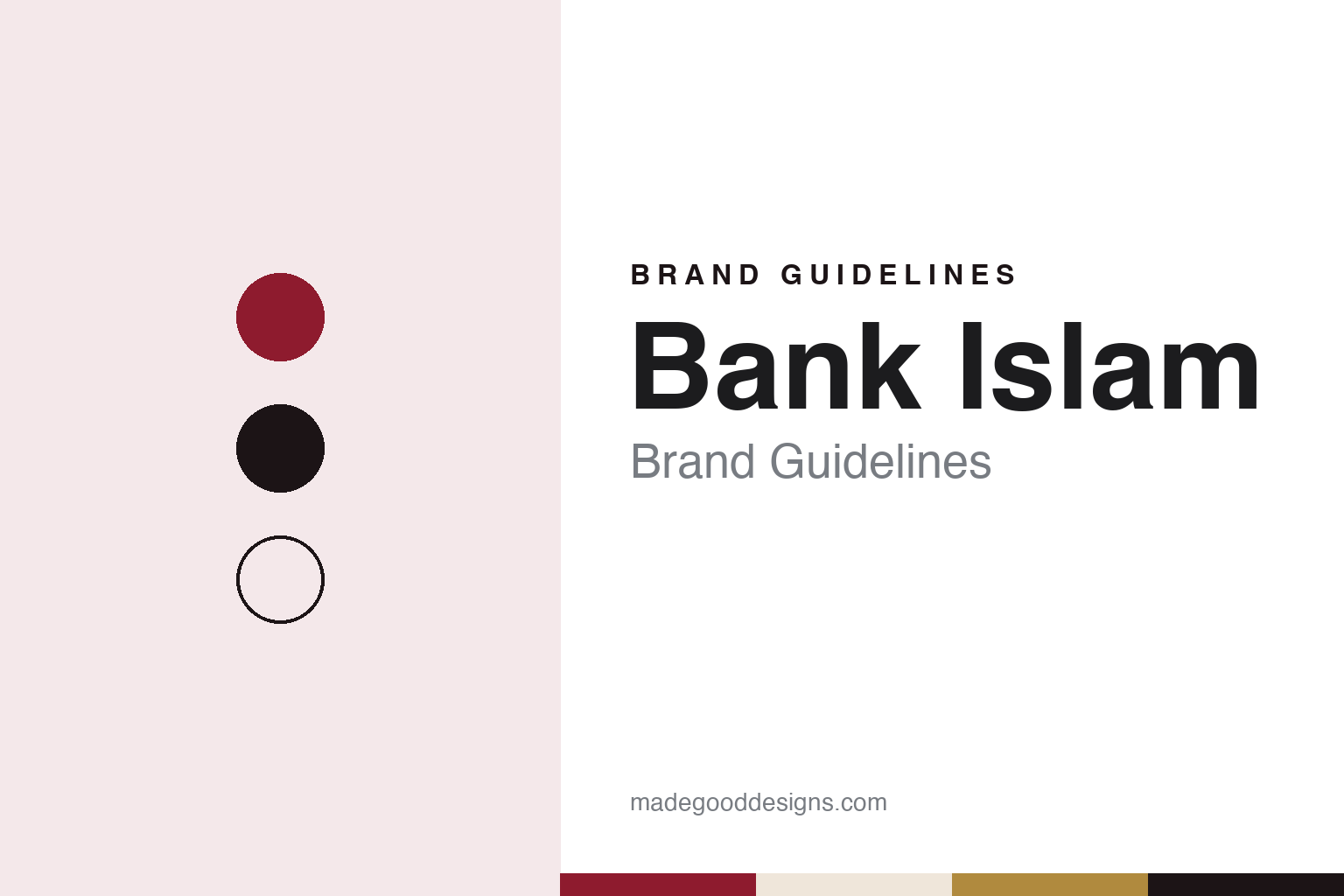
Two constants: a deep crimson, sand and brass palette and a Steady sans register. Abstract homage — not a Bank Islam product or mark; no logo, card or branch sign is reproduced.
Bank Islam
A Sharia-based bank for Malaysia, from 1983.
Bank Islam Malaysia Berhad began operating on 1 July 1983, as Malaysia’s first Islamic bank, according to Malay Wikipedia, which says it was set up to give the country’s Muslims a banking alternative based on Sharia principles. English Wikipedia gives the same founding date and describes a bank that later extended its services to the wider population. Both Wikipedias give its full name in Jawi, the Arabic-based script used for Malay, as well as in Latin letters.
The bank was listed on the Kuala Lumpur Stock Exchange on 17 January 1992, Malay Wikipedia says. For much of its life it sat inside a holding structure. In 2009 the Gulf newspaper Khaleej Times reported that BIMB Holdings owned 51 per cent of Bank Islam, Dubai Financial, a unit of Dubai Group, 40 per cent, and Lembaga Tabung Haji, the Malaysian pilgrims fund, the remaining 9 per cent; at the time Dubai Group said it was reviewing its options for the stake. English Wikipedia describes BIMB Holdings, founded in March 1997, as owned by Tabung Haji, with Bank Islam and Takaful Malaysia among its subsidiaries.
That structure was turned inside out in 2021. On 7 October 2021 the national news agency Bernama reported that BIMB Holdings had distributed its shares in Bank Islam and in Syarikat Takaful Malaysia Keluarga to its own shareholders, that BIMB had become a wholly owned subsidiary of Bank Islam, and that Bank Islam would take over BIMB’s place on the Main Market of Bursa Malaysia from 8 October 2021, keeping the stock short name “BIMB.”
Colour
Accounts, cards and a recovery plan.
Bank Islam’s brand has been shaped by a difficult period. Malay Wikipedia, drawing on the bank’s own reports, says it made heavy losses in 2005 and 2006 and launched a recovery plan in October 2006. Besides new capital, a new IT system and cost cuts, the plan included a corporate rebranding: a new identity, core values and brand essence, and refitted branches with a new look. Malay Wikipedia lists a return to profit from the financial year to June 2007 and records that it received a Reader’s Digest Trusted Brand Platinum award for Islamic financial services in May 2009.
Its logo history is told unevenly. English Wikipedia’s infobox dates the current logo to 2005, while Malay Wikipedia captions an older mark as the one used before 31 December 2001.
Its products carry Arabic names and are explained by the Sharia contracts behind them. The Al-Awfar account combines savings with investment and adds prize draws; in July 2023 The Star, carrying a Bernama report, said Al-Awfar had been on the market for 15 years, was based on the concept of mudharabah, a profit-sharing contract, and had about 1.2 million accounts, with its fund invested in the bank’s home-finance and fixed-asset portfolio. The Kad-i card, Malay Wikipedia says, is built on tawarruq, a sale-and-resale structure in which a commodity is bought on deferred terms and sold for cash to a third party. Malay Wikipedia also lists Waheed-i, a fixed-term deposit based on wakalah, or agency, and a 20 per cent stake in Amana Bank of Sri Lanka. Its products are reviewed by a Shariah Supervisory Council, whose chair English Wikipedia lists among the bank’s key people alongside its chairman and chief executive.
Typography
Green, gold and two scripts.
Islamic banks present themselves through a small set of recurring signals. Green, gold and deep blue appear often in their wordmarks and branch signs, and many write their names in two scripts side by side: Arabic, or Jawi in Malaysia, next to Latin letters. Geometric patterns, drawn from the long tradition of Islamic ornament, turn up on cards, reports and branch interiors, usually as a background rather than as a logo.
Their names tend to say what they are. Words such as “Islamic,” “Islam” and “Syariah” sit in the name itself, alongside the country or city, so that the banking model is part of the brand. Product names follow the same logic: accounts and financing are often labelled with the Arabic name of the contract behind them, such as murabaha, a cost-plus sale; ijara, a lease; mudharabah, a profit-sharing arrangement; or wakalah, an agency.
Their websites have a common structure. Alongside the usual pages on savings, cards and home and business financing, most carry a page on the bank’s Sharia supervisory board or council, the panel of scholars that reviews its products, and many add pages on sukuk, the Sharia-compliant certificates used in place of conventional bonds, on takaful, the cooperative form of insurance, and on zakat and charitable giving. Newer banking apps add prayer times and the qibla direction next to transfers and payments.
Annual and sustainability reports are where much of the identity is set out at length, with the Sharia board’s statement printed beside the auditors’ report. This guide follows what dated sources say about each bank — when it was founded, how it was merged, renamed or listed, and how it describes its own products — and treats the palette and type shown here as an unofficial interpretation rather than any bank’s own.
Aa
A steady sans for a name written in Jawi and Latin letters. (Specimen set in Manrope, a sans STAND-IN; NOT the Bank Islam logo.)
Bank Islam
From branches to BIMB Mobile.
Its links with Tabung Haji have also shaped its services. Malay Wikipedia says Bank Islam worked with the fund on a Uniteller service that lets customers carry out Tabung Haji transactions and register for the Hajj pilgrimage at Bank Islam branches across the country, and that it offered TAP Mobile Banking-i, a mobile banking service that works without internet access.
Much of the bank’s recent brand work is digital. In November 2024 The Star, again carrying a Bernama report, said Bank Islam had introduced two new platforms, the BIMB Mobile banking app and BIMB Web, which the bank described as having a modern interface and as supporting “branchless banking.” The BIMB initials, once the holding company’s, now sit on the bank’s own app and its stock listing.
Regulators have also had their say. In July 2025 The Star reported, from a Bernama story, that Bank Negara Malaysia had imposed administrative monetary penalties on Bank Islam under the Islamic Financial Services Act 2013: one on 29 May 2025 for sanction-screening breaches and one on 30 June 2025 for prolonged service disruptions. The central bank said the penalties had been paid.
The name itself is literal: “Bank Islam Malaysia Berhad,” with Berhad marking a Malaysian public company. Its products carry Arabic-derived names — Al-Awfar, Kad-i, Waheed-i — and the bank explains each through a named Sharia contract, while its app and its listing use the BIMB initials.
For a design guide, Bank Islam shows how a literal name, a second script and contract-based product names can carry an identity through restructuring. Compare Maybank and CIMB, two other Malaysian banking groups with Islamic arms. For this guide we use a deep crimson, warm sand and brass with a sans, an unofficial interpretation; no product or logo is reproduced.
Explore & save
Keep Bank Islam’s identity on hand — save it to a board in the Made Good inspiration library.
Bank Islam identity set
Pin the Bank Islam deep crimson, sand and brass palette and the Steady sans register to your own board.