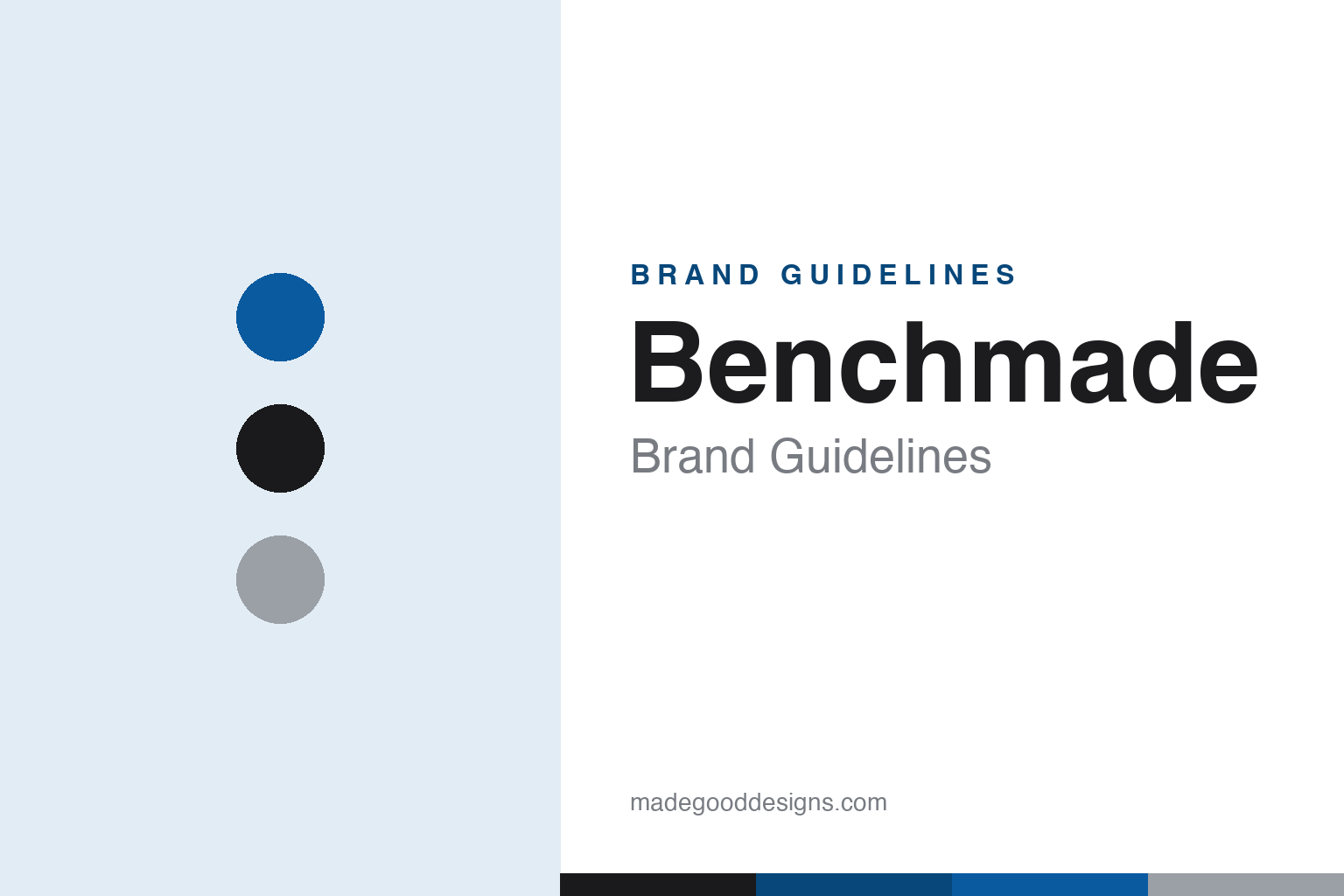
Benchmade Brand Guidelines
Made to be carried — a butterfly-knife heritage, the smooth AXIS lock, and premium American everyday-carry.
Aa
Two constants: a signature blue-and-black palette and a bold, tactical sans. Abstract homage — no butterfly, not the Benchmade mark.
Made to be carried
Benchmade began with butterfly knives.
Benchmade is a lesson in heritage encoded in a logo. It was founded in 1979 by Les de Asis, originally making balisong (butterfly) knives. The company’s name evolved along with it: it began as Bali-Song, became Pacific Cutlery Corporation, and adopted the name Benchmade in 1987. It later moved from California to Oregon in two steps — to Clackamas in 1990, then to Oregon City in 1996, still its home today. (Two honest notes: no official brand hex is published, and the wordmark typeface is undocumented.)
Today Benchmade makes premium, American-made folding knives and fixed blades for everyday carry, work, hunting and rescue. Its signature mechanism is the AXIS lock — a smooth, ambidextrous, spring-tensioned lock introduced in 1998 (on the Model 710). An honest and interesting nuance: Benchmade didn’t invent it in-house — it was designed by custom knifemakers Bill McHenry and Jason Williams, and Benchmade licensed and trademarked “AXIS.” (The underlying utility patent has since expired, which is why competitors now sell similar “crossbar” locks — so describe it as “introduced in 1998,” not perpetually exclusive.)
The brand’s butterfly logo is literal heritage: it directly encodes the company’s balisong (butterfly-knife) origin. Benchmade is known for its recognisable “Benchmade blue,” a tiered range — Blue Class (everyday/recreation), Black Class (professional/duty) and Gold Class (collector, limited editions) — famous designs like the 940 Osborne (by designer Warren Osborne), and the complimentary LifeSharp lifetime sharpening service. It’s privately held and family-owned: after founder Les de Asis died in early 2020, his wife Roberta and then son Jon de Asis took the helm the same year. The identity is bold and tactical — blue and black. Made to be carried.
Colour
Benchmade lives in a signature blue and black. Click a swatch to copy the hex.
Benchmade’s identity centres on its recognisable “Benchmade blue,” set against black and steel. The blue — carried through packaging and the “Blue Class” tier — is a genuine, ownable brand cue that reads as confident, capable and modern, while the black and steel reinforce the tactical, precision-tool character. It’s a bold, functional palette befitting premium everyday-carry gear: serious and dependable rather than decorative. The honest caveat: Benchmade publishes no official brand hex, so the blue and black here are an original, unofficial interpretation, not first-party values — and no butterfly logo is reproduced.
The lesson is a distinctive, ownable colour can anchor a functional brand. Benchmade’s blue is a recognisable cue across packaging and product tiers. For designers, it’s a reminder that a single, consistent signature colour can build recognition for a precision-tool brand. The takeaways: own a distinctive signature colour (Benchmade blue); support it with tactical neutrals (black, steel); and treat specific hexes as unofficial when no brand spec is published.
Typography
The wordmark is a bold tactical sans — capable and modern.
Benchmade’s identity carries a bold, tactical, capable spirit — a strong sans-serif wordmark whose confident letterforms read as precise, dependable and modern. The bold type matches a brand built on premium everyday-carry and duty knives, and it signals capability and engineering rather than decoration. Set against a blue-and-black palette, the type feels tactical and assured — exactly the made-to-be-carried personality Benchmade cultivates. It’s bold and functional rather than delicate, mirroring the precision tools. Because the exact wordmark face isn’t publicly documented, the honest description is “a bold tactical sans spirit,” not a named font. The type behaves like the brand: capable, tactical and modern.
Aa
A bold tactical sans spirit — capable and modern. (Specimen set in Saira, a technical sans in the spirit of the Benchmade identity; the real face is undocumented.)
Heritage you carry
Benchmade turned origin into identity.
Benchmade is a lesson in turning an origin story into a lasting identity. The company started making butterfly knives in 1979, and rather than leave that behind, it encoded it into the butterfly logo — so the emblem itself tells the origin story every time you see it. Around that heritage it built a modern, engineering-led brand: a signature mechanism (the smooth AXIS lock), a recognisable signature colour (Benchmade blue), a clear product hierarchy (Blue/Black/Gold Class), and trust-building service (LifeSharp lifetime sharpening) — all reinforcing a “premium, made-to-be-carried, made in USA” promise. The result is a brand that feels both rooted (the butterfly heritage, family ownership through succession) and contemporary (engineered EDC gear). The lesson is that a distinctive origin, honestly carried into the logo and identity, can anchor a modern brand — and that engineering signatures (a lock, a colour, a service) build the recognition and loyalty on top. Encode the heritage; engineer the rest.
For designers and brand-builders, Benchmade offers a clear takeaway: an origin story encoded into the identity, plus engineering signatures, builds a durable brand. The lessons: put the heritage into the mark itself (the butterfly = balisong origin); own distinctive signatures (the AXIS lock, Benchmade blue, the class tiers); and build trust with real service (LifeSharp). It’s also a reminder to keep the facts precise — Benchmade was founded in 1979 (Bali-Song → Pacific Cutlery → Benchmade 1987), is family-owned, and its AXIS lock was a licensed McHenry-Williams design introduced in 1998. Benchmade turned origin into identity — proof that heritage in the mark can anchor a modern brand.
Explore & save
Keep Benchmade’s identity on hand — save it to a board in the Made Good inspiration library.
Benchmade identity set
Pin the blue-and-black palette and the tactical-sans spirit to your own board.