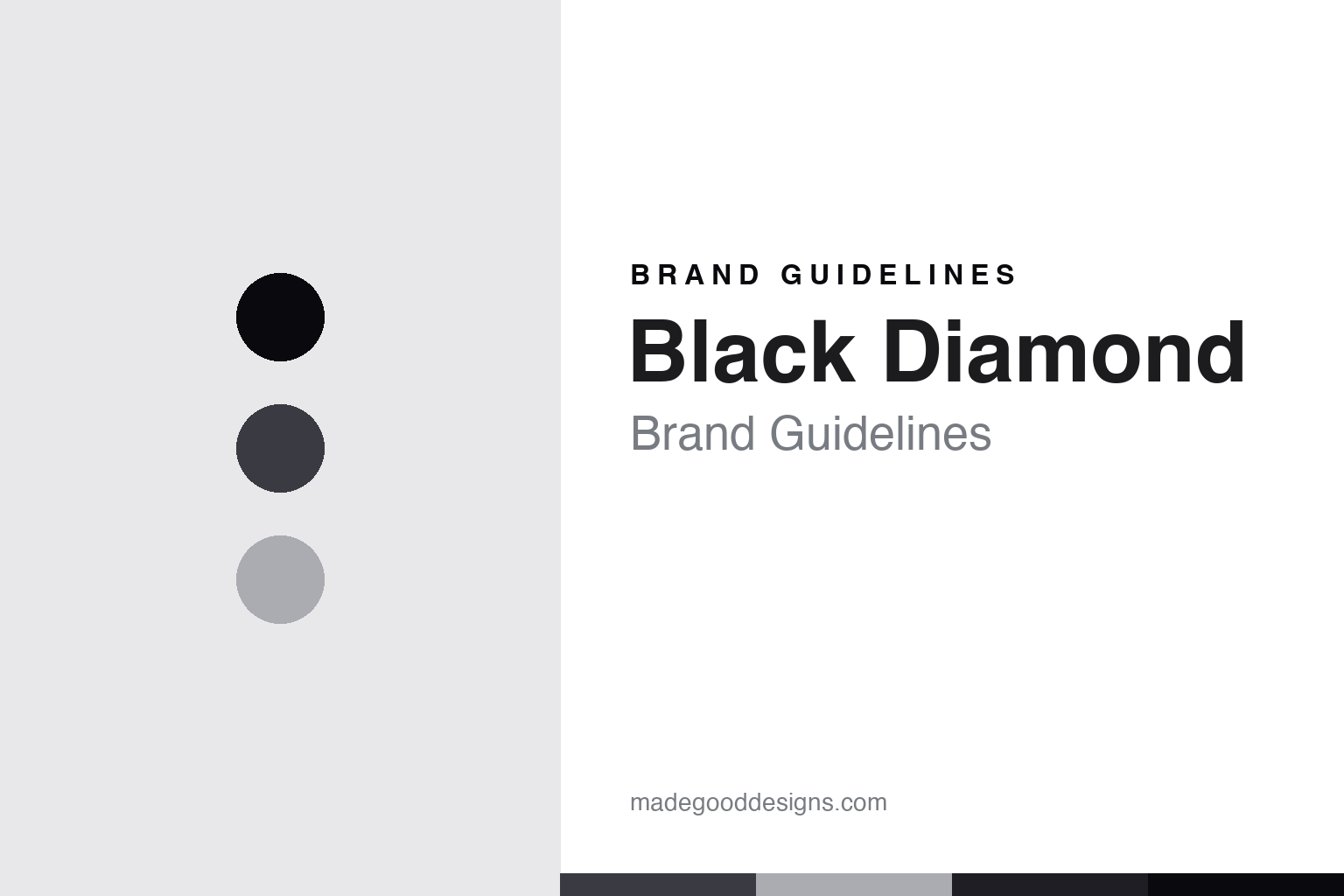
Black Diamond Brand Guidelines
The cam from a bankrupt legend.
Aa
Two constants: a diamond-graphite palette and a cam-sans register. Abstract homage — not a Black Diamond product or mark.
The cam from a bankrupt legend
Black Diamond is the Camalot maker built from Chouinard Equipment — a Clarus brand from Utah.
Black Diamond brings the round its American icon — the Salt Lake City company built by employees from the assets of a bankrupt legend, whose Camalot cam is a climbing-hardware standard. Black Diamond makes cams and hardware, and its answer to a round about the climbing-gear makers is a reinvention: gear born from Yvon Chouinard’s old company, remade by its own workers. A cam, from a rescue.
Its identity is the cam from a bankrupt legend. Black Diamond’s Camalot, its Chouinard lineage and its Clarus ownership are the story here. A cam, from Utah. The cam from a bankrupt legend.
(Honest notes, so the story stays precise. Black Diamond — at blackdiamondequipment.com — makes climbing hardware, including the Camalot spring-loaded cams, carabiners with Magnetron gates, harnesses, belay devices, ice tools and helmets, plus headlamps, trekking poles and ski and avalanche gear. Its roots run to Yvon Chouinard, later Patagonia’s founder, who hand-forged pitons and built Chouinard Equipment; after product-liability losses and a 1989 Chapter 11, former employees, led by Peter Metcalf, bought the assets and founded Black Diamond Equipment on the first of December 1989, moving to the Salt Lake City area in 1991 — so it is a successor, not founded by Chouinard, and not Patagonia. On where it is made — a theme of this round — the making is mixed: some hardware in Salt Lake City and substantial production at a company-owned plant in Zhuhai, China, so we do not claim made-in-USA. On ownership, it is a brand of Clarus Corporation, listed as CLAR, which acquired it in 2010 and has since reshaped its portfolio; we frame Clarus as the owner as of publication. Its marks — Black Diamond, Camalot, Magnetron — are IP we describe but do not reproduce, and there is no official brand hex; these tones are an unofficial interpretation. This is design commentary and does not promote any product.)
Colour
Black Diamond lives in a diamond graphite. Click a swatch to copy the hex.
Black Diamond’s identity is reinvented, mixed-made and public-owned — a diamond graphite, an ink, a silver, a deep graphite, and a paper. The palette leans diamond graphite and silver: a dark, machined register that nods to billet aluminium and a black-diamond name rather than a loud palette. It signals a reinvented American hardware maker. The honest caveat: with no published brand hex, these values are an original, unofficial interpretation, not first-party colours.
The lesson is a diamond graphite signals a reinvented, machined identity. Black Diamond’s world is a machined, reinvented object. For designers, it is a reminder that a dark graphite and a soft silver can carry a gear brand — the tone of machined billet. Because these tones can fail as small text, keep type dark and let the colour live in the accents, palette and band. The takeaways: reinvent from a legend honestly; be honest about mixed making; name the public owner; and treat any single hex as unofficial.
Typography
The register is a cam sans — machined, precise, made.
Black Diamond’s identity carries a machined, precise, made spirit — a hardware maker, not a fashion. A cam sans captures the mood: solid, engineered and confident, the register of a spring-loaded cam machined from billet. Set in a diamond-graphite palette, the cam sans feels machined and precise — exactly the personality Black Diamond carries. It is machining rather than a logo, mirroring machined billet. (Black Diamond’s real wordmark, and Camalot, are things we describe but do not reproduce, and the exact typeface is not ours to use.) Because it is not ours to use, the honest description is “a cam-sans spirit,” shown here in a stand-in. The type behaves like the cam: machined, precise and made.
Aa
A cam-sans spirit — machined and precise. (Specimen set in Manrope, a cam-sans STAND-IN; NOT the Black Diamond logo.)
The climbing gear makers
Black Diamond stands for the cam from a bankrupt legend.
Black Diamond brings the round its American icon. A diamond-graphite palette, a cam sans and a Camalot make one thing — the cam from a bankrupt legend — the whole identity: reinvented, mixed-made and public-owned. The Camalot is the differentiator, and the Chouinard lineage is the meaning. The point is a company its own employees built from the assets of Yvon Chouinard’s bankrupt gear firm, now a hardware standard and a public company’s brand.
Put to work, the identity is a reinvention told straight, as design. A maker in this spirit would build honestly from a legend’s remains, be honest about mixed making, and name the public owner. A reader in this spirit would keep the facts right: employees led by Peter Metcalf bought Chouinard Equipment’s assets and founded Black Diamond in 1989; it is a successor, not founded by Chouinard, and not Patagonia; the making is mixed between Salt Lake City and a company-owned plant in China; and it is a Clarus Corporation brand. Black Diamond sits in the round’s where-made thread at the mixed-making end — the one clear offshore-mix in a round of home makers — and the owner thread at the public-company end with Edelrid’s group. The honest editorial moves are to frame the Chouinard lineage as a successor acquisition, to separate Black Diamond from Patagonia, to say made in the USA and China, and to name Clarus as of publication. The lesson Black Diamond teaches is that a brand can be honestly reinvented from a legend, and honesty about the lineage, the mixed making and the owner keeps the reinvention credible.
For designers and brand-builders, Black Diamond continues the climbing gear makers: reinvent from a legend — honestly. The lessons: build from acquired assets without overclaiming the lineage; separate a shared heritage from a different company; be honest about mixed manufacturing; name a public owner as of publication; and never reproduce a logo. It is also a reminder to stay precise: Black Diamond is the Camalot maker built from Chouinard Equipment, a Clarus brand from Utah — with the palette here an unofficial interpretation. Read that way, Black Diamond is less a cam than a reinvention: a hardware standard remade by the workers of a bankrupt legend, from Salt Lake City. The lesson for a brand is that an honest reinvention and honest making reinforce each other, and framing the Chouinard lineage precisely keeps the reinvention earned. Black Diamond made the-cam-from-a-bankrupt-legend the identity — proof that a brand can be rebuilt from a legend’s remains.
Explore & save
Keep Black Diamond’s identity on hand — save it to a board in the Made Good inspiration library.
Black Diamond identity set
Pin the diamond-graphite palette and the cam-sans register to your own board.